- 13 Oct 2026
- 2 posts
Have you ever walked up to an elevator, restroom, machine, or piece of equipment and seen a sign saying “Out of Order” or “Out of Service”?
At first, the two phrases can seem interchangeable. After all, both tell you that something isn't available for normal use. But there can be a subtle difference in how these messages are understood and when each one makes the most sense.
Choosing the right message is important because a sign should communicate the situation quickly. Whether you're managing a workplace, commercial building, warehouse, school, hotel, or public facility, clear signage can help prevent confusion and discourage people from trying to use equipment or areas that aren't currently available.
Let's look at the difference between out of order signs and out of service signs and when you might use each one.
What Does "Out of Order" Mean?
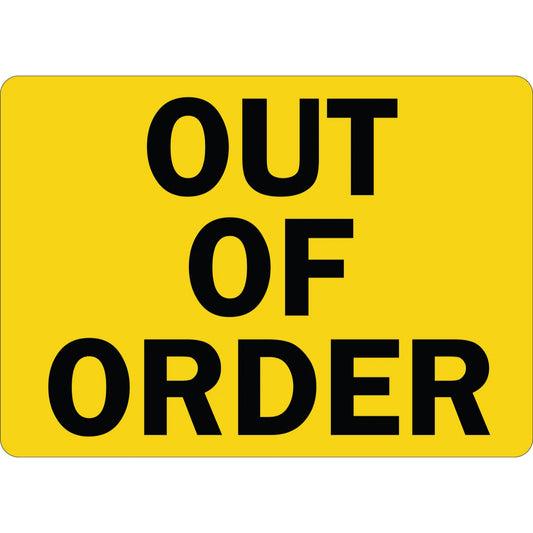
"Out of order" generally tells people that something is not functioning properly or is unavailable because it isn't working as intended.
For example, imagine walking up to an elevator and seeing an Out of Order sign. The message immediately tells you that the elevator shouldn't be used and that you need to find another option.
The same message can be used for:
- Vending machines
- Elevators
- Restrooms
- Automatic doors
- Ticket machines
- Office equipment
- Payment terminals
- Water fountains
- Public-use equipment
The phrase is particularly useful when something has stopped working or has a mechanical, electrical, or operational problem.
An out of order sign provides a simple message without requiring a lengthy explanation. Someone can see it and immediately understand that the equipment or facility isn't available for normal use.
What Does "Out of Service" Mean?
"Out of service" generally communicates that something is temporarily unavailable for use, but it doesn't necessarily mean that the item is broken.
For example, a piece of equipment might be taken out of service for:
- Maintenance
- Inspection
- Cleaning
- Repairs
- Testing
- Scheduled servicing
- Replacement
- Temporary operational changes
In this situation, the equipment might actually be working perfectly well. It's simply not available for use at that particular time.
For example, a restroom could be closed for cleaning, or a machine could be unavailable because technicians are performing scheduled maintenance.
An Out of Service sign can communicate this temporary status without suggesting that the equipment itself has completely failed.
Out of Order Signs vs. Out of Service Signs
So, what's the easiest way to understand the difference?
Think of it this way:
Out of Order = Something isn't working properly.
Out of Service = Something isn't currently available for use.
There can be overlap between the two terms, and businesses sometimes use them interchangeably. The most appropriate choice depends on what you're trying to communicate.
For example, if an elevator has stopped working, "Out of Order" may be a straightforward choice.
If an elevator is temporarily unavailable because it is undergoing scheduled maintenance, "Out of Service" may communicate the situation more accurately.
When Should You Use Out of Order Signs?
Out of order signs are useful when equipment or facilities aren't functioning as expected.
Let's say a vending machine stops accepting payments. Rather than allowing customers to repeatedly try using it, an out of order sign can quickly communicate that the machine isn't currently available.
The same principle applies to office equipment.
If a printer has developed a technical problem, placing an out of order sign near it can prevent employees from wasting time trying to operate it.
These signs can be especially useful in busy environments where people need to understand the status of equipment without asking an employee.
When Should You Use Out of Service Signs?
Out of service signs are often more appropriate when something has been intentionally removed from use.
For example, a machine might be undergoing routine maintenance. It may not be broken, but employees shouldn't operate it while technicians are working on it.
An out of service message can communicate that the equipment is temporarily unavailable.
Other examples include:
- A restroom closed for cleaning
- An elevator undergoing inspection
- A machine being serviced
- A parking area temporarily unavailable
- A public facility temporarily closed
- Equipment waiting for scheduled maintenance
In these situations, the phrase focuses more on availability than on whether something is actually broken.
Why Clear Signage Matters
Regardless of which phrase you choose, the most important thing is that people understand the message.
Imagine someone sees a machine that isn't being used but has no sign explaining why. They may assume it's available and attempt to operate it.
A clear sign can immediately communicate that the equipment shouldn't be used.
This is particularly important in workplaces, warehouses, manufacturing facilities, offices, schools, hotels, and other environments where many people may interact with equipment throughout the day.
Out of order signs and out of service signs can therefore support better communication by making equipment status visible.
However, signage should be used alongside appropriate workplace procedures. A sign by itself should not be treated as a substitute for proper equipment shutdown, isolation, maintenance procedures, or other safety controls when those measures are required.
What Should an Out of Order Sign Include?
A good out of order sign doesn't need to be complicated.
The message should be large enough to notice and easy to understand from a reasonable distance.
Depending on the situation, you may include:
- "Out of Order" as the main message
- A short explanation
- "Do Not Use"
- Contact or maintenance information
- Instructions for reporting problems
- Equipment identification
- An expected return-to-service date, if known
The amount of information depends on where the sign will be used.
For a simple office printer, "Out of Order — Please Do Not Use" may be enough.
For industrial equipment, additional procedures or warnings may be necessary depending on the circumstances.
Choosing the Right Message
When deciding between the two, ask yourself a simple question:
Is the item unavailable because it isn't working, or because it has been intentionally taken out of use?
If it isn't functioning properly, out of order signs may be the clearer choice.
If it has been temporarily removed from use for maintenance, cleaning, inspection, or another planned reason, out of service may be more appropriate.
Of course, workplace terminology can vary, and some organizations may have their own preferred wording. Consistency is important, so employees and visitors can quickly understand what the signs mean.
Final Thoughts
Although out of order signs and out of service signs can look similar, the wording can communicate slightly different situations.
"Out of Order" generally suggests that something isn't working properly, while "Out of Service" usually indicates that something is temporarily unavailable, whether or not it is actually broken.
The best sign is ultimately the one that accurately communicates the current situation. Keep the message clear, make the sign easy to notice, and provide additional instructions when necessary.
Whether you're managing a busy warehouse, office, retail location, commercial building, or public facility, clear status signage can help people understand what they can and cannot use.
A few simple words can prevent confusion—and sometimes, that's exactly what good signage is supposed to do.