- 27 Oct 2026
- 1 posts
Coupons often have a short life. A code that works from 1 November to 14 November gives you 14 days if you count both dates, and a day counter can confirm that so you do not miss the last day. Many shoppers also have cashback on top. So the next question is how the two work together.
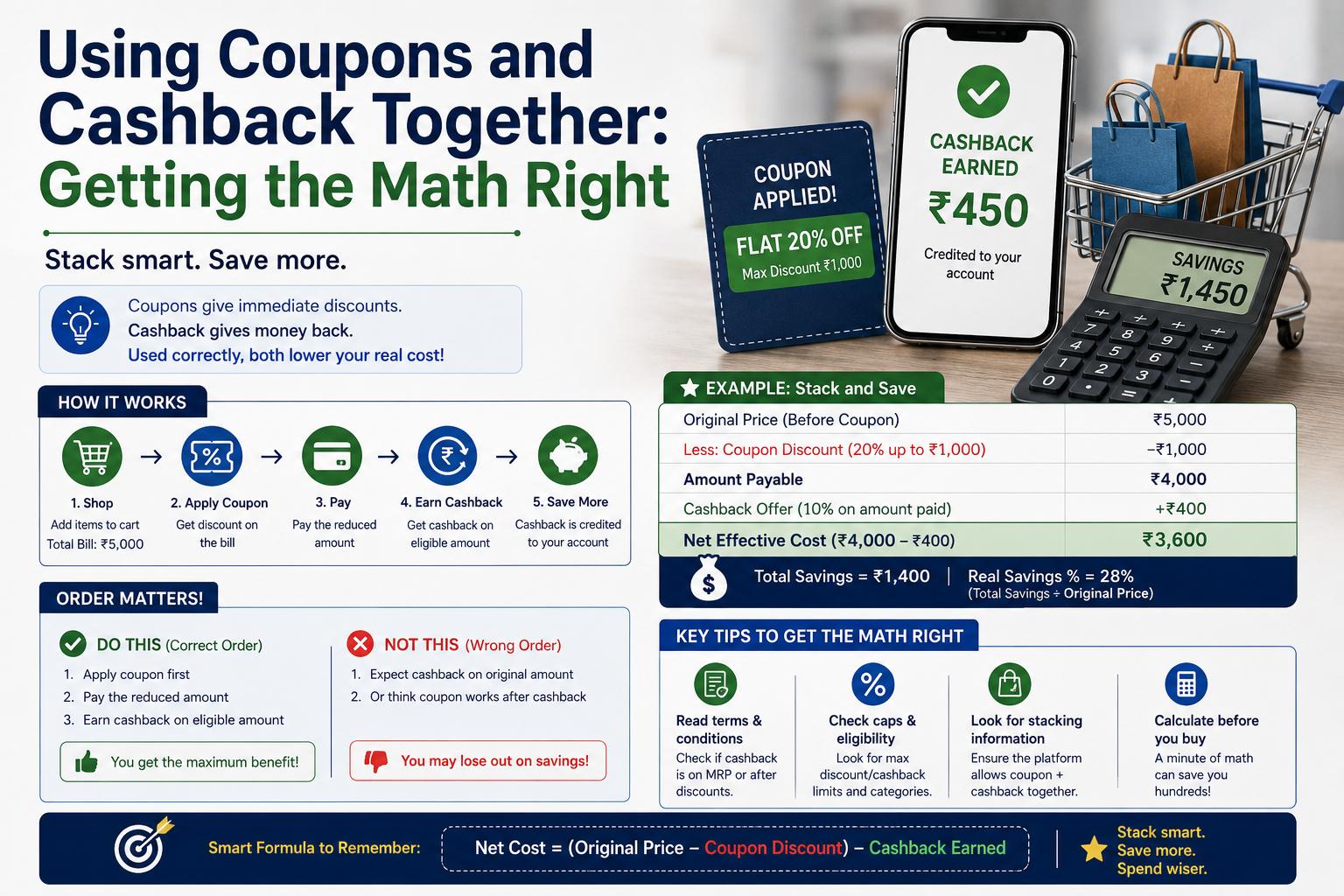
The good news is that you can use both. The sums just need a little care, because the order and the base amount change the answer.
Percent coupon plus percent cashback
Say an item costs $100. You have a 20% coupon, and your cashback is 5%.
- Coupon first. 20% off $100 means you pay $80.
- Cashback on what you paid. 5% of $80 is $4.
- Final cost. $80 − $4 = $76.
Your total saving is $24, which is 24% of the original price. It is not 25%, which is what you get if you just add 20% and 5%. The cashback is taken from a smaller amount, so it is a little smaller.
Does the order matter?
For two percentages, no. You can multiply 0.80 by 0.95 in any order and you will get 0.76, so you pay 76% of the price either way. What matters is which amount the cashback is worked out on.
Cashback on the full price
Some programs pay cashback on the price before the coupon. If that is the case here, 5% of $100 is $5, and your final cost is $80 − $5 = $75. That is $1 better than before.
You cannot tell which one applies from the advert alone. The terms will say. If they do not, assume the smaller amount, which is the cashback on what you actually paid.
A fixed-amount coupon
Now say the coupon takes $15 off a $120 item, and the cashback is 4%.
- Price after the coupon: 120 − 15 = $105
- Cashback on $105: 105 × 0.04 = $4.20
- Final cost: 105 − 4.20 = $100.80
Your total saving is $19.20 on $120, which is 16%. Here the coupon is 12.5% of the price (15 ÷ 120), and the cashback adds a little more.
Look at your typical savings
If you shop often, it helps to know what you really save. Say your savings on three orders were $24, $18 and $12. The total is $54. Use an average finder and divide by 3 to get $18 saved per order, which gives you a real picture of what these deals are worth to you.
That number also helps you spot a bad deal. If a coupon needs you to spend $40 more to save $5, the average tells you that this deal is not normal for you.
When coupons and cashback may not mix
Some stores do not allow cashback if you use a coupon code. Others pay it only on the part you really paid. A few pay it only when you click through a special link. These rules are different in every place, so read the terms for both the coupon and the cashback before you check out.
If something is not clear, ask the store or the cashback company before you buy. It is better to know first than to find out later.
Things to check before you pay
- Is the coupon still valid today?
- Does it need a minimum spend?
- Is the cashback paid on the price before or after the coupon?
- Does tax or delivery count?
- What happens to the coupon and the cashback if you return the item?
Watch out for "spend more to save more"
Coupons that need a minimum spend can make you buy more than you planned. If you only wanted a $60 item and the coupon needs $100, you have to buy $40 more to get the deal. That is only a good idea if you really need the extra things.
A simple test is to ask: "Would I buy this if there was no coupon?" If the answer is no, skip it. A saving of $10 on something you did not want is still $50 gone from your wallet if the item costs $60.
Work out the final cost
Before you pay, write down the final cost in three steps. First, take off the coupon. Second, work out the cashback on the amount you pay. Third, take that away to get the real cost. A cashback calculator can do the middle step for you, so you can focus on whether the final price is fair.
Common mistakes
- Adding the two percentages together.
- Working out cashback on the wrong amount.
- Forgetting a minimum spend.
- Counting cashback before it is confirmed.
Final thoughts
Coupons and cashback can work together. Take off the coupon first, then work out the cashback on what you pay, unless the terms say otherwise. Check the rules, and do not buy something just because you can stack deals.