- 25 Nov 2025
- 1 posts
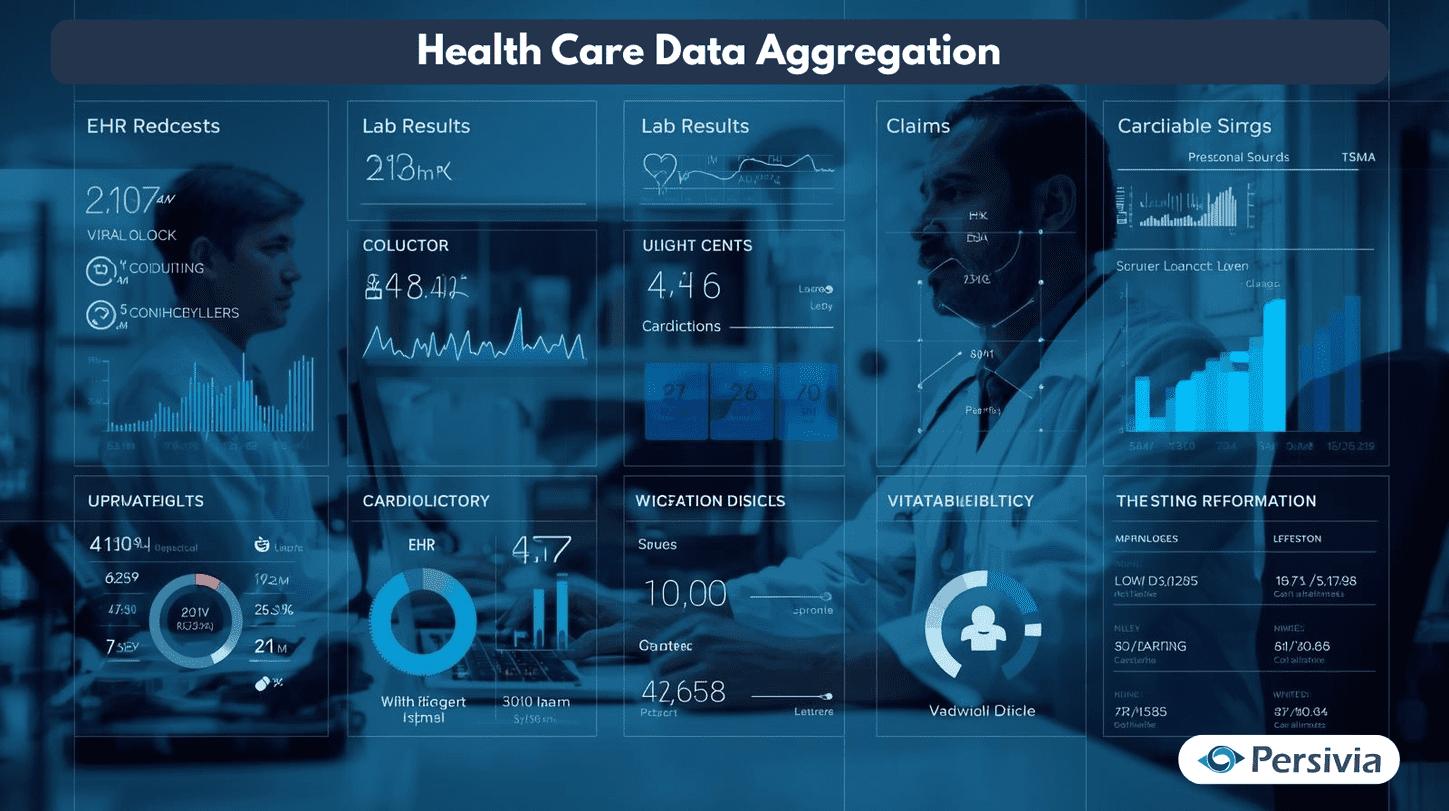
Physicians waste 16 minutes or so a day in finding patient information in systems that are not interconnected with each other.It is almost two hours a week of data hunting rather than patient treatment.The solution to this is healthcare data aggregation, which pulls EHR, Labs, claims, and wearable information into a single view.Cardiologists have quicker and more accurate decisions when presented with a full history of medication, as well as the latest lab tests and insurance claims of a patient.
The difficulty does not lie in the unavailability of data; the volume of data generated by hospitals is 50 petabytes per year.The issue is divisiveness.One system holds the cholesterol results of a patient, another one the prescriptions, and another one holds the emergency room visits.Data aggregation in healthcare links these dots so that the fragments are assembled to become actionable intelligence, and this saves time and lives.
What is Healthcare Data Aggregation?
Healthcare data Aggregation can be defined as the process of merging, standardizing, and consolidating patient information that comes from various sources in a single and convenient format.Consider it as making a jigsaw puzzle; the pieces are individual till they are combined together by aggregation.
The process involves three core steps:
- Collection: Extracting data from EHRs, HIEs, claims systems, patient portals, and medical devices
- Standardization: Converting different formats (HL7, FHIR, CCDA) into a common structure
- Integration: Merging records using patient matching algorithms and enterprise master patient indexes (eMPI)
Why Healthcare Needs Better Data Integration
Healthcare operates in silos. There are silos within healthcare.The primary care incorporates one EHR, and specialists integrate another, and insurance claims exist in a whole different database.Such internal fragmentation has actual issues that affect patient safety and quality of care daily.
Critical issues caused by disconnected data:
- Physicians order duplicate tests because they can't see the results from other facilities
- Medication errors occur when providers lack visibility into complete prescription histories
- Care gaps go unnoticed because risk factors are buried in unconnected systems
Building Longitudinal Patient Records
A longitudinal patient record (LPR) is a record of the health history of a person, spanning across all care environments and caregivers.Conventional systems record single instances of a hospital visit, a lab result, and a solitary prescription.These snapshots are linked together by LPRs into a time record.
The process begins by determining and connecting records of various sources with the right patient.Here, advanced systems access duplicate entries and conflicting information and then sort the information in chronological order, irrespective of the source of information.
Key components include:
- Comprehensive medication history from all pharmacies and prescribers
- Lab results and imaging studies from multiple facilities
- Clinical notes from primary care, specialists, and hospital stays
- Claims data showing all billed services across the care continuum
- Device data from wearables and home monitoring equipment
Clinical notes contain critical information that structured data fields miss. Natural Language Processing (NLP) reads these unstructured notes and extracts meaningful information, converting "COPD exacerbation" and "chronic obstructive pulmonary disease flare-up" into the same standardized concept. A healthcare data platform using advanced NLP can process thousands of clinical notes in minutes.
The Technology Behind Modern Data Aggregation
The contemporary aggregation of health data is based on an advanced architecture to work with various types of data and remain fast and accurate.The base integrates both flexibility and optimization of performance to handle an imaging file to streaming device data.
Data Lake House Architecture
The technology of data lake houses allows storing large amounts of raw data in its primary form and ensures optimization to quickly query and analyze it.This is important as healthcare produces data of truly unbelievable variety:
- X-ray images (gigabytes)
- Continuous glucose monitor data (streaming data)
- Genomic sequencing data (terabytes)
- Clinical notes data (text)
- Billing codes data (structured data)
Key capabilities:
- Flexibility to store any type of healthcare data without pre-processing
- Performance optimization for running complex analytics queries
- Scalability to handle petabytes of information as organizations grow
Unified Data Models
A Unified Data Model (UDM) creates a common structure for organizing healthcare information from hundreds of different sources. Without a UDM, each data source speaks its own language. One EHR labels blood pressure as "BP," another uses "blood_pressure_systolic," and a third codes it numerically. The UDM translates all variations into one standardized format with both batch processing for scheduled updates and real-time processing for critical information like ADT feeds. Organizations using comprehensive UDMs report faster data integration times compared to custom-built solutions.
Enterprise Master Patient Index
Patient matching prevents dangerous scenarios like displaying another patient's allergy information during prescribing.To continuously identify and combine the records of duplicate entries, an eMPI utilizes advanced algorithms to productively manage variations in names, transpositions of numbers in dates of birth, absent data in multiple sources, and to provide continuous observation.
How AI Transforms Aggregated Data Into Insights
AI is an analysis of aggregated patient data to create predictions, detect gaps, and cause real-time alerts, which directly influence the delivery of care.Clinical intelligence resulting from the combination of detailed information and deep algorithms is something human beings would never pick up.
AI models examine hundreds of variables simultaneously diagnosis codes, medications, lab trends, social determinants, and past utilization patterns. They flag patients at high risk for sepsis before symptoms become severe, predict which diabetics will likely develop complications within six months, and calculate fall risk scores for elderly patients.
Automated care gap identification continuously scans aggregated records against evidence-based guidelines:
- Overdue preventive screenings (mammograms, colonoscopies, A1C tests)
- Missing evidence-based medications for chronic conditions
- Incomplete documentation is needed for accurate risk adjustment
- Patients are not engaged with recommended specialist follow-up
AI sends notifications as soon as there is a real-time update of aggregated data.A patient comes to an urgent care, complaining of chest pain. The system immediately examines the aggregate information and warns the doctor of high cardiac risk before he or she even gets into the exam room.
Data Sources and Integration Methods
Health data aggregation pulls information from diverse sources, each requiring different technical approaches for integration.
Impact on Clinical Decisions
The practical value of aggregated data shows up in daily clinical scenarios where providers make better, faster decisions with complete information at their fingertips.
Reducing Diagnostic Errors
This is because unfinished information is a major cause of diagnostic errors.A doctor and an emergency physician can immediately obtain the current CT scan of the patient from another hospital, earlier medical history, and current prescriptions, which saves them unnecessary recidivism of images and find the proper diagnosis much faster.
Eliminating Duplicate Testing
Healthcare wastes billions annually on redundant tests. A patient visits their primary care doctor complaining of fatigue. Without aggregated data, the doctor orders a complete metabolic panel. With aggregation, they see the patient had identical labs done two weeks ago at an urgent care, and can review those results instead of repeating the test. This reduces costs, radiation exposure, and patient frustration.
Improving Medication Safety
In the United States, medication errors cause damage to 1.5 million individuals each year.