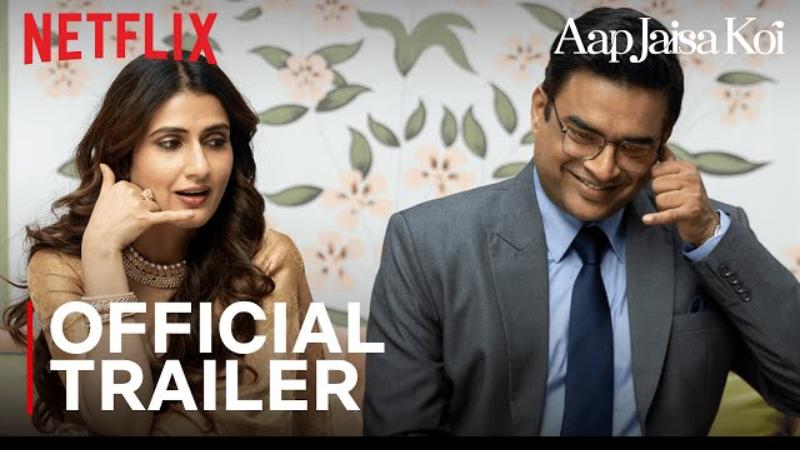
In a heartfelt conversation ahead of the release of Aap Jaisa Koi, Netflix’s latest romantic family drama, lead actors R Madhavan and Fatima Sana Shaikh, along with director Vivek Soni, reflect on love, relationships, dating apps, and changing dynamics in both cinema and society. The film, which premieres tomorrow on Netflix, delves into romance with a timeless yet contemporary lens, exploring love beyond age and generational boundaries.
How many of you are on a dating app?
Fatima Sana Shaikh: As for Madhavan, he has been married for a very long time. I don't think he was ever on one. As for me, I find it very unnatural. I’m not on any dating app.
R Madhavan: Yes, actually I never had the requirement of being on a dating app. Even if I ever was, I’m not going to tell you (laughs).
Vivek Soni: I was once, briefly. But I quickly realised that I am not someone who enjoys dating via apps. I would rather meet someone in person and have a real conversation. Starting a conversation based on just a profile picture felt too artificial. It doesn’t come to me naturally. I prefer knowing someone first before making a connection.
Madhavan: It all starts with objectification, doesn’t it? Whether the looks are matching or not. It becomes a very superficial space.
The film speaks of 'barabari wala pyaar' — equality in love. What does that mean to you personally?
Fatima Sana Shaikh: I think equality in love begins with mutual respect and aligned ideologies. No two people are ever completely alike. You evolve within a relationship. Your partner's strengths may compensate for your weaknesses and vice versa. That mutual support, where your weaknesses turn into collective strengths, creates a wholesome bond. That’s barabari to me.
Madhavan: I’ve seen a beautiful example of that kind of love in my own family. My grandparents had an arranged marriage, and my grandmother was barely fourteen or fifteen when she got married. My grandfather was around twenty-one or twenty-two. That was the norm back then. Despite the circumstances, they lived a life full of love and deep companionship for nearly eighty years.
In the last few years of their lives, I remember seeing my grandfather constantly caring for her—asking whether she had eaten, taken her medicines, or needed anything. He even remembered her favorite color. He wouldn’t eat until she had eaten. That level of care and attention, even at the age of eighty, was something so pure and selfless. That’s love, no matter how it began.
But yes, the definition of equality has changed. For their generation, it meant something else. For us, it has transformed quickly, and now we are adapting to an entirely different idea of equality in relationships. I think middle-class men in our time always wanted to give respect to their partners—we embraced that evolution willingly.
Cinema too has evolved in how it portrays love and relationships. Madhavan, you’ve been part of the industry through this change. What do you make of it?
Madhavan: The characters we play now are far more layered. Earlier, there was often a hero-centric narrative, but now, every character, male or female, is written with depth. Every role has meaning, emotional complexity, and a unique voice. That's the real evolution of cinema. And it’s reflective of our society. People have changed, their experiences are more diverse, and cinema captures that beautifully.
Fatima: Cinema does reflect society. When cinema changes, society changes and vice versa. Audiences now engage in conversations about films. They aren’t passive viewers anymore. They’re active participants. They don’t just consume content—they react, discuss, and critique it. And that feedback loop is helping filmmakers stay grounded in reality and create content that truly resonates.
Vivek Soni: That’s exactly the space we wanted to tap into with Aap Jaisa Koi. It's not just about romance in a conventional sense. It’s about revisiting love with maturity, and understanding its many layers—emotional, generational, and situational. The story is rooted in relationships and how they evolve over time, especially when they are challenged by circumstances, social expectations, and personal choices.
Final thoughts on what Aap Jaisa Koi means to each of you?
Fatima: For me, it’s a film that speaks to the heart. It deals with relationships that are real, with imperfections and deep connections. It’s refreshing to see a narrative where love isn’t bound by age or traditional dynamics.
Madhavan: It’s a reminder that love is timeless and evolving. That barabari doesn’t mean sameness—it means mutual respect, understanding, and evolving together. And I hope audiences see a little bit of their own story in this one.
Vivek Soni: Aap Jaisa Koi is a tribute to the complexities of modern relationships while cherishing the simplicity of old-school love. It’s a dialogue across generations, and I hope it leaves viewers with more questions than answers—because that’s when real introspection begins.
As Aap Jaisa Koi gears up for its Netflix release, the film promises to deliver more than just a love story. It is a nuanced take on emotional connections in a changing world—one where barabari in love becomes not just an ideal, but a necessity.