

Taurus Monthly Horoscope (Aug-2024)




Taurus Monthly Horoscope: August 2024
Dates: April 20 - May 20
August brings a wave of promising prospects for Taurus, highlighting your steadfastness and drive as your greatest strengths this month. Embrace the opportunities that come your way, whether they be career advancements or new collaborations that could enhance your professional life.
Career & Professional Life: In the realm of work, August is ripe with potential. Your persistence and work ethic are set to bring positive changes, including potential promotions and financial gains. Stay receptive to new projects and partnerships—they could significantly impact your career trajectory.
Financial Outlook: Your financial situation looks stable, but it’s crucial to adhere to your budget and avoid impulsive purchases. Focus on long-term financial strategies by diversifying your investments. This is the time to prioritize disciplined spending and savings to ensure continued financial health.
Love & Relationships: August adds a layer of depth and transformation to your love life, Taurus. It’s a month for introspection and reassessment of your relationships. Whether you're in a relationship or single, honest self-reflection and communication will be pivotal. For those in partnerships, this is a chance to address any evolving needs and strengthen your bond. Open dialogues will help navigate any changes and fortify your connection.
For singles, this month is ideal for meeting new people and exploring fresh romantic possibilities. Keep an open mind and be ready for unexpected connections. Trust your intuition when engaging with potential partners.
Health & Wellness: Your health takes center stage this month. It’s essential to establish a balanced wellness routine that caters to both your physical and emotional needs. Make self-care a priority by ensuring you get enough rest and consider integrating practices like yoga or meditation into your daily life. These habits will help manage stress and enhance overall well-being.
Maintain a focus on a nutritious diet and regular exercise to support your physical health. Small adjustments can significantly impact your energy and mood. Listening to your body and responding to its needs will help you stay on track with your health goals.
Education & Personal Growth: August is a fruitful period for professional and educational advancements. Your dedication is likely to yield positive results, so set ambitious goals and actively pursue them. Embrace new challenges and additional responsibilities with confidence.
Students should find this an opportune time to seek out mentorship. A mentor can offer valuable guidance and support your academic progress. Stay adaptable and open to changes, as they can positively influence your educational journey.
Money & Finances: Your financial prospects are looking up this month, with potential unexpected gains. However, it’s important to manage your resources carefully. Stick to your budget and avoid unnecessary spending. Focus on investments that align with your long-term financial goals, and always conduct thorough research before committing.
If you're involved in joint financial ventures, ensure transparency and clear agreements to avoid misunderstandings. Proper documentation and open communication will safeguard your financial interests.
Important Dates: 5, 11, 21, 29
Tip of the Month: Embrace new experiences and opportunities, particularly in your relationships and career. Being open to change and new ventures will help you make the most of the month’s offerings.

8 Mukhi Rudraksha Benefits, Meaning, Ketu Effects and How to Wear
The 8 Mukhi Rudraksha, also known as the Eight-Faced Rudraksha, is a sacred bead identified by eight natural vertical lines, or mukhis, running from the top to the bottom of its surface. In Hindu tradition, it is associated with Lord Ganesha, the deity worshipped for wisdom, intelligence, new beginnings and the removal of obstacles. Because Lord Ganesha is also known as Vighnaharta, meaning the remover of obstacles, the 8 Mukhi Rudraksha is traditionally believed to help the wearer deal with delays, difficulties and unexpected challenges. In Vedic astrology, the bead is commonly associated with the planet Ketu and is also linked with the Muladhara or Root Chakra, which represents stability, security and grounding. Traditional texts and spiritual beliefs also connect the 8 Mukhi Rudraksha with divine feminine energies, the eight Vasus and the sacred river Ganga. 8 Mukhi Rudraksha and Ketu Dosha In Vedic astrology, planetary movements are believed to influence different areas of life. Ketu is associated with detachment, spirituality, uncertainty and sudden changes, and an unfavourable placement of Ketu in a birth chart is traditionally believed to create confusion, delays or instability. The 8 Mukhi Rudraksha is often recommended as a spiritual remedy for people experiencing challenging effects associated with Ketu. It is also traditionally worn by those seeking relief from obstacles linked with Kaal Sarp Dosha and other difficult planetary combinations. Some practitioners also associate the bead with Rahu and Saturn-related challenges, although recommendations can vary depending on the individual horoscope. Benefits of Wearing 8 Mukhi Rudraksha According to traditional spiritual and astrological beliefs, wearing an 8 Mukhi Rudraksha may help strengthen confidence, patience and the ability to deal with difficult situations. It is believed to encourage wisdom, awareness, positivity and mental clarity while helping the wearer remain focused during periods of uncertainty. The bead is also traditionally associated with overcoming delays, failures and obstacles in professional and personal life. Some believers wear it to support decision-making, increase willpower and develop greater stability. People involved in fields involving uncertainty, risk or probability, such as business, investments or trading, sometimes choose the 8 Mukhi Rudraksha for its traditional association with removing obstacles and improving judgment. However, such beliefs should not be considered a guarantee of financial success. Traditional practitioners also associate the bead with balancing the Muladhara Chakra and promoting a sense of grounding and emotional stability. Claims that Rudraksha beads can treat diseases or physical conditions are based on traditional beliefs and are not established medical treatments. Anyone experiencing health concerns should seek advice from a qualified healthcare professional. How to Wear 8 Mukhi Rudraksha Before wearing an 8 Mukhi Rudraksha, devotees traditionally cleanse and energize the bead through prayer or a simple puja. Some people also consult a knowledgeable priest or astrologer to determine whether the bead is suitable according to their birth chart. Wednesday is commonly considered an auspicious day for wearing the 8 Mukhi Rudraksha. The wearer may bathe early in the morning, put on clean clothes and sit facing east while offering prayers to Lord Ganesha. The Rudraksha can be worn around the neck or wrist using a clean silk or wool thread. It may also be capped in silver or gold according to personal preference and traditional practice. Before purchasing the bead, check that its eight natural mukhi lines are clearly visible and run continuously from one end to the other. Buyers should preferably purchase from a trusted seller and avoid beads with artificially carved lines or visible alterations. The 8 Mukhi Rudraksha continues to hold an important place in Hindu spirituality and Vedic astrology because of its association with Lord Ganesha, Ketu and the removal of obstacles. For devotees, it is primarily a symbol of spiritual protection, wisdom, stability and determination rather than a substitute for medical, financial or professional advice.
Read More →
Vastu for Childrens Room: Best Direction, Bed and Study Tips
A child’s room is more than just a place to sleep. It is where children study, play, relax and develop habits that can influence their daily routine. In traditional Vastu Shastra, the placement of the bedroom, bed, study table, storage, lighting and colors is believed to help create a calm, positive and supportive environment for children. Parents who follow Vastu principles often design children’s rooms to encourage concentration, discipline, creativity and restful sleep. While these guidelines come from traditional belief systems rather than modern scientific evidence, they can still be used as a cultural framework when planning a comfortable and organized space. Why Vastu Is Considered Important for a Children’s Room According to Vastu traditions, children are believed to be particularly sensitive to their surroundings. A cluttered, poorly arranged or uncomfortable room may affect their routine, sleep and ability to focus, while a well-planned space is believed to promote positivity and emotional balance. The overall aim of children’s room Vastu is to create an environment that feels peaceful, organized and suitable for both learning and rest. A room designed with proper placement of furniture, suitable lighting and calming colors may also help parents maintain better structure in the child’s daily routine. Best Direction, Bed Placement and Sleeping Position The West direction is traditionally considered suitable for a children’s bedroom. It is believed to encourage discipline, punctuality and a structured lifestyle. The room entrance should ideally not directly face the child’s bed. According to Vastu beliefs, this arrangement is preferred to create a more protected and peaceful sleeping environment. The bed is generally recommended in the South-West part of the room. Children are traditionally advised to sleep with their head facing either South or East. A wooden bed is commonly preferred over a metal bed in Vastu. The room should also be kept free from unnecessary clutter around the sleeping area to maintain a calm atmosphere. Study Table, Storage and Electronics Vastu Tips The study table should ideally be positioned so that the child faces North, East or North-East while studying. These directions are traditionally associated with learning, concentration and clarity of thought. The study area should remain clean and organized. Books, stationery and other materials can be arranged neatly to reduce distractions. Cabinets and wardrobes are generally recommended in the South-West part of the room. This area can be used to store books, clothes, toys and other belongings. Electronic devices should be kept under control, particularly around study and sleep areas. According to traditional Vastu recommendations, computers and laptops may be placed toward the North, while a television, if required, can be positioned in the South-East. Regardless of Vastu, limiting unnecessary screen time close to bedtime can also help create a calmer bedroom routine. Colors, Lighting and Mirrors for Children’s Room Soft shades of blue and green are commonly recommended for children’s rooms under Vastu principles. These colors are traditionally associated with freshness, calmness, concentration and positivity. Very dark or overly intense colors may be avoided if they make the room feel heavy or overstimulating. Parents can instead choose lighter and soothing shades that suit the child’s personality. Lighting is another important element. The South-East portion of the room is traditionally considered suitable for lighting. The room should be well-lit without being excessively bright or too dim. Natural daylight is also beneficial for making the room feel open and cheerful. Study lamps should provide adequate illumination without causing glare or eye strain. Traditional Vastu advice often recommends avoiding mirrors directly in the children’s room, particularly mirrors facing the bed. If a mirror is necessary, it can be positioned away from the sleeping area or inside a wardrobe. Simple Vastu Checklist for Children’s Room Prefer the West direction for the children’s bedroom. Place the bed toward the South-West. Encourage sleeping with the head toward South or East. Use a wooden bed where possible. Position the study table so the child faces North, East or North-East. Keep the study area clean and clutter-free. Place wardrobes and cabinets toward the South-West. Choose light blue, green or other calming shades. Use balanced lighting and maximize natural daylight. Keep electronic devices organized and away from the bed when possible. Avoid placing a mirror directly opposite the bed. A children’s room should ultimately be safe, comfortable, functional and suited to the child’s individual needs. Vastu principles can be incorporated alongside practical considerations such as ventilation, adequate lighting, ergonomic furniture, storage and age-appropriate safety. Note: Vastu Shastra is a traditional belief system and its effects are not scientifically established. These suggestions should be viewed as cultural or lifestyle guidance rather than guaranteed methods for influencing a child’s behavior, academic success or wellbeing.
Read More →
Mercury Transit in Virgo 2026: Predictions for All Zodiac Signs
Mercury will enter Virgo on Monday, September 7, 2026. In traditional astrology, Mercury represents communication, intelligence, learning, analysis and decision-making, while Virgo is considered one of the signs ruled by Mercury. Mercury Transit in Virgo 2026 timings: India: 1:35 PM IST US Central: 3:05 AM CDT US Eastern: 4:05 AM EDT Because of Mercury’s association with Virgo, this transit is traditionally linked with sharper thinking, better organization, clearer communication and greater attention to detail. People may feel encouraged to plan carefully, complete pending work and approach important decisions with a practical mindset. At the same time, excessive analysis, criticism and perfectionism could create unnecessary stress. The effects may differ for each zodiac sign depending on individual birth charts. Mercury Transit in Virgo 2026: Overall Impact Mercury in Virgo may support learning, writing, research, planning and professional communication. It could also encourage people to organize their routines, review unfinished tasks and focus more closely on facts before making decisions. Activities requiring concentration and attention to detail may receive extra support during this period. However, maintaining balanced communication and avoiding unnecessary overthinking will be important. Aries Aries may become more organized and practical, especially in professional matters. Communication at work could improve, but overly critical or harsh words may create disagreements with colleagues or senior officials. Remedy: Use sandalwood incense during morning prayer or meditation. Taurus Taurus natives may become more cautious while handling finances, relationships and major decisions. Attention to detail could improve, although resistance to change may delay certain opportunities. Remedy: Traditionally, rose water may be added to bath water. Gemini Gemini may experience stronger communication, learning ability and adaptability. New opportunities could emerge, but taking on too many responsibilities at once may lead to mental fatigue. Remedy: Include green shades in clothing or surroundings. Cancer Cancer may become more emotionally aware during conversations and more sensitive to the feelings of others. Supportive communication could strengthen relationships, although excessive thinking may increase emotional stress. Remedy: Use a mild lavender fragrance or incense at home. Leo Leo may communicate with greater confidence and creativity. Social interactions could improve, but a forceful or aggressive approach may lead to avoidable conflicts. Remedy: Tiger’s Eye is traditionally associated with confidence and grounding. Virgo With Mercury moving through its own sign, Virgo may experience stronger concentration, analytical thinking and problem-solving abilities. However, perfectionism and excessive self-criticism could become challenging. Major financial or property-related decisions should be considered carefully rather than made impulsively. Remedy: Use white or pastel shades in the workspace to create a calmer environment. Libra Libra may become more diplomatic in personal and professional communication. Negotiations and relationship discussions could progress smoothly, although indecision may arise in financial matters. Remedy: Jade or Opal is traditionally associated with harmony and balance. Scorpio Scorpio may become more focused on research, investigation and meaningful conversations. Strong concentration could support professional matters, but excessive secrecy or suspicion may affect relationships. Remedy: Add calming dark-blue elements to your surroundings. Sagittarius Sagittarius may feel drawn toward learning, travel and exploring fresh ideas. Communication could become more confident, although speaking too bluntly may result in misunderstandings. Remedy: Amethyst is traditionally associated with calmness and thoughtful decision-making. Capricorn Capricorn may benefit from better planning, organization and practical thinking. Competitive examinations, interviews and professional discussions could receive greater attention. Financial decisions should be based on careful research and individual circumstances rather than astrology alone. Remedy: Blue-colored decor or objects may be used as a traditional symbolic remedy. Aquarius Aquarius may experience stronger networking and collaboration opportunities. Innovative ideas could attract attention, although confrontational situations or unpredictable reactions should be handled carefully. Remedy: Keep living and working areas bright and well-lit. Pisces Pisces may experience greater creativity, intuition and interest in expanding social connections. Career decisions or possible job changes could come into focus, making careful evaluation important before taking action. Remedy: Soft-blue shades may be used at home or in the workplace to encourage a calm atmosphere. Mercury Transit in Virgo 2026 Message Mercury’s transit through Virgo is traditionally considered favorable for communication, learning, planning and organizing responsibilities. The key theme of this period is finding a balance between careful analysis and excessive overthinking. The transit may encourage people to reassess goals, improve routines and make more thoughtful decisions related to careers, relationships and finances. Note: Astrology is a traditional belief system and is not scientifically established. These predictions and remedies are intended for spiritual and cultural purposes only and should not replace professional financial, medical, legal or career advice.
Read More →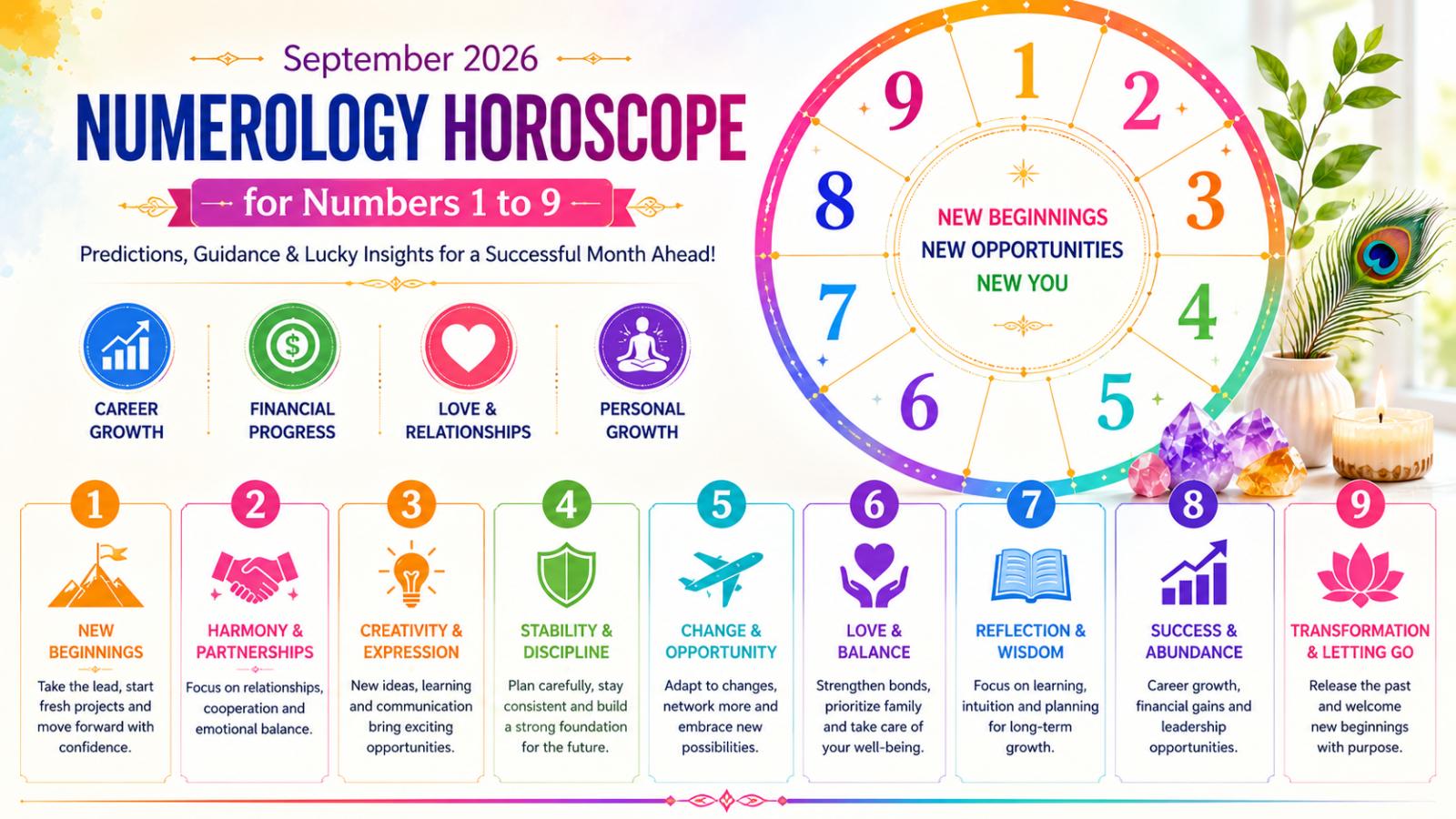
September 2026 Numerology Horoscope for Numbers 1 to 9
September 2026 carries the Universal Month vibration of Number 1 in numerology, a number traditionally associated with fresh starts, confidence, independence and new opportunities. The month may encourage people to take initiative, make important decisions and move forward with greater clarity. However, numerology interprets this energy differently for each number. While some may see stronger career or financial opportunities, others may focus more on relationships, learning, emotional balance or preparing for future changes. Here is the September 2026 numerology forecast for Numbers 1 to 9 Numerology Number 1 September may bring strong motivation to begin something new. Number 1 natives could feel ready to change jobs, launch a project, start a business or make an important personal decision. Career growth may come through leadership, skill development and professional networking. This is a month to act confidently while avoiding unnecessary impatience. Clear goals and disciplined action could help turn new ideas into meaningful progress. Numerology Number 2 For Number 2, cooperation and emotional intelligence may be more important than competition. Relationships, family matters and professional partnerships could need additional attention. Diplomacy and thoughtful communication may help resolve misunderstandings. In love, patience and mutual understanding could strengthen existing relationships, while singles may meet someone through friends, family or professional connections. Numerology Number 3 September could bring creativity, optimism and stronger communication for Number 3 natives. New ideas, travel, learning and social opportunities may become important themes. Professional opportunities may emerge through creative work, communication or networking. However, too many choices could become distracting, making focus essential for achieving meaningful results. Numerology Number 4 Number 4 natives may benefit from discipline, planning and patience. September is better suited to practical decisions than impulsive action. New responsibilities may arise at work, and others could depend on your judgment. An unexpected opportunity may require stepping outside your comfort zone. Improving routines, managing time effectively and maintaining work-life balance could also become priorities. Numerology Number 5 September may be fast-moving for Number 5 natives. Communication, networking, travel and fresh ideas could open new doors. Career prospects may be encouraging in fields such as sales, media, marketing, technology, consulting and travel. Job seekers could receive promising opportunities, while entrepreneurs may benefit from new contacts or projects. Avoid spreading your attention across too many goals at once. Numerology Number 6 Relationships, family and emotional balance may take centre stage for Number 6. The month could encourage you to strengthen personal bonds while also taking greater responsibility for your own well-being. Career progress may come through teamwork, creativity and reliability. Fields connected with education, healthcare, hospitality, counselling, design and wellness may feel particularly supportive. Setting healthy boundaries will be important to avoid taking on excessive responsibilities Numerology Number 7 September may encourage Number 7 natives to reflect, learn and prepare rather than rush into major decisions. This can be a useful period for research, certifications, interviews, professional training and long-term planning. Trusting intuition while relying on careful analysis could help you identify the right opportunities. Numerology Number 8 Number 8 may experience strong momentum in career, business and finances. Leadership opportunities, negotiations, salary discussions, promotions or business expansion could come into focus. Entrepreneurs may see improved opportunities through partnerships and stronger client relationships. Ambition can bring results, but maintaining health and personal relationships alongside professional goals will be equally important. Numerology Number 9 September may represent a period of transition for Number 9 natives. Numerology traditionally associates this phase with releasing old patterns and making space for new beginnings. Career changes, leadership opportunities or business expansion may become possible. Personal growth may also involve moving away from situations or relationships that no longer support your long-term direction. September 2026 Numerology Message The overall numerology theme for September 2026 is about beginning again with greater confidence. Number 1 energy traditionally encourages independence, initiative and forward movement, but success may depend on balancing enthusiasm with careful planning. Numbers 1, 5 and 8 may feel especially driven toward professional progress, while Numbers 2 and 6 could focus more strongly on relationships and emotional harmony. Numbers 4 and 7 may benefit from patience and preparation, while Numbers 3 and 9 could experience creativity and personal transformation. The month can be used as an opportunity to reassess priorities, strengthen useful habits and take thoughtful steps toward personal and professional goals. Note: Numerology is a traditional belief system and is not scientifically established. These predictions are intended for spiritual, cultural and entertainment purposes rather than as professional financial, career, medical or relationship advice.
Read More →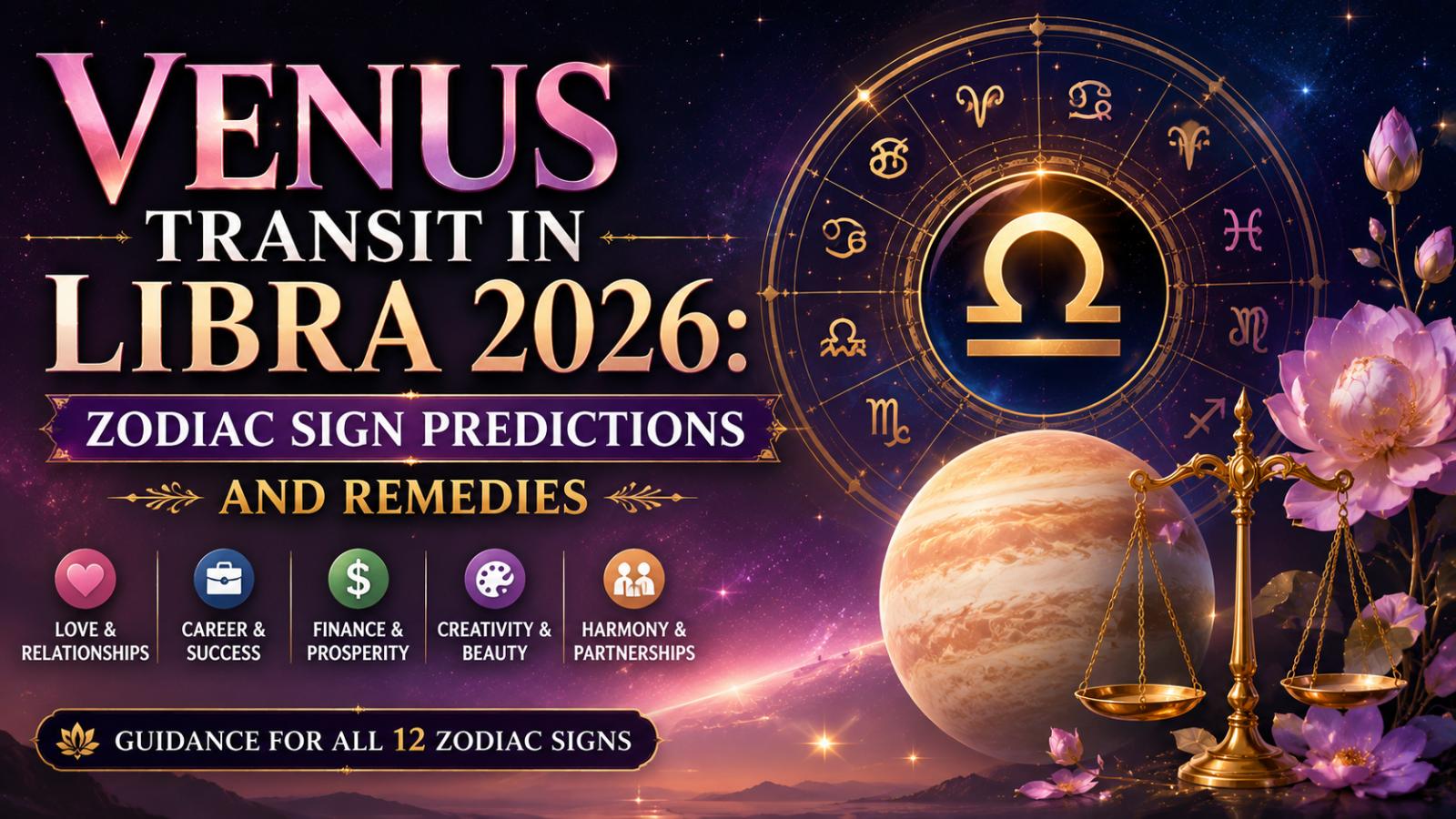
Venus Transit in Libra 2026: Zodiac Sign Predictions and Remedies
A Venus transit occurs when Venus moves from one zodiac sign into another. In traditional astrology, Venus represents love, relationships, beauty, attraction, creativity, luxury, pleasure and financial comforts. Astrologers believe that when Venus changes signs, these areas of life may be influenced according to the qualities of the new sign and the house activated in an individual's birth chart. Venus moving into Libra is considered especially significant because Libra is traditionally ruled by Venus. Libra is associated with balance, harmony, partnerships, diplomacy and fairness. As a result, this transit is often linked with stronger relationship awareness, creative expression, social connections and a greater desire to restore harmony in personal and professional life. The Venus Transit in Libra 2026 may influence relationships, career decisions, financial matters, creativity and personal connections. Its effects can vary for each zodiac sign depending on the individual's complete horoscope. Venus Transit in Libra 2026 Date and Time India: Wednesday, September 2, 2026, at 1:51 PM IST US Eastern Time: Wednesday, September 2, 2026, at 4:21 AM EDT US Central Time: Wednesday, September 2, 2026, at 3:21 AM CDT Venus in Libra is traditionally associated with charm, attraction, cooperation and the desire to restore harmony. The transit may encourage people to communicate more diplomatically, improve relationships and seek a healthier balance between personal goals and partnerships. Venus Transit 2026 Predictions for All Zodiac Signs Aries Venus brings greater attention to partnerships, marriage and professional collaborations for Aries. Business relationships may improve, while employees and professionals could benefit from diplomacy, networking and smoother communication. Personal relationships may also become more harmonious. Married couples could find it easier to resolve disagreements, while singles may encounter someone with the potential for a meaningful relationship. Remedy: Maintain a daily gratitude journal focused on relationships and partnerships. Taurus For Taurus, workplace routines, health habits and professional relationships come into focus. Existing disagreements with colleagues may become easier to manage through patience and cooperation. Financially, better debt management, delayed payments or returns from earlier investments may offer some relief. In personal relationships, avoiding unnecessary criticism can help maintain harmony. Remedy: Create a calm atmosphere at home and spend a few minutes each day in peaceful reflection. Gemini Creativity, romance, education and self-expression receive increased attention for Gemini. Those working in writing, entertainment, media, design or other creative industries may find useful opportunities. Romantic relationships could become more expressive and enjoyable. Singles looking for a serious connection may also experience encouraging developments during this period. Remedy: Spend time developing a creative skill and remain disciplined with financial decisions. Cancer Home, family, property and emotional security become important themes for Cancer. Some people may consider renovating their home, purchasing household items, making property-related decisions or planning a vehicle purchase. Family relationships may become warmer, while spending more time with loved ones could bring emotional satisfaction and greater stability. Remedy: Keep your home clean, peaceful and organized to encourage a positive atmosphere. Leo Communication becomes one of Leo's strongest advantages during this Venus transit. Writers, marketers, artists, media professionals and those whose work depends on networking may benefit. Short professional journeys, new contacts or additional income opportunities may also emerge. Romantic conversations can become warmer and more expressive. Remedy: Use thoughtful words and avoid unnecessary arguments with siblings or close associates. Virgo Financial planning, family responsibilities and communication are highlighted for Virgo. A diplomatic approach could help in professional discussions, negotiations or important conversations. Income and savings may gradually improve if spending is managed carefully. Family relationships remain supportive, and celebrations or social gatherings could create pleasant moments. Remedy: Maintain a practical budget and speak calmly during important family discussions. Libra Venus moving through Libra may increase confidence, charm and personal appeal. This can be an encouraging period for people working in fashion, beauty, entertainment, design, media and other creative fields. Relationships may become more affectionate and cooperative. Libra natives may also feel motivated to improve their appearance, lifestyle or personal surroundings. Remedy: Focus on self-care while maintaining balance between personal desires and responsibilities. Scorpio Foreign connections, expenses, private matters and behind-the-scenes activities receive greater attention for Scorpio. Opportunities may emerge through international contacts, remote work or online professional networks. At the same time, spending on travel, entertainment or luxury purchases could rise. Emotional honesty and trust will be especially important in close relationships. Remedy: Maintain a record of expenses and devote some time to meditation or quiet reflection. Sagittarius Networking, friendships and financial gains are important themes for Sagittarius. Professional contacts may help move important projects forward, while incentives, bonuses or other financial gains could become possible. Social activities may increase, and singles could meet someone interesting through friends, professional groups or social gatherings. Remedy: Strengthen positive friendships and participate in charitable or community activities. Capricorn Career, reputation and public image receive greater emphasis for Capricorn. A diplomatic and cooperative approach may help improve professional relationships and bring recognition from colleagues or senior figures. Career advancement could also support financial growth. However, increased professional responsibilities may leave less time for personal matters. Remedy: Keep your workspace clean and organized, and remain respectful during professional negotiations. Aquarius Higher education, long-distance travel, international opportunities and learning become significant for Aquarius. Students, teachers, artists and professionals connected with global organizations may benefit. Relationships may also deepen through shared beliefs, intellectual interests, travel experiences or meaningful conversations about the future. Remedy: Continue learning and use your knowledge or experience to help others whenever possible. Pisces Shared finances, investments, emotional intimacy and financial transformation come into focus for Pisces. Unexpected gains may occur in some cases, although sudden expenses could also arise. Careful financial planning will therefore be important. Relationships may become deeper when unresolved emotional issues are discussed openly and patiently. Remedy: Avoid unnecessary financial speculation and reflect carefully before making major emotional or financial decisions. What Venus in Libra Could Mean Overall Venus in Libra is traditionally regarded as a favorable period for diplomacy, cooperation, creativity, relationships and social harmony. People may feel more motivated to settle disagreements, improve partnerships and create greater balance in personal and professional life. The transit may particularly support activities connected with art, fashion, beauty, communication, networking, relationship-building and collaborative work. Financial decisions may also receive greater attention, especially when connected with lifestyle choices, partnerships or long-term planning. Individual experiences can vary considerably because the influence of Venus in Libra depends on the complete birth chart, including the rising sign, planetary positions, house placements and other ongoing astrological transits. These predictions are general astrological interpretations and should be considered guidance rather than guaranteed outcomes.
Read More →
Vastu for Dining Room: Best Direction, Table Placement and Colors
The dining room is more than a place to serve meals. It is often where family members sit together, talk about their day and spend uninterrupted time with one another. In Vastu Shastra, the location and arrangement of the dining space are traditionally believed to influence the atmosphere created around mealtimes. Following Vastu principles does not guarantee prosperity or prevent disagreements, but many people use these traditional guidelines while designing their homes to create a comfortable, organized and welcoming dining environment. Best Direction for Dining Room as Per Vastu According to traditional Vastu guidance, the western part of the house is considered suitable for a dining room. If that location is unavailable, the North or East may also be considered. The dining area should ideally be located close to the kitchen so that serving food remains convenient and the two spaces function together naturally. For multi-storey homes, keeping the kitchen and dining room on the same floor can improve convenience. The dining space should also feel open and comfortable rather than overcrowded. Adequate ventilation, natural light and enough room around the table can make everyday dining more pleasant. The entrance to the dining room is traditionally preferred on the East, West or North side. Wherever possible, avoid arranging the dining-room door directly opposite the main entrance, especially when privacy during family meals is important. Dining Table Placement and Shape The dining table is the main element of the room and should be positioned so people can sit and move around comfortably. According to Vastu traditions, the table may be placed toward the South-West portion of the room or centrally, while leaving some distance between the table and the walls. Avoid placing the dining table directly beneath a heavy beam if another arrangement is possible. Apart from Vastu considerations, this can also help the dining space feel more open. Square and rectangular dining tables are commonly recommended in Vastu because their structured shape is associated with stability and balance. Choose a table that suits the size of the room rather than selecting one that makes the space feel congested. Traditional Vastu advice also tends to favor clean, well-maintained furniture over very old or damaged dining tables. Whatever style you choose, the table should be sturdy, comfortable and suitable for regular family use. Best Dining Room Colors and Decor The dining area should feel cheerful, relaxing and inviting. Soft shades such as cream, off-white, light yellow, peach, pink and gentle orange tones are often suggested for dining rooms. Wall decor can include pleasant nature paintings, floral artwork or tasteful food-related imagery. Avoid overcrowding the walls with too many decorative objects. Keeping the room clean and clutter-free can create a calmer atmosphere during meals. Good lighting is equally important. Natural daylight during the day and warm, comfortable lighting in the evening can make the room more welcoming. Best Direction to Face While Eating Traditional Vastu principles generally recommend facing East while eating, particularly for the head of the family. North and West are also commonly considered acceptable directions, while facing South is traditionally avoided. Rather than forcing seating arrangements, however, comfort and practicality should remain important, especially in smaller homes. Ultimately, a well-designed dining room should encourage family members to sit together comfortably and enjoy their meals without distraction. Combining traditional Vastu recommendations with good lighting, ventilation, cleanliness and practical furniture placement can help create a dining space that feels peaceful, organized and welcoming.
Read More →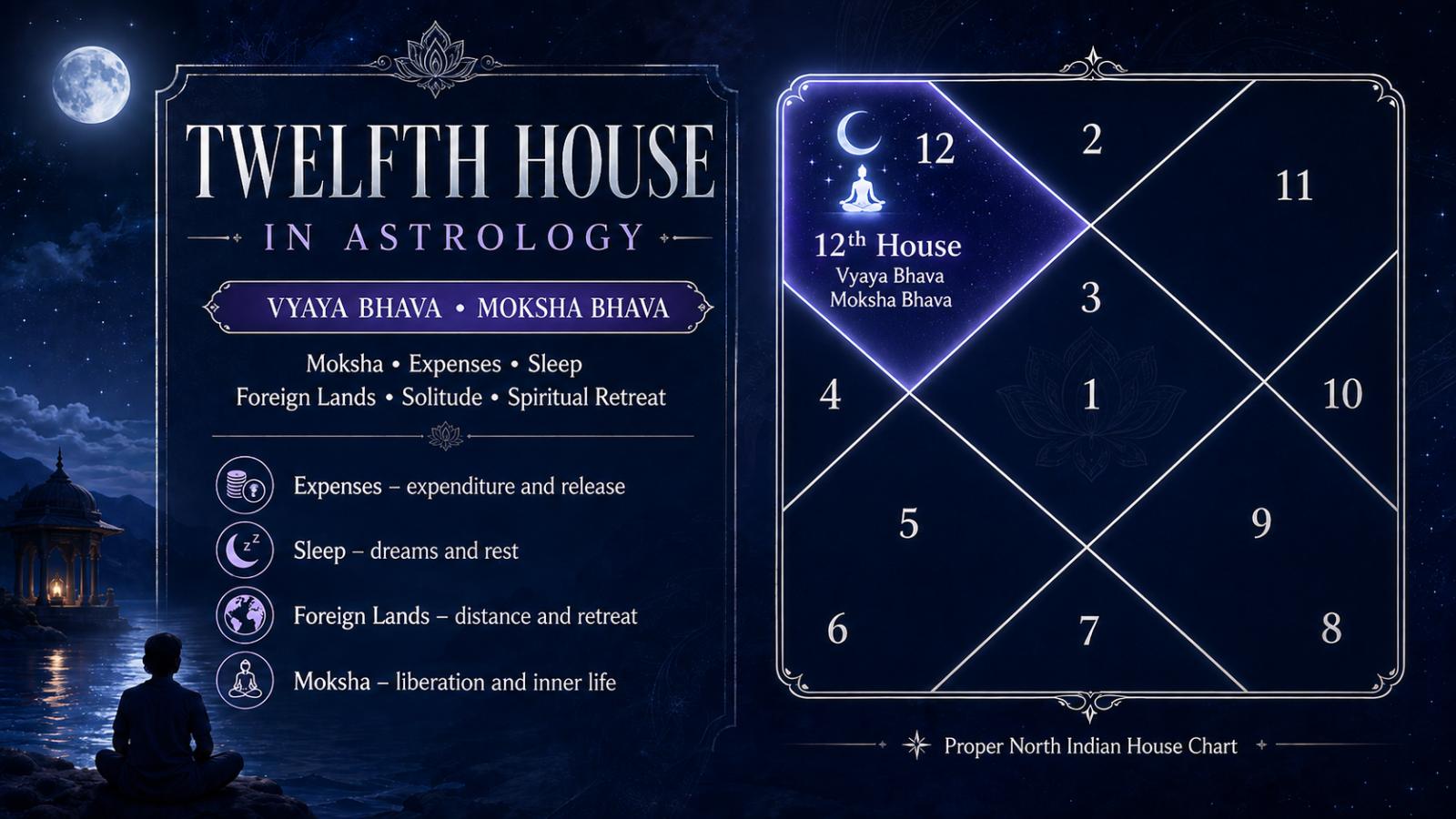
Twelfth House in Astrology: Moksha, Expenses, Sleep and Navagrahas
The Twelfth House in astrology, known as Vyaya Bhava or Moksha Bhava in Vedic astrology, represents expenses, sleep, dreams, foreign lands, isolation, retreat, spiritual liberation and hidden patterns. Its meaning depends on the Rashi, Twelfth House lord and Navagrahas placed in the house. The Twelfth House in astrology is associated with expenses, sleep, dreams, solitude, foreign lands, isolation, spiritual retreat, hidden patterns and liberation. In Vedic astrology, it is often called Vyaya Bhava, the house of expenditure, and is also connected with Moksha Bhava, the path of spiritual release. While the Eleventh House relates to gains, friends and fulfillment of desires, the Twelfth House focuses on release, surrender, withdrawal, inner reflection and what moves beyond ordinary material life. Astrology is a traditional interpretive system whose claims have not been scientifically established. It should not replace professional medical, legal, financial or mental health advice. What Does the Twelfth House Represent? Common Twelfth House themes include: Expenses and losses Sleep and dreams Solitude and isolation Foreign lands and distant places Spiritual retreat and meditation Ashrams, hospitals or places of seclusion Hidden patterns and subconscious tendencies Charity and selfless service Moksha and spiritual liberation A strong Twelfth House does not automatically mean loss, loneliness or difficulty. Its meaning depends on the Rashi occupying it, Navagrahas placed there, the Twelfth House lord, aspects and the complete birth chart. Moksha, Expenses and Inner Life The Twelfth House is traditionally studied for expenses, withdrawal, sleep, foreign residence, spiritual retreat and liberation from attachments. In Vedic astrology, it may show how a person spends energy, money and emotional resources. It can also point toward meditation, charity, compassion, dreams, private life and the desire to move away from worldly noise. Because this house can be linked with isolation, hospitals, sleep and hidden emotional patterns, interpretations should be handled with care. Astrology should not be used to diagnose health conditions, predict suffering or replace mental health guidance. The Lord of the Twelfth House The Graha ruling the Rashi in the Twelfth House is called the Twelfth House lord or Vyaya Bhava lord. Its Rashi, house placement, strength, conjunctions and aspects may show how Twelfth House themes develop. For example, if Pisces occupies the Twelfth House, Guru becomes its traditional lord, and Guru’s placement becomes important. Navagrahas in the Twelfth House Navagrahas placed in the Twelfth House may influence expenses, sleep, foreign connections, solitude, spirituality and hidden inner patterns. Surya (Sun): Private identity, spiritual leadership, foreign influence, hidden pride or work behind the scenes Chandra (Moon): Sensitive dreams, emotional solitude, compassion, changing sleep patterns and inner reflection Mangala (Mars): Restless energy, hidden conflicts, expenses through action, foreign effort or disciplined spiritual practice Budha (Mercury): Research, private writing, foreign communication, hidden thoughts and analytical reflection Guru or Brihaspati (Jupiter): Spiritual wisdom, charity, guidance, foreign learning, compassion and protection in solitude Shukra (Venus): Comfort in private life, artistic retreat, expenses on pleasure, foreign relationships or refined spiritual devotion Shani (Saturn): Discipline, isolation, responsibility, delayed peace, service in secluded places and serious spiritual effort Rahu: Foreign residence, unusual dreams, hidden desires, strong imagination or unconventional spiritual interests Ketu: Detachment, moksha, meditation, renunciation, past-life impressions and deep inward spiritual awareness These are broad traditional meanings. The final interpretation depends on the Graha’s Rashi, dignity, Nakshatra, conjunctions, aspects and the condition of the Twelfth House lord. Rahu and Ketu are lunar nodes rather than physical planets, but they are included among the Navagrahas in Vedic astrology. What Does an Empty Twelfth House Mean? An empty Twelfth House does not mean that a person will avoid expenses, foreign travel, sleep issues, solitude or spiritual growth. Astrologers may interpret it through the Rashi occupying the house, the placement of the Twelfth House lord and aspects influencing the house. An empty house remains active through its ruler. Twelfth House Transits When a Graha moves through the Twelfth House, astrologers may connect the period with expenses, foreign travel, sleep, retreat, spiritual practice, hidden matters or emotional release. A Guru transit may be associated with spiritual growth, compassion or guidance, while a Shani transit may emphasize discipline, solitude, responsibility and patient inner work. These interpretations are not guaranteed outcomes. Understanding the Twelfth House The Twelfth House helps astrologers study expenses, sleep, dreams, solitude, foreign lands, hidden patterns, spiritual retreat, charity and moksha. Its meaning depends on the Rashi occupying the house, Navagrahas placed inside it, the Twelfth House lord, aspects and the house system used. To understand how it connects with the complete birth chart, read our guide to the 12 houses in astrology.
Read More →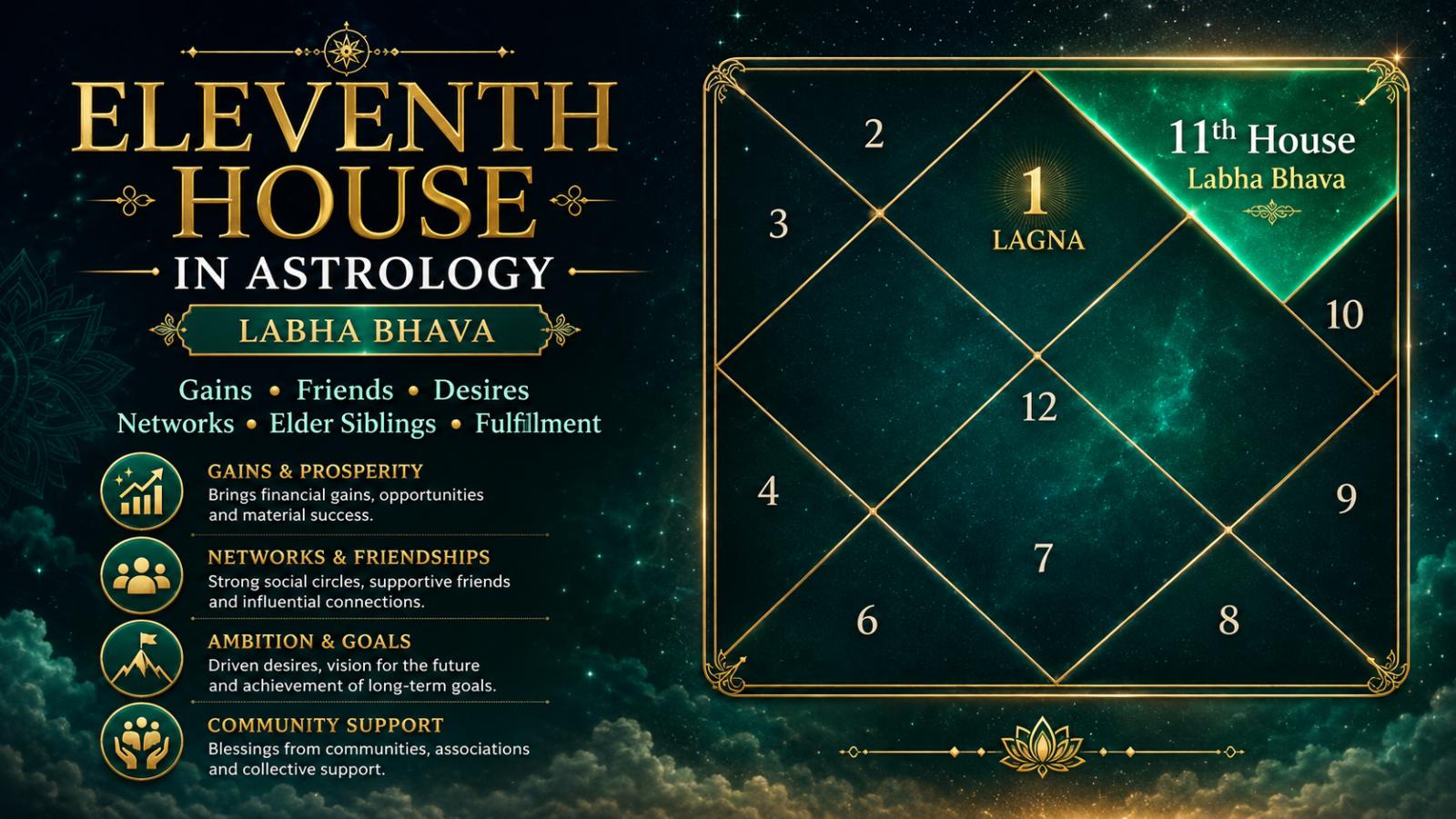
Eleventh House in Astrology: Gains, Friends, Desires and Navagrahas
The Eleventh House in astrology, known as Labha Bhava in Vedic astrology, represents gains, income, friends, elder siblings, social networks, ambitions and fulfillment of desires. Its meaning depends on the Rashi, Eleventh House lord and Navagrahas placed in the house. The Eleventh House in astrology is associated with gains, income, friends, elder siblings, social networks, ambitions, hopes and the fulfillment of desires. In Vedic astrology, it is often called Labha Bhava or Labha Sthana, the house of gains. While the Tenth House relates to career, karma and public responsibilities, the Eleventh House focuses on the rewards, support systems and networks that may develop from effort and social participation. Astrology is a traditional interpretive system whose claims have not been scientifically established. It should not replace professional financial, legal, medical or mental health advice. What Does the Eleventh House Represent? Common Eleventh House themes include: Gains and income Fulfillment of desires Friends and social circles Elder siblings Professional networks Community support Long-term hopes Groups and organizations Rewards from effort A strong Eleventh House does not automatically guarantee wealth, popularity or easy success. Its meaning depends on the Rashi occupying it, Navagrahas placed there, the Eleventh House lord, aspects and the complete birth chart. Gains, Friends and Social Networks The Eleventh House is traditionally studied for gains, profits, achievements and the fulfillment of personal desires. In Vedic astrology, it may also show friends, elder siblings, influential contacts, professional circles and support from groups or communities. It can indicate how a person connects with networks and how those connections may help in achieving long-term goals. Because this house is linked with income and gains, interpretations should be handled carefully. Astrology should not be used as financial advice or as a guarantee of profit. The Lord of the Eleventh House The Graha ruling the Rashi in the Eleventh House is called the Eleventh House lord or Labha Bhava lord. Its Rashi, house placement, strength, conjunctions and aspects may show how Eleventh House themes develop. For example, if Aquarius occupies the Eleventh House, Shani becomes its traditional lord, and Shani’s placement becomes important. Navagrahas in the Eleventh House Navagrahas placed in the Eleventh House may influence gains, friendships, elder siblings, ambitions, networks and social support. Surya (Sun): Gains through authority, leadership, government, status or influential connections Chandra (Moon): Popularity, changing social circles, emotional support and gains through public connection Mangala (Mars): Competitive networks, bold ambitions, active friends and gains through effort or courage Budha (Mercury): Business contacts, communication, trade, networking, media and intellectual gains Guru or Brihaspati (Jupiter): Supportive friends, wisdom, blessings, expansion of gains and ethical networks Shukra (Venus): Social charm, artistic circles, comforts, luxury gains and pleasant friendships Shani (Saturn): Slow but steady gains, disciplined networks, elder support and long-term achievements Rahu: Large networks, foreign contacts, unusual ambitions, sudden gains or desire for recognition Ketu: Detachment from social approval, spiritual friends, selective networks or inward ambitions These are broad traditional meanings. The final interpretation depends on the Graha’s Rashi, dignity, Nakshatra, conjunctions, aspects and the condition of the Eleventh House lord. Rahu and Ketu are lunar nodes rather than physical planets, but they are included among the Navagrahas in Vedic astrology. What Does an Empty Eleventh House Mean? An empty Eleventh House does not mean that a person will lack friends, gains, elder siblings, networks or fulfilled desires. Astrologers may interpret it through the Rashi occupying the house, the placement of the Eleventh House lord and aspects influencing the house. An empty house remains active through its ruler. Eleventh House Transits When a Graha moves through the Eleventh House, astrologers may connect the period with gains, social activity, friendships, elder siblings, professional networks or progress toward long-term goals. A Guru transit may be associated with support, expansion or opportunities, while a Shani transit may emphasize patience, responsibility and slow but steady gains. These interpretations are not guaranteed outcomes. Understanding the Eleventh House The Eleventh House helps astrologers study gains, income, friends, elder siblings, social networks, ambitions, community support and the fulfillment of desires. Its meaning depends on the Rashi occupying the house, Navagrahas placed inside it, the Eleventh House lord, aspects and the house system used. To understand how it connects with the complete birth chart, read our guide to the 12 houses in astrology.
Read More →
Vastu for Kitchen: Best Direction, Colors, Placement & Tips
The kitchen is one of the most important spaces in a home. In Vastu Shastra, it is closely associated with Agni, or the fire element, which represents energy, warmth and transformation. Because food is prepared here, the kitchen is traditionally believed to influence the overall atmosphere and balance of the household. A Vastu-friendly kitchen focuses on the right direction, proper placement of the stove and sink, suitable colors, organized storage and good ventilation. Even if your kitchen cannot follow every rule, small adjustments can help make the space more comfortable, clean and harmonious. Best Direction for Kitchen According to Vastu The south-east direction is considered the best location for a kitchen because it is associated with the fire element. If possible, the cooking stove should also be placed in the south-east section. The person cooking is traditionally advised to face east. If a south-east kitchen is not possible, the north-west direction is considered a suitable alternative. Vastu guidelines generally recommend avoiding kitchens in the north-east, south-west and exact center of the house. However, in apartments and already constructed homes, major changes may not always be practical. Stove, Sink and Water Placement The stove represents fire and should preferably be placed in the south-east corner. Avoid placing it directly opposite the kitchen entrance or immediately beside the sink. Water and fire are considered opposing elements in Vastu. The sink, water purifier and drinking water storage are therefore generally recommended in the north or north-east section. Where possible, maintain some counter space between the stove and sink. This not only follows traditional Vastu principles but also creates separate cooking and washing zones. Kitchen Storage, Refrigerator and Entrance Heavy storage cabinets are generally preferred on the south and west walls. These areas can be used for grains, utensils, cookware and large kitchen appliances. The north-east section should preferably remain lighter and less crowded. For refrigerator placement, the west or south-west direction is commonly recommended. Avoid placing heavy appliances in the north-east when possible. The kitchen entrance should remain clean, well-lit and free from clutter. Traditional Vastu also advises avoiding a kitchen door that directly faces a toilet or bathroom door. Best Kitchen Colors and Ventilation Light and warm colors are usually considered suitable for a Vastu-friendly kitchen. Popular options include light yellow, cream, peach, soft orange, beige, off-white and light green. Very dark shades, especially black and dark grey, are generally avoided because they can make the space appear heavy or smaller. Good ventilation is equally important. Windows on the eastern side are traditionally preferred because they allow morning sunlight into the kitchen. A chimney or exhaust fan should be installed where it can efficiently remove smoke, heat and cooking odors. Common Kitchen Vastu Mistakes to Avoid Avoid placing the stove and sink directly next to each other, overcrowding the north-east corner, blocking windows or keeping unnecessary clutter on countertops. Broken appliances, leaking taps and expired food should also be removed or repaired promptly. Keeping the kitchen clean and organized can improve both functionality and overall comfort. Kitchen flooring should be durable, easy to clean and slip-resistant. Ceramic tiles, vitrified tiles, marble, granite and natural stone are commonly used options. What If Your Kitchen Is Not Vastu-Compliant? Not every home can be redesigned according to traditional Vastu guidelines. In such cases, simple changes can still be useful. You can rearrange portable appliances, introduce lighter colors, improve ventilation, separate cooking and water zones, organize storage and remove clutter. Repairing damaged fixtures and keeping countertops clean can also make a noticeable difference.
Read More →
7 Mukhi Rudraksha: Benefits, Significance and How to Wear
The 7 Mukhi Rudraksha, also known as the Seven Faced Rudraksha, is a sacred bead with seven natural lines or mukhis running across its surface. In Vedic tradition, it is associated with the Anang form of Lord Shiva and is also believed to carry the blessings of the Saptamatrikas, Goddess Mahalakshmi and the seven ancient sages. The bead is traditionally linked with planet Saturn (Shani), which represents discipline, karma, patience, responsibility and life lessons. Because of this association, the 7 Mukhi Rudraksha is often recommended in spiritual practice for people who wish to reduce obstacles, improve stability and develop a more disciplined approach toward life. High-quality 7 Mukhi Rudraksha beads are commonly sourced from Nepal. Traditionally, the bead is believed to help the wearer recognise inner strengths, build confidence and move toward greater prosperity, progress and stability. According to Vedic astrology, planetary movements are believed to influence different areas of life depending on an individual's birth chart. At certain times, some planetary combinations may be considered challenging. Rudraksha beads are traditionally used as spiritual remedies to support balance, positivity and inner strength during such periods. Significance of 7 Mukhi Rudraksha The 7 Mukhi Rudraksha is strongly associated with wealth, prosperity, emotional balance and karmic healing. It is believed to help individuals overcome repeated setbacks, delays or feelings of stagnation despite continued effort. Traditional belief also connects this Rudraksha with the ability to release negative memories and move forward with greater emotional clarity. It is often worn by those seeking confidence, financial stability and relief from the mental burden of past experiences. The bead is also associated with the Manipura Chakra, or Solar Plexus Chakra, which is linked in yogic tradition with courage, confidence, willpower and self-esteem. Benefits of Wearing 7 Mukhi Rudraksha According to traditional Rudraksha and Vedic astrology beliefs, the 7 Mukhi Rudraksha may offer several spiritual and emotional benefits. Supports Saturn-related balance: It is traditionally worn to reduce the challenging effects associated with Saturn and periods such as Sade Sati. Encourages financial stability: The bead is commonly associated with prosperity, steady income and better financial discipline. Promotes confidence: It is believed to strengthen courage, self-esteem and the ability to face difficult situations. Supports career growth: Traditional belief connects it with new professional opportunities, progress and improved decision-making. Encourages positivity: It may help the wearer maintain hope, patience and a more constructive outlook. Promotes harmony: The bead is believed to support understanding, emotional balance and better relationships. Boosts creativity: It is traditionally associated with artistic ability, intuition and clearer self-expression. Helps overcome setbacks: It is often worn by people who feel that repeated obstacles are affecting personal or professional growth. Supports inner stability: Its connection with the Manipura Chakra is believed to encourage determination and emotional strength. Attracts prosperity: As it is associated with Goddess Mahalakshmi, the bead is traditionally considered auspicious for abundance and financial well-being. Some traditional texts and practices also associate the 7 Mukhi Rudraksha with physical well-being. However, such beliefs should not be considered a substitute for professional medical advice, diagnosis or treatment. Who Can Wear 7 Mukhi Rudraksha? The 7 Mukhi Rudraksha is commonly recommended for individuals who are experiencing delays, financial instability, career obstacles or challenges traditionally associated with Saturn. It may also be chosen by business owners, professionals, artists, students and people seeking greater confidence and emotional balance. Since Rudraksha recommendations may vary according to an individual's horoscope, some practitioners prefer consulting a knowledgeable astrologer before wearing the bead, particularly when it is being used as a specific astrological remedy. How to Wear 7 Mukhi Rudraksha Before wearing a 7 Mukhi Rudraksha, many traditional practitioners recommend cleansing and energising the bead through prayer or mantra chanting. Best Day to Wear Saturday: Traditionally preferred when the main purpose is to balance the influence of Saturn. Friday: Sometimes chosen when the focus is prosperity, abundance and the blessings of Goddess Mahalakshmi. Metal and Thread The 7 Mukhi Rudraksha can traditionally be worn in a silk or wool thread. It may also be capped in silver or gold, depending on personal preference and astrological guidance. The bead can be worn around the neck or kept as part of a Rudraksha mala. What to Do Before Wearing On the day of wearing the Rudraksha: Wake up early and take a bath. Wear clean clothes and sit in a peaceful place. Preferably face east while performing the prayer. Clean the Rudraksha gently and place it before your place of worship. Chant “Om Mahalaxmi Namah” or “Om Hum Namah” 108 times. Wear the Rudraksha with a calm and positive intention. Some traditions also recommend offering flowers, incense or clean water during the energising process. Tips for 7 Mukhi Rudraksha To maintain the bead properly, avoid exposing it frequently to harsh chemicals, perfumes or strong soaps. Clean it gently from time to time and allow it to dry naturally. If the bead becomes too dry, a small amount of natural oil may traditionally be applied to help preserve its surface. Store it in a clean and respectful place when it is not being worn.
Read More →









