

Gemini Weekly Horoscope (26 May 2025 to 01 Jun 2025)




At work, your natural charisma will shine, helping you take on leadership roles and win appreciation. In your love life, long-term plans may be discussed with your partner, while singles might feel drawn to someone ambitious or older. Although intimacy levels may be average, your physical and mental well-being will be above average, making it a fulfilling week overall.
Remedy: Start feeding green grass to cows daily in the morning.
Tags
#GeminiHoroscope #WeeklyHoroscope #GeminiZodiac #EmotionalIntelligence #FamilyHarmony #WorkplaceCharisma #LeadershipWeek #ZodiacPredictions #GeminiLoveLife #SelfGrowth #MentalWellbeing #GeminiEnergy #FeedCowsRemedy #GeminiRelationships #Astrology2025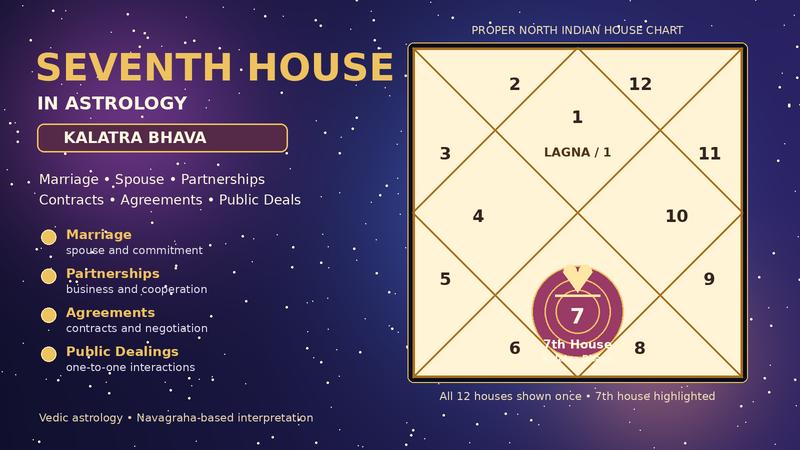
Seventh House in Astrology: Marriage and Navagrahas
The Seventh House in astrology, often called Kalatra Bhava in Vedic astrology, represents marriage, spouse, committed partnerships, business agreements, contracts and public dealings. This house shows how relationships develop through the Rashi, Seventh House lord and Navagrahas placed within it. The Seventh House in astrology is associated with marriage, spouse, committed relationships, business partnerships, contracts, agreements and public dealings. In Vedic astrology, it is often called Kalatra Bhava or Jaya Bhava. While the Sixth House relates to work, debts, disputes and service, the Seventh House focuses on one-to-one relationships, cooperation and formal partnerships. Astrology is a traditional interpretive system whose claims have not been scientifically established. It should not replace professional medical, legal, financial or mental health advice. What Does the Seventh House Represent? Common Seventh House themes include: Marriage and spouse Committed relationships Business partnerships Contracts and agreements Public dealings Cooperation and negotiation Relationship expectations Open opponents Long-term commitments A strong Seventh House does not automatically guarantee marriage, harmony or partnership success. Its meaning depends on the Rashi occupying it, Navagrahas placed there, the Seventh House lord, aspects and the complete birth chart. Marriage, Partnerships and Agreements The Seventh House is one of the main houses studied for marriage and committed relationships. It may show the type of partnership a person seeks, how they cooperate with others and what patterns may appear in close relationships. In Vedic astrology, this house is also considered for spouse-related matters, business partnerships, legal agreements and public interaction. Because relationships depend on real choices, communication and circumstances, astrology should not be used to make final decisions about marriage, divorce, business or legal matters. The Lord of the Seventh House The Graha ruling the Rashi in the Seventh House is called the Seventh House lord or Kalatra Bhava lord. Its Rashi, house placement, strength, conjunctions and aspects may show how Seventh House themes develop. For example, if Libra occupies the Seventh House, Shukra becomes its lord, and Shukra’s placement becomes important. Navagrahas in the Seventh House Navagrahas placed in the Seventh House may influence marriage, spouse, partnerships, agreements and public dealings. Surya (Sun): Strong-willed spouse, leadership in partnerships, pride, status or ego issues in relationships Chandra (Moon): Emotional bonding, sensitivity, changing relationship needs and nurturing partnerships Mangala (Mars): Passion, attraction, courage, conflict, directness or competitiveness in relationships Budha (Mercury): Communication, negotiation, business partnerships and intellectual connection Guru or Brihaspati (Jupiter): Wisdom, guidance, ethics, support and growth through relationships Shukra (Venus): Love, attraction, harmony, romance, pleasure and relationship refinement Shani (Saturn): Commitment, responsibility, delay, seriousness or long-term partnership duties Rahu: Unconventional relationships, strong attraction, foreign connections or intense partnership desires Ketu: Detachment, spiritual connection, distance or inward reflection in relationships These are broad traditional meanings. The final interpretation depends on the Graha’s Rashi, dignity, Nakshatra, conjunctions, aspects and the condition of the Seventh House lord. Rahu and Ketu are lunar nodes rather than physical planets, but they are included among the Navagrahas in Vedic astrology. What Does an Empty Seventh House Mean? An empty Seventh House does not mean that a person will never marry or form a committed relationship. Astrologers may interpret it through the Rashi occupying the house, the placement of the Seventh House lord and aspects influencing the house. An empty house remains active through its ruler. Seventh House Transits When a Graha moves through the Seventh House, astrologers may connect the period with relationships, marriage discussions, business partnerships, agreements or public interaction. A Guru transit may be associated with growth, guidance or support in relationships, while a Shani transit may emphasize responsibility, patience or commitment. These interpretations are not guaranteed outcomes. Understanding the Seventh House The Seventh House helps astrologers study marriage, spouse, partnerships, contracts, agreements, negotiation and public dealings. Its meaning depends on the Rashi occupying the house, Navagrahas placed inside it, the Seventh House lord, aspects and the house system used. To understand how it connects with the complete birth chart, read our guide to the 12 houses in astrology.
Read More →
Sun Transit in Cancer 2026: Date, Effects and Remedies
Sun Transit in Cancer 2026 begins on July 16 at 11:44 PM IST, equal to 1:14 PM CDT or 12:14 PM fixed CST. The transit continues until August 16 and may highlight emotions, family, security and personal priorities, along with traditional Sun remedies. Sun Transit in Cancer 2026: Date, Effects and Remedies The Sun Transit in Cancer 2026 begins on July 16 and starts a month-long astrological phase linked with emotions, family, security and personal priorities. The Sun remains in Cancer until August 16, 2026, before moving into Leo. In astrology, the Sun represents confidence, authority, leadership and recognition, while Cancer is associated with home, care and emotional stability. The combination of these energies may encourage people to focus more closely on their personal lives, family responsibilities and emotional needs. Sun Transit in Cancer 2026 Date and Time Transit Date: 16 July 2026 (Thursday) Time in India (IST): 11:44 PM Time in US (Central Time – CT): 16 July 2026, 1:14 PM CDT The transit continues until August 16, 2026, creating a month-long period that may bring greater attention to family matters, personal security and emotional decision-making. What Does the Sun in Cancer Mean in Astrology? The Sun is traditionally connected with confidence, leadership, reputation and recognition. Cancer is linked with emotions, family bonds, care and security. When the Sun moves through Cancer, people may become more protective of loved ones and more sensitive to personal matters. Decisions can feel more emotional during this period, so balancing feelings with practical judgment may be helpful. The transit may also encourage people to think more deeply about what makes them feel secure, supported and emotionally comfortable. Common Effects of Sun Transit in Cancer Family and home matters may demand more attention during this transit. People may want to improve their living space, spend more time with loved ones or address unresolved emotional concerns. Career choices may also be influenced by the desire for greater stability. Instead of seeking only quick recognition, some people may become more interested in long-term security and dependable progress. Communication may become more personal or emotionally charged. Taking a moment before reacting can help prevent unnecessary misunderstandings. Financially, this period may encourage people to review family budgets, property plans, household expenses or spending connected with comfort and lifestyle. The Sun Transit in Cancer can also highlight the need to balance ambition with emotional well-being. Leadership may become more caring and protective, but excessive sensitivity or mood-based decisions may create difficulties. General Remedies for Sun Transit in Cancer Traditional astrology suggests several simple spiritual practices associated with the Sun. Offering clean water to the rising Sun in the morning is one of the most commonly followed Surya remedies. People may also chant the Surya Beej Mantra or recite the Aditya Hridaya Stotra according to their personal beliefs and spiritual traditions. Sunday prayers, charitable acts and donations of wheat or jaggery are also traditionally associated with strengthening positive Sun qualities. Respecting parents, mentors and elders is another traditional practice connected with Sun energy. From a practical perspective, this period can also be used to build confidence, communicate calmly and avoid making important decisions based only on temporary emotions. The Sun Transit in Cancer 2026 may place greater focus on emotional security, family relationships and personal priorities. The exact influence can vary according to the Moon sign, ascendant and other planetary placements in an individual birth chart.
Read More →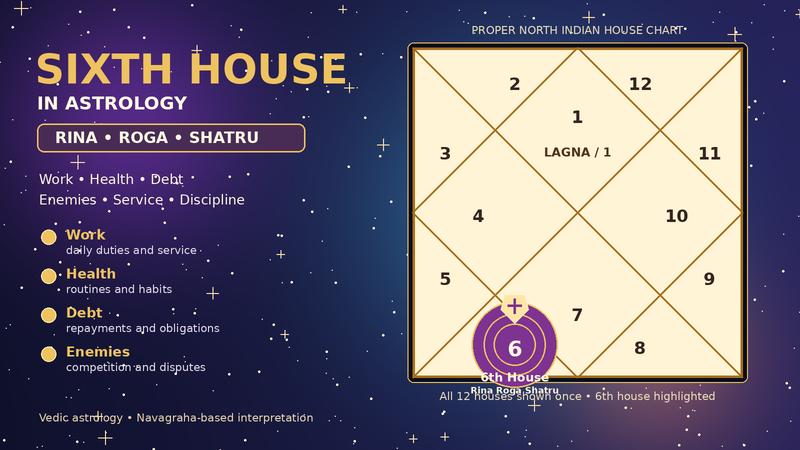
Sixth House in Astrology: Health, Debt and Navagrahas
The Sixth House in astrology, known in Vedic astrology as Rina Roga Shatru Bhava, represents daily work, health routines, debts, enemies, disputes, service and discipline. This house shows how a person handles responsibilities, challenges and practical problem-solving through Navagraha placements. The Sixth House in astrology is associated with daily work, service, health routines, debts, enemies, competition, discipline and problem-solving. In Vedic astrology, it is often connected with Rina, Roga and Shatru Bhava, meaning debts, illness and opponents. While the Fifth House relates to creativity, children and intelligence, the Sixth House focuses on duties, effort, practical responsibilities and the challenges a person must manage in everyday life. Astrology is a traditional interpretive system whose claims have not been scientifically established. It should not replace professional medical, legal, financial or mental health advice. What Does the Sixth House Represent? Common Sixth House themes include: Daily work and service Health routines and habits Debts and repayments Enemies and competitors Litigation and disputes Discipline and effort Coworkers and workplace duties Pets and small animals Problem-solving and resilience A strong Sixth House does not automatically mean illness, conflict or debt. Its meaning depends on the Rashi occupying it, Navagrahas placed there, the Sixth House lord, aspects and the complete birth chart. Work, Health, Debts and Enemies The Sixth House may show how a person handles routine duties, workplace responsibilities and service to others. In Vedic astrology, it is also studied for health challenges, debts, enemies, legal disputes and competition. It can indicate the ability to overcome obstacles through discipline, effort and persistence. Because this house relates to health, debt and disputes, interpretations should be handled carefully. Astrology should not be used for diagnosis, treatment, financial decisions or legal strategy. The Lord of the Sixth House The Graha ruling the Rashi in the Sixth House is called the Sixth House lord. Its Rashi, house placement, strength, conjunctions and aspects may show how Sixth House themes develop. For example, if Virgo occupies the Sixth House, Budha becomes its lord, and Budha’s placement becomes important. Navagrahas in the Sixth House Navagrahas placed in the Sixth House may influence work habits, health routines, debts, conflicts, service and competition. Surya (Sun): Authority in work, leadership in service, strong will and pride in overcoming rivals Chandra (Moon): Emotional sensitivity to routines, changing work patterns and concern for health habits Mangala (Mars): Courage, competitiveness, fighting spirit, conflict-handling and physical effort Budha (Mercury): Analytical work, problem-solving, communication, accounting and practical skills Guru or Brihaspati (Jupiter): Guidance, ethics in service, healing support and wisdom in handling disputes Shukra (Venus): Harmony at work, service through art, comfort-seeking habits and refined routines Shani (Saturn): Discipline, responsibility, patience, delayed results and steady effort in work Rahu: Strong ambition, unusual work patterns, competitive drive and complex disputes Ketu: Detachment from routine, spiritual service, hidden worries or inward problem-solving These are broad traditional meanings. The final interpretation depends on the Graha’s Rashi, dignity, Nakshatra, conjunctions, aspects and the condition of the Sixth House lord. Rahu and Ketu are lunar nodes rather than physical planets, but they are included among the Navagrahas in Vedic astrology. What Does an Empty Sixth House Mean? An empty Sixth House does not mean that a person will avoid work, illness, debt or conflict. Astrologers may interpret it through the Rashi occupying the house, the placement of the Sixth House lord and aspects influencing the house. An empty house remains active through its ruler. Sixth House Transits When a Graha moves through the Sixth House, astrologers may connect the period with work pressure, health routines, debts, disputes, competition or service responsibilities. A Guru transit may be associated with guidance or problem-solving, while a Shani transit may emphasize discipline, patience and long-term responsibility. These interpretations are not guaranteed outcomes. Understanding the Sixth House The Sixth House helps astrologers study daily work, service, health routines, debts, enemies, disputes, discipline and the ability to overcome difficulties. Its meaning depends on the Rashi occupying the house, Navagrahas placed inside it, the Sixth House lord, aspects and the house system used. To understand how it connects with the complete birth chart, read our guide to the 12 houses in astrology.
Read More →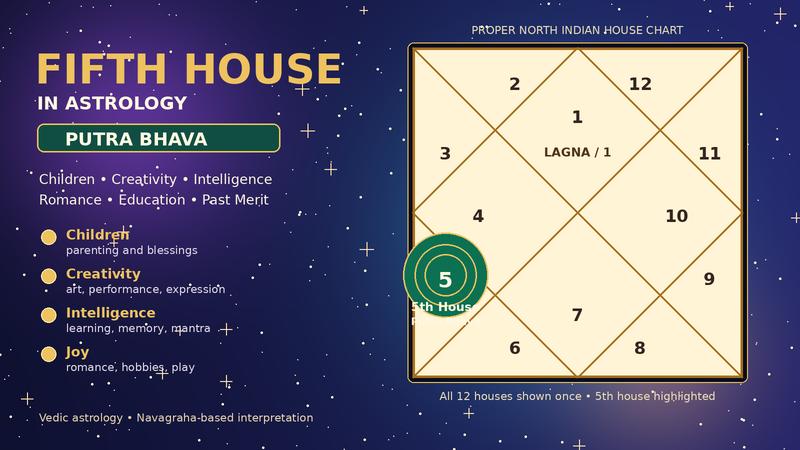
Fifth House in Astrology: Children, Creativity and Navagrahas
The Fifth House in astrology is associated with children, creativity, intelligence, romance, education, self-expression and past merit. In Vedic astrology, it is often called Putra Bhava. While the Fourth House relates to home, mother and emotional security, the Fifth House focuses on creative expression, learning, joy, affection and the ability to produce something meaningful. Astrology is a traditional interpretive system whose claims have not been scientifically established. It should not replace professional medical, legal, financial or mental health advice. What Does the Fifth House Represent? Common Fifth House themes include: Children and parenting Creativity and self-expression Intelligence and learning Romance and affection Education and memory Hobbies and entertainment Mantra, devotion and spiritual merit Speculation and calculated risks Joy, play and performance A strong Fifth House does not automatically guarantee children, fame or creative success. Its meaning depends on the Rashi occupying it, Navagrahas placed there, the Fifth House lord, aspects and the complete birth chart. Children, Creativity and Intelligence The Fifth House is traditionally studied for children, blessings connected with offspring and the emotional bond between parent and child. It is also connected with creativity, imagination, learning ability and the way a person expresses joy. In Vedic astrology, the Fifth House may also be examined for mantra practice, devotion, memory, education and purva punya, or past-life merit. Because it is linked with speculation, it may be considered in matters involving risk-taking. Astrological interpretation should never be used as financial advice. The Lord of the Fifth House The Graha ruling the Rashi in the Fifth House is called the Fifth House lord or Putra Bhava lord. Its Rashi, house placement, strength, conjunctions and aspects may show how Fifth House themes develop. For example, if Leo occupies the Fifth House, Surya becomes its lord, and Surya’s placement becomes important. Navagrahas in the Fifth House Navagrahas placed in the Fifth House may influence children, creativity, intelligence, romance, education and spiritual merit. Surya (Sun): Confidence, leadership, pride in children, creativity and desire for recognition Chandra (Moon): Emotional creativity, affection, imagination, nurturing nature and love for children Mangala (Mars): Competitive spirit, passion, bold creativity, sports, risk-taking or impulsive romance Budha (Mercury): Intelligence, writing, learning, humor, communication and analytical creativity Guru or Brihaspati (Jupiter): Wisdom, education, children, guidance, devotion and moral understanding Shukra (Venus): Romance, beauty, art, pleasure, performance and refined creative expression Shani (Saturn): Serious learning, delayed joy, responsibility toward children or disciplined creativity Rahu: Unusual creativity, intense desire for recognition, unconventional romance or speculative ambition Ketu: Spiritual intelligence, detachment from praise, mantra interest or inward creative expression These are broad traditional meanings. The final interpretation depends on the Graha’s Rashi, dignity, Nakshatra, conjunctions, aspects and the condition of the Fifth House lord. Rahu and Ketu are lunar nodes rather than physical planets, but they are included among the Navagrahas in Vedic astrology. What Does an Empty Fifth House Mean? An empty Fifth House does not mean that a person will lack children, intelligence, romance or creativity. Astrologers may interpret it through the Rashi occupying the house, the placement of the Fifth House lord and aspects influencing the house. An empty house remains active through its ruler. Fifth House Transits When a Graha moves through the Fifth House, astrologers may connect the period with children, education, creativity, romance, hobbies, spiritual practice or speculative decisions. A Guru transit may be associated with learning, guidance or blessings, while a Shani transit may emphasize discipline, responsibility or delay. These interpretations are not guaranteed outcomes. Understanding the Fifth House The Fifth House helps astrologers study children, creativity, intelligence, romance, education, joy, mantra practice and past merit. Its meaning depends on the Rashi occupying the house, Navagrahas placed inside it, the Fifth House lord, aspects and the house system used. To understand how it connects with the complete birth chart, read our guide to the 12 houses in astrology.
Read More →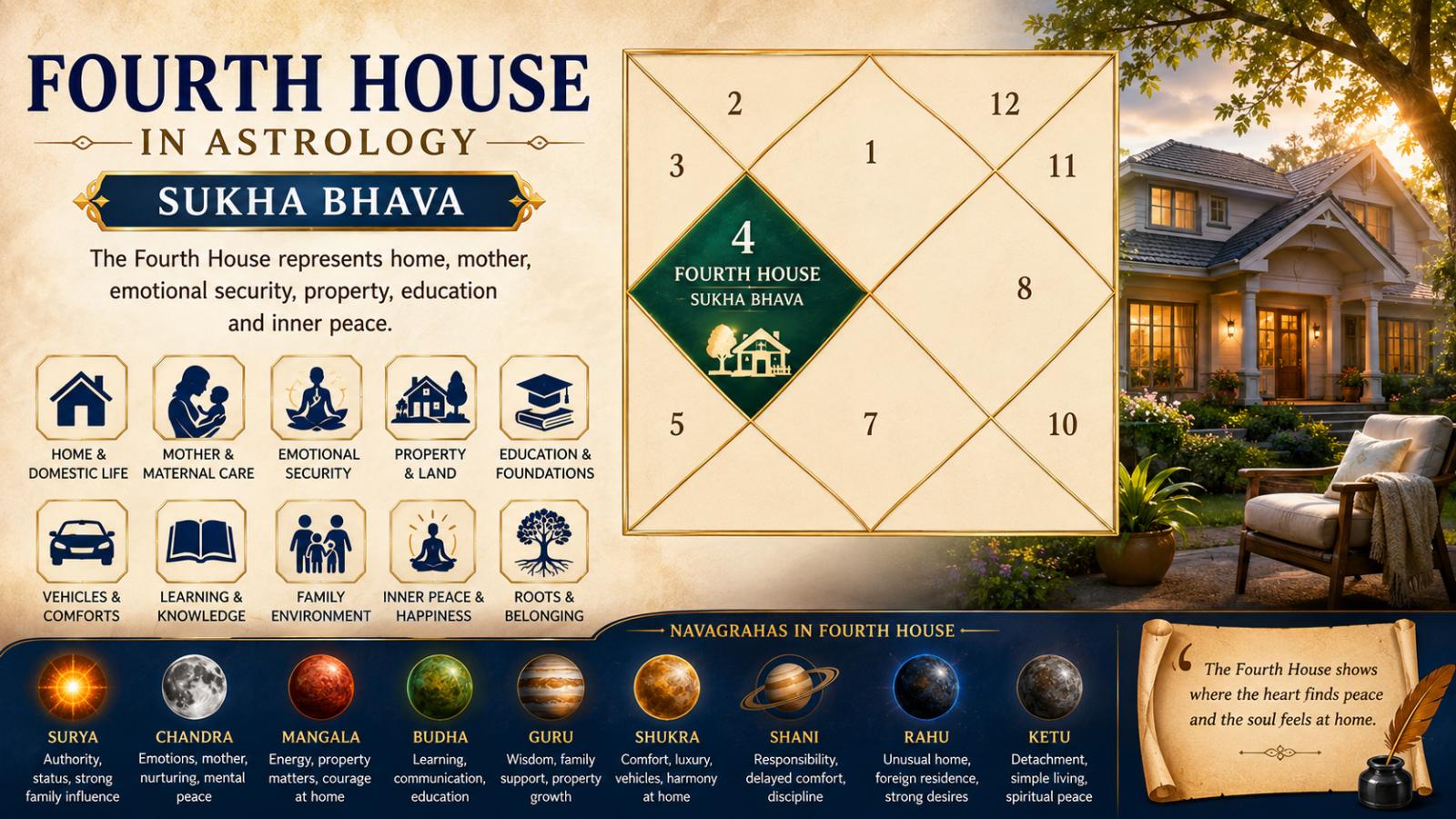
Fourth House in Astrology: Home, Mother and Navagrahas
The Fourth House in astrology is associated with home, mother, emotional security, property, vehicles, education and inner peace. In Vedic astrology, it is often called Sukha Bhava, the house of comfort and happiness. While the Third House relates to effort, communication and siblings, the Fourth House focuses on private life, emotional foundations and the sense of belonging. Astrology is a traditional interpretive system whose claims have not been scientifically established. It should not replace professional medical, legal, financial or mental health advice. What Does the Fourth House Represent? Common Fourth House themes include: Home and domestic life Mother or maternal influence Emotional security Property and land Vehicles and comforts Education and learning foundations Family environment Inner peace and happiness Private life and roots A strong Fourth House does not automatically guarantee comfort, property or family harmony. Its meaning depends on the Rashi occupying it, Navagrahas placed there, the Fourth House lord, aspects and the complete birth chart. Home, Mother and Emotional Security The Fourth House may show how a person experiences home, family roots and emotional stability. In Vedic astrology, it is closely connected with the mother or maternal influence. It may also be studied for domestic happiness, property matters, vehicles and the private emotional world. Because this house relates to comfort and peace, astrologers may examine it to understand what gives a person a sense of safety and belonging. Astrological interpretations should not be used as legal, financial or family advice. The Lord of the Fourth House The Graha ruling the Rashi in the Fourth House is called the Fourth House lord or Sukha Bhava lord. Its Rashi, house placement, strength, conjunctions and aspects may show how Fourth House themes develop. For example, if Cancer occupies the Fourth House, Chandra becomes its lord, and Chandra’s placement becomes important. Navagrahas in the Fourth House Navagrahas placed in the Fourth House may influence home life, emotional security, property, education and inner happiness. Surya (Sun): Pride in family, authority at home, status through property or strong parental influence Chandra (Moon): Emotional attachment to home, nurturing nature, sensitivity and connection with mother Mangala (Mars): Energy in property matters, courage at home, land-related activity or domestic tension Budha (Mercury): Learning, communication at home, education, planning and intellectual family environment Guru or Brihaspati (Jupiter): Wisdom, family support, education, peace, property growth and moral values Shukra (Venus): Comfort, beauty, vehicles, luxury, harmony and artistic domestic surroundings Shani (Saturn): Responsibility at home, delayed comfort, discipline, property duties or emotional restraint Rahu: Unusual home life, strong desire for property, foreign residence or unconventional comforts Ketu: Detachment from home comforts, spiritual reflection, inner withdrawal or simple living These are broad traditional meanings. The final interpretation depends on the Graha’s Rashi, dignity, Nakshatra, conjunctions, aspects and the condition of the Fourth House lord. Rahu and Ketu are lunar nodes rather than physical planets, but they are included among the Navagrahas in Vedic astrology. What Does an Empty Fourth House Mean? An empty Fourth House does not mean that a person will lack a home, family support, education or emotional stability. Astrologers may interpret it through the Rashi occupying the house, the placement of the Fourth House lord and aspects influencing the house. An empty house remains active through its ruler. Fourth House Transits When a Graha moves through the Fourth House, astrologers may connect the period with home, family, property, vehicles, education or emotional reflection. A Guru transit may be associated with support, learning or growth, while a Shani transit may emphasize responsibility, discipline or duties connected with home and family. These interpretations are not guaranteed outcomes. Understanding the Fourth House The Fourth House helps astrologers study home, mother, emotional security, property, vehicles, education and inner comfort. Its meaning depends on the Rashi occupying the house, Navagrahas placed inside it, the Fourth House lord, aspects and the house system used. To understand how it connects with the complete birth chart, read our guide to the 12 houses in astrology.
Read More →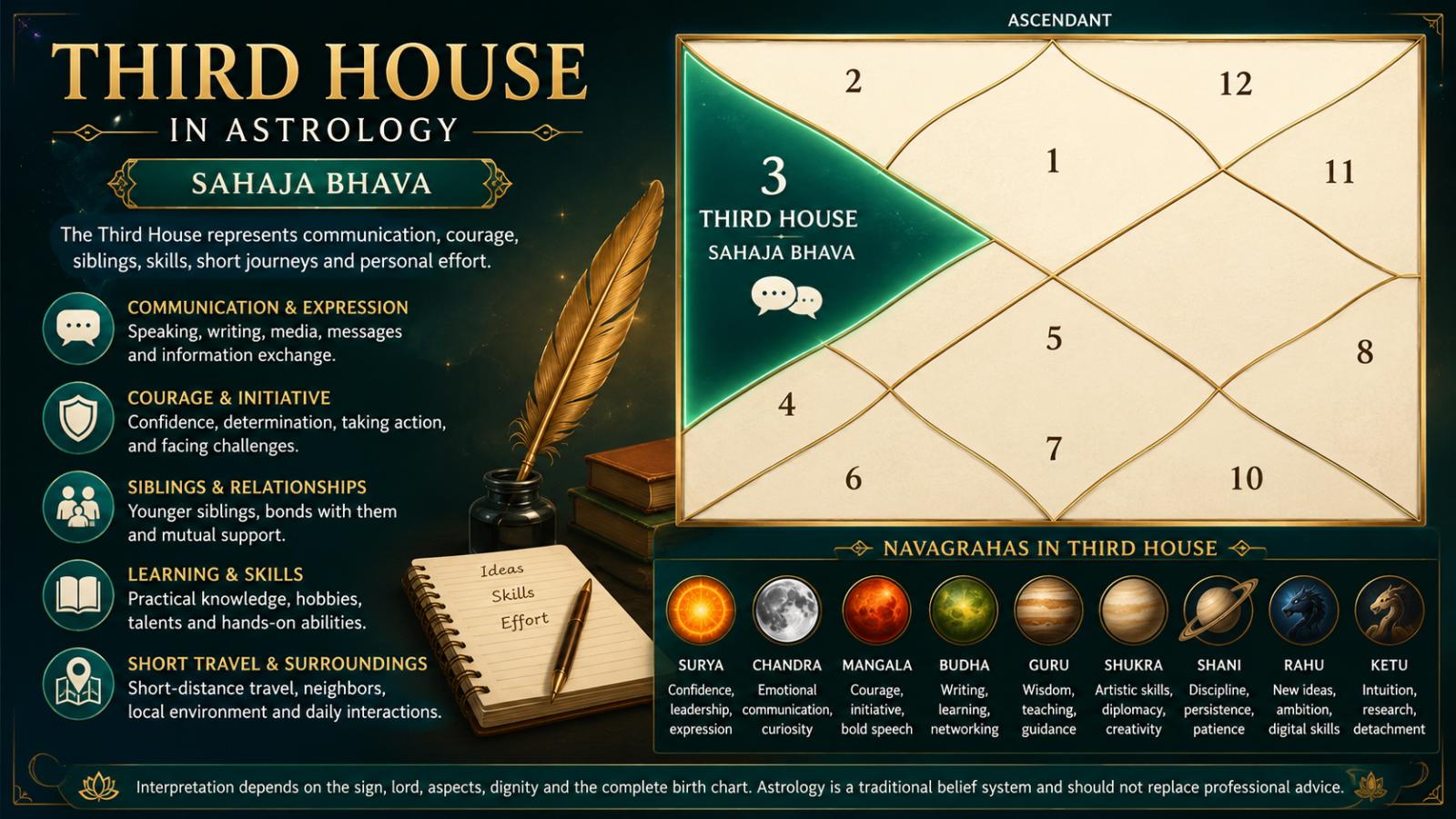
Third House in Astrology: Communication and Navagrahas
The Third House in astrology is associated with communication, courage, siblings, skills, short journeys and personal effort. In Vedic astrology, it is often called Sahaja Bhava. While the Second House relates to speech and family values, the Third House focuses more on how a person expresses ideas, develops abilities and takes initiative in everyday life. Astrology is a traditional interpretive system whose claims have not been scientifically established. It should not replace professional medical, legal, financial or mental health advice. What Does the Third House Represent? Common Third House themes include: Communication and writing Courage and initiative Younger siblings Practical learning Skills and hobbies Short-distance travel Neighbors and local surroundings Hands, arms and physical effort Media and information exchange A strong Third House does not automatically guarantee confidence or communication ability. Its meaning depends on the Rashi occupying it, Navagrahas placed there, the Third House lord, aspects and the complete birth chart. Communication, Courage and Siblings The Third House may describe how a person shares information, responds to challenges and develops skills through effort. In Vedic astrology, it is also connected with younger siblings and the relationship a person may have with them. Writing, speaking, publishing and everyday communication may be studied through this house. Because it is linked with courage and self-effort, astrologers may also examine it for initiative and persistence. The Lord of the Third House The Graha ruling the Rashi in the Third House is called the Third House lord or Sahaja Bhava lord. Its Rashi, house placement, strength, conjunctions and aspects may show how Third House themes develop. For example, if Gemini occupies the Third House, Budha becomes its lord, and Budha’s placement becomes important. Navagrahas in the Third House Navagrahas placed in the Third House may influence communication, courage, skills, siblings and personal effort. Surya (Sun): Confident expression, leadership, courage and a strong need to be heard Chandra (Moon): Emotional communication, adaptability, curiosity and changing interests Mangala (Mars): Bold speech, initiative, competitiveness, courage and possible sibling conflict Budha (Mercury): Writing, learning, business ability, networking and quick communication Guru or Brihaspati (Jupiter): Wisdom, teaching, ethical expression and support through knowledge Shukra (Venus): Artistic talent, diplomacy, pleasant communication and creative interests Shani (Saturn): Disciplined effort, cautious speech, persistence and delayed results Rahu: Unconventional ideas, digital communication, ambition and persuasive expression Ketu: Introspection, independent thinking, research and detachment from recognition These are broad traditional meanings. The final interpretation depends on the Graha’s Rashi, dignity, Nakshatra, conjunctions, aspects and the condition of the Third House lord. Rahu and Ketu are lunar nodes rather than physical planets, but they are included among the Navagrahas in Vedic astrology. What Does an Empty Third House Mean? An empty Third House does not mean that a person lacks communication skills, courage or siblings. Astrologers may interpret it through the Rashi occupying the house, the placement of the Third House lord and aspects influencing the house. An empty house remains active through its ruler. Third House Transits When a Graha moves through the Third House, astrologers may connect the period with communication, learning, travel, siblings, new skills or personal effort. A Guru transit may be associated with learning and growth, while a Shani transit may emphasize patience, discipline and sustained effort. These interpretations are not guaranteed outcomes. Understanding the Third House The Third House helps astrologers study communication, courage, siblings, practical skills, local travel and personal initiative. Its meaning depends on the Rashi occupying the house, Navagrahas placed inside it, the Third House lord, aspects and the house system used. To understand how it connects with the complete birth chart, read our guide to the 12 houses in astrology.
Read More →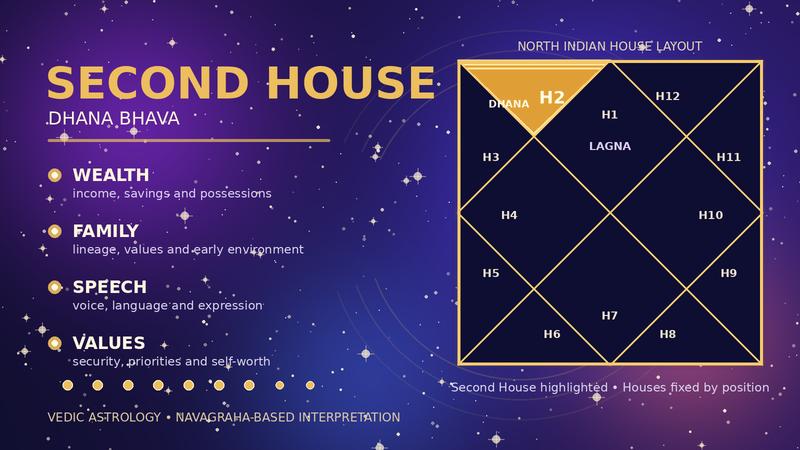
Second House in Astrology: Wealth, Speech and Navagrahas
The Second House in astrology is traditionally associated with wealth, family, speech, food, possessions and personal values. In Vedic astrology, it is often called Dhana Bhava, the house of accumulated resources. While the First House describes identity, the Second House shows how a person may build security, manage resources and express values through speech, family life and material choices. Astrology is a traditional interpretive system whose claims have not been scientifically established. It should not replace professional financial, medical, legal or mental health advice. What Does the Second House Represent? Common Second House themes include: Income and accumulated wealth Savings and possessions Family background Speech and communication style Food and eating habits Personal values Self-worth and security Face, mouth and voice A strong Second House does not automatically guarantee wealth. Its meaning depends on the Rashi occupying it, Grahas placed there, the Second House lord, aspects and the complete birth chart. Wealth, Family and Speech The Second House is mainly linked with resources already earned or accumulated. It may describe saving habits, financial priorities and the way a person seeks material stability. In Vedic astrology, it is also connected with family, especially the early family environment and inherited values. Because it is associated with the mouth and voice, astrologers may examine it for speech, tone and language. Food preferences and eating patterns may also be considered symbolically. Astrological placements should not be used as financial advice or to diagnose health conditions. The Lord of the Second House The Graha ruling the Rashi in the Second House is called the Second House lord or Dhana Bhava lord. Its Rashi, house placement, strength, conjunctions and aspects may show how Second House themes develop. For example, if Taurus occupies the Second House, Shukra becomes its lord, and Shukra’s placement becomes important. Navagrahas in the Second House Grahas placed in the Second House may influence money, speech, values and family matters. Surya (Sun): Pride in family, authoritative speech, status and strong values Chandra (Moon): Emotional attachment to family, changing finances and sensitive speech Mangala (Mars): Direct speech, strong earning drive, risk-taking or family conflict Budha (Mercury): Communication, calculation, business ability and income through intellectual skills Guru or Brihaspati (Jupiter): Wisdom, generous speech, education and expansion of resources Shukra (Venus): Comfort, refined speech, beauty, art and material enjoyment Shani (Saturn): Disciplined saving, cautious speech, delay or family responsibility Rahu: Strong ambition for wealth, unusual income patterns or persuasive speech Ketu: Detachment from possessions, inward values or unconventional expression These are broad traditional meanings. The final interpretation depends on the Graha’s Rashi, dignity, Nakshatra, conjunctions, aspects and the condition of the Second House lord. Rahu and Ketu are lunar nodes rather than physical planets, but they are included among the Navagrahas in Vedic astrology. What Does an Empty Second House Mean? An empty Second House does not mean that a person will lack money, family support or communication skills. Astrologers may interpret it through the Rashi occupying the house, the placement of the Second House lord and aspects influencing the house. An empty house remains active through its ruler. Second House Transits When a Graha moves through the Second House, astrologers may connect the period with finances, savings, family responsibilities, speech or changing personal values. A Guru transit may be associated with growth or learning, while a Shani transit may emphasize discipline, budgeting or long-term responsibility. These interpretations are not guaranteed outcomes. Understanding the Second House The Second House helps astrologers study wealth, savings, possessions, family, speech, food and personal values. Its meaning depends on the Rashi occupying the house, Navagrahas placed inside it, the Second House lord, aspects and the house system used. To understand how it connects with the complete birth chart, read our guide to the 12 houses in astrology.
Read More →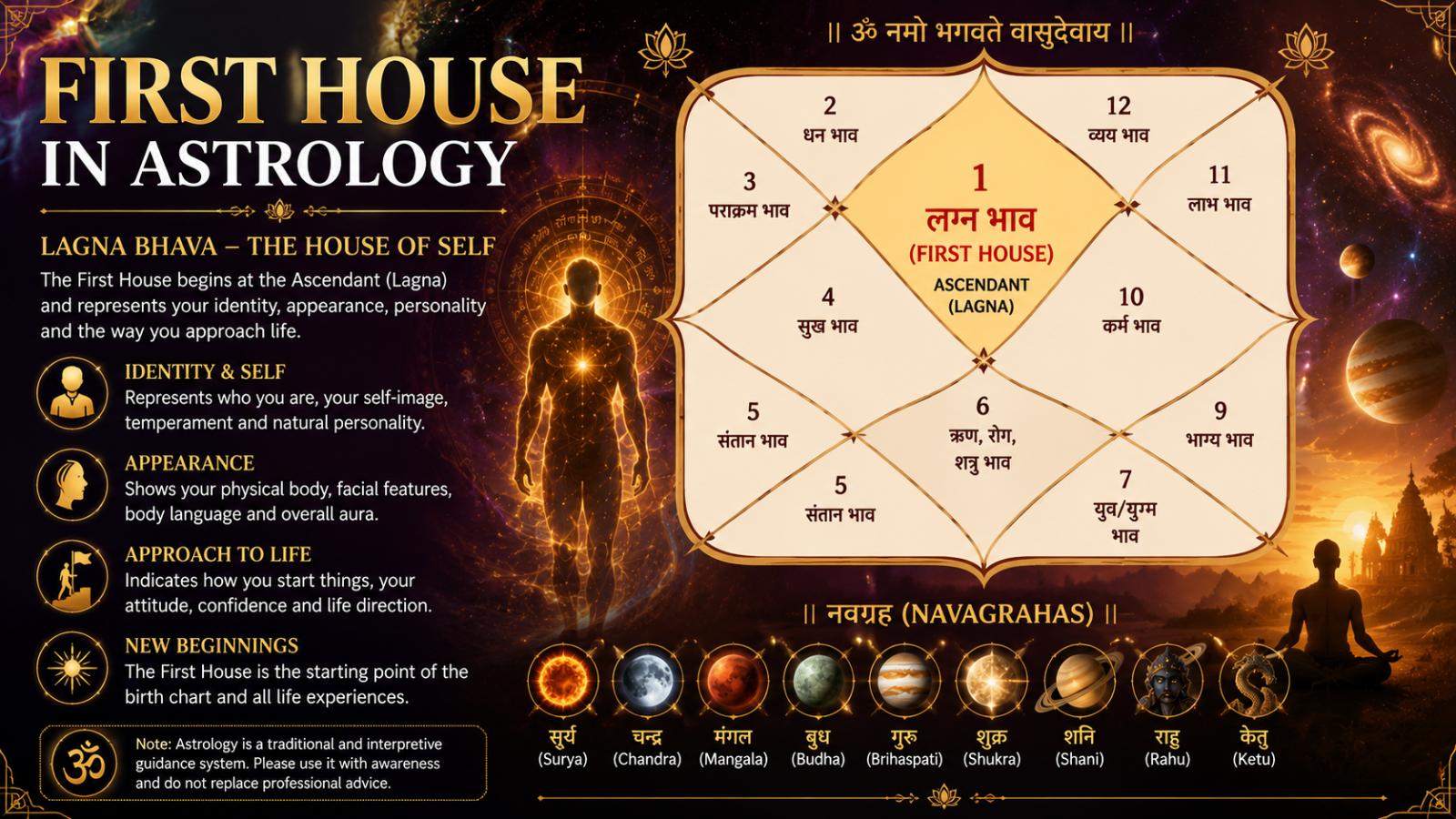
First House in Astrology: Meaning, Planets and Ascendant
The First House in astrology represents identity, appearance, temperament and the way a person approaches life. It begins at the Ascendant, also called the rising sign. While the Sun sign is linked with core identity and the Moon sign with emotional needs, the First House is traditionally associated with outward behavior, first impressions and instinctive reactions. Astrology is a traditional interpretive system whose claims have not been scientifically established. It should not replace medical, legal, financial or mental health advice. What Does the First House Represent? Often called the house of self, the First House may show how a person presents themselves, responds to new situations and begins personal experiences. Common themes include: Identity and self-image Physical appearance Temperament Personal style First impressions Initiative Approach to life A strong First House does not automatically mean someone is confident or self-centered. Its meaning depends on the rising sign, Navagrahas placed there, aspects and the chart ruler. The First House and the Ascendant The Ascendant is the zodiac sign rising on the eastern horizon at the recorded time and place of birth. It marks the beginning of the First House. Because the Ascendant changes throughout the day, an accurate birth time is important. A change in time may alter the rising sign or move a Graha near a house cusp. The Ascendant is traditionally linked with appearance, mannerisms, first impressions and the way a person enters new situations. The Ruler of the First House The planet ruling the Ascendant sign is called the chart ruler or Lagna lord. Its sign, house placement and aspects may provide more information about how the First House is expressed. If Aries is rising, Mars becomes the chart ruler. If Taurus is rising, Venus becomes the chart ruler. The ruler’s placement may connect identity with another area of life. Navagrahas in the First House The Navagrahas placed in the First House are often considered noticeable in personality, appearance and behavior. Surya (Sun): Identity, confidence, authority and self-expression Chandra (Moon): Emotions, sensitivity, adaptability and instinctive reactions Mangala (Mars): Initiative, courage, directness and competitiveness Budha (Mercury): Communication, curiosity, intelligence and mental activity Guru or Brihaspati (Jupiter): Wisdom, optimism, generosity and an expansive presence Shukra (Venus): Charm, sociability, attraction and aesthetic awareness Shani (Saturn): Seriousness, patience, restraint, responsibility and discipline Rahu: Ambition, individuality, desire for recognition and an unconventional identity Ketu: Detachment, introspection, spiritual inclination and inward self-exploration These are only broad starting points. The Graha’s Rashi, dignity, conjunctions, aspects, Nakshatra and overall condition must also be considered. Rahu and Ketu are lunar nodes rather than physical planets, but they are included among the Navagrahas because of their importance in Vedic astrology. Zodiac Signs on the First House Cusp The rising sign influences the style through which the First House may be expressed. Fire signs may appear direct and enthusiastic. Earth signs may seem practical and steady. Air signs may appear communicative and socially responsive, while water signs may seem sensitive or intuitive. These are broad tendencies, not fixed personality descriptions. What Does an Empty First House Mean? An empty First House does not mean that a person lacks identity, confidence or presence. Astrologers may interpret it through the Ascendant sign, Lagna lord and aspects involving that ruler. An empty house remains active through its sign and ruling planet. First House Transits When a Graha moves through the First House, astrologers may connect the period with identity, appearance, personal direction or new beginnings. A Jupiter transit may be associated with growth or expansion, while a Saturn transit may emphasize responsibility, discipline or self-definition. Transit interpretations should not be treated as guaranteed predictions. Understanding the First House The First House is the starting point of the birth chart. It helps astrologers interpret identity, presentation, instinctive behavior and a person’s approach to life. Its meaning depends on the Ascendant, Navagrahas inside the house, the Lagna lord, planetary aspects and the house system used. To see how it fits into the full chart, read our complete guide to the 12 houses in astrology.
Read More →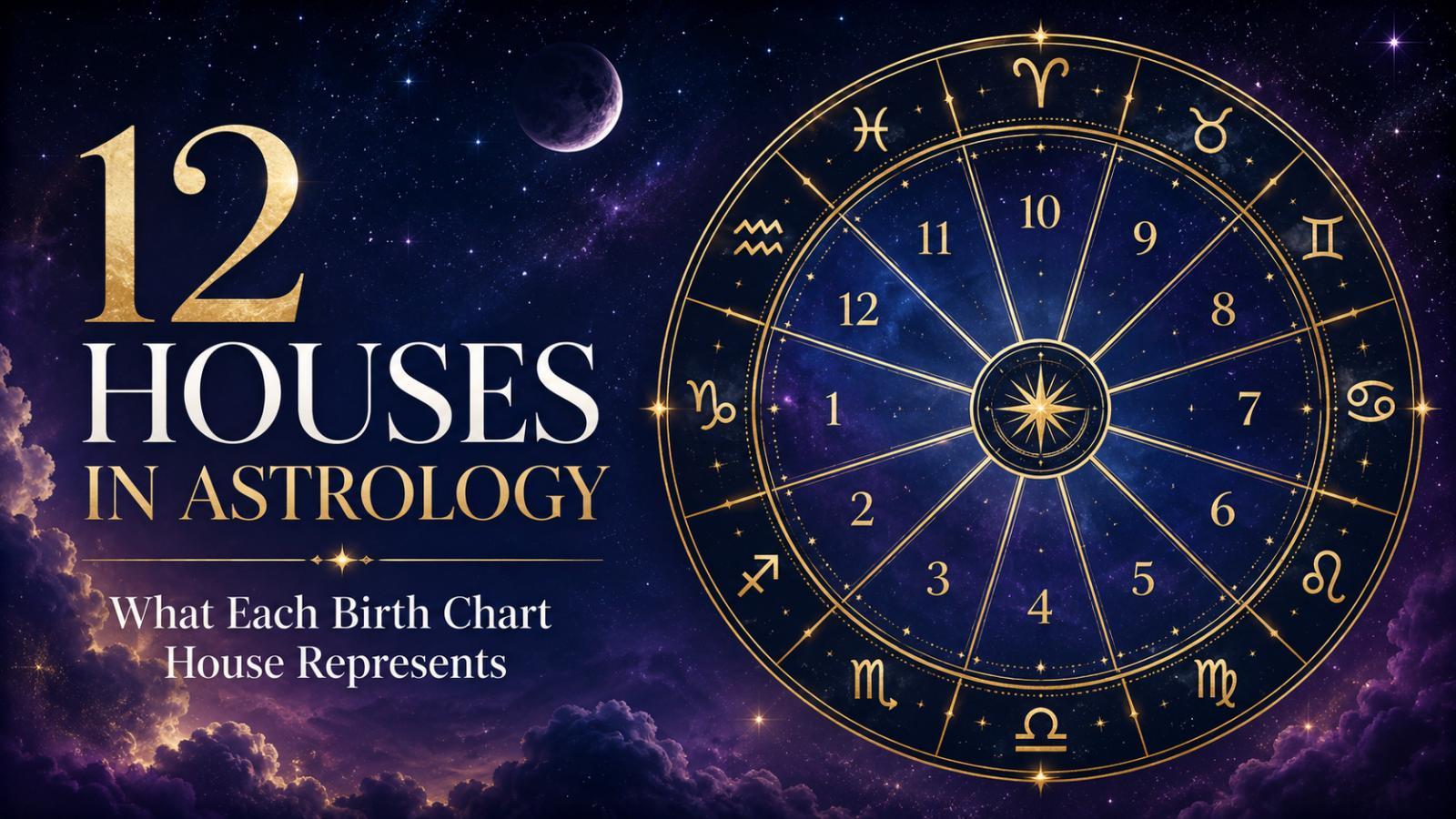
12 Houses in Astrology: Meaning of Each Birth Chart House
The 12 houses in astrology represent areas such as identity, money, communication, home, relationships, career and spiritual reflection. Planets show the energy involved, signs describe how it is expressed, and houses indicate where it may appear. Astrology is a traditional interpretive system whose claims have not been scientifically established. It should not replace medical, legal, financial or mental health advice. What Are the Houses in Astrology? A birth chart is a symbolic map of the sky for a specific date, time and place. It contains 12 houses, each linked with a different area of life. The First House begins at the Ascendant, or rising sign. House boundaries may vary by calculation system. Why Birth Time and Location Matter House calculations require a birth date, recorded birth time and birthplace. These determine the Ascendant and house cusps. A small time difference may change the rising sign or move a planet into a neighboring house. Without a reliable birth time, house placements may be inaccurate. The 12 Houses in Astrology at a Glance The table summarizes the areas linked with each house. House Main meaning Areas traditionally associated with it First House Identity and personal approach Appearance, temperament, first impressions, initiative and approach to life Second House Money and personal values Income, possessions, savings, material security, priorities and self-worth Third House Communication and learning Speaking, writing, siblings, neighbors, practical learning and short journeys Fourth House Home and emotional foundations Family, ancestry, property, private life, belonging and emotional security Fifth House Creativity and self-expression Romance, children, hobbies, entertainment, performance, sports and pleasure Sixth House Work and daily routines Employment conditions, coworkers, habits, service, wellness routines and pets Seventh House Partnerships and agreements Marriage, long-term relationships, business partners, contracts and negotiation Eighth House Shared resources and transformation Joint finances, debt, taxes, inheritance, intimacy, trust and renewal Ninth House Higher learning and beliefs Universities, international travel, philosophy, religion, law and publishing Tenth House Career and public life Reputation, ambition, leadership, recognition, authority and achievement Eleventh House Community and future goals Friends, networks, organizations, teamwork, social causes and aspirations Twelfth House Solitude and reflection Dreams, the subconscious, meditation, retreat, hidden patterns and compassion The table is a starting point. Separate articles will explain each house’s planets, signs, ruler and transits. How Astrologers Interpret a House Astrologers consider several connected factors. The Zodiac Sign on the House Cusp A cusp is a house’s starting boundary. Its sign describes how the house’s themes may be expressed. Planets Inside the House A planet may bring its qualities into that area of life. Its sign, aspects and condition also matter. The Ruler of the House The planet ruling the sign on the cusp helps show how and where the house’s themes may develop. Planetary Aspects Aspects are angular relationships used to interpret how planetary functions interact. The House System House boundaries may change according to the calculation system used. A planet near a cusp may appear in one house under one system and in a neighboring house under another. Understanding the 12 Houses House meanings depend on the sign on each cusp, planets inside it, its ruler, aspects and the system used. The table gives an overview; separate guides will explain each house in greater depth.
Read More →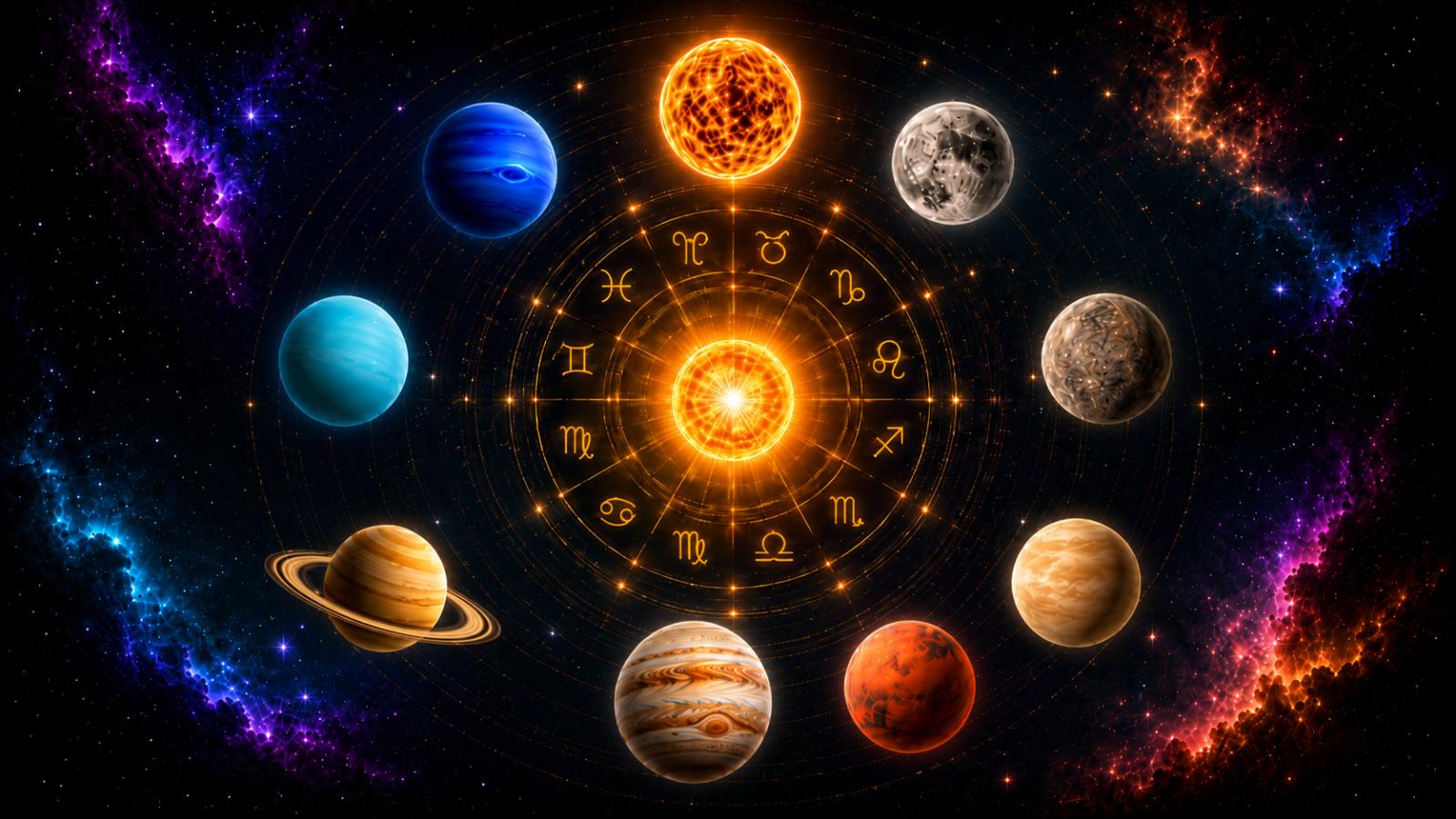
Meaning of the Nine Planets in Vedic Astrology
In Vedic astrology, the nine grahas—Surya, Chandra, Mangala, Budha, Guru, Shukra, Shani, Rahu and Ketu—represent different areas of life and personality. The word graha is often translated as “planet,” although Rahu and Ketu are lunar nodes rather than physical planets. No graha is interpreted alone. Its zodiac sign, house, strength and relationship with other grahas add important context. These meanings are traditional interpretations, not guaranteed predictions. Surya: Identity and Authority Surya, or the Sun, represents identity, confidence, vitality, purpose and leadership. It may show how a person develops self-respect, seeks recognition and handles responsibility. A balanced Surya may support clarity and confidence, while an unbalanced expression may appear as pride or a strong need for approval. Chandra: Mind and Emotions Chandra, or the Moon, represents the mind, emotions, habits, sensitivity and inner security. It may describe how a person reacts emotionally, gives or receives care and responds to changing situations. A balanced Chandra may support calmness and empathy, while a disturbed expression may bring worry or emotional fluctuation. Mangala: Courage and Action Mangala, or Mars, represents energy, courage, initiative, ambition and action. It may show how a person pursues goals, faces conflict and protects personal boundaries. Constructive Mangala may support bravery and determination, while poorly directed energy may appear as impatience, anger or impulsive behavior. Budha: Intelligence and Communication Budha, or Mercury, represents intelligence, speech, learning, logic and communication. It may influence how a person understands ideas, makes decisions and expresses thoughts. A balanced Budha may support clear communication and adaptability, while imbalance may appear as overthinking, inconsistency or indecision. Guru: Wisdom and Growth Guru, also called Brihaspati or Jupiter, represents wisdom, knowledge, growth, guidance and higher learning. It may show where a person seeks meaning, education and broader understanding. Constructive Guru may encourage optimism and sound judgment, while excess may lead to overconfidence or unrealistic expectations. Shukra: Love and Values Shukra, or Venus, represents love, attraction, relationships, beauty, comfort and personal values. It may describe how a person gives affection, seeks harmony and appreciates art or pleasure. A balanced Shukra may support warmth and diplomacy, while imbalance may create dependence on approval, comfort or material enjoyment. Shani: Discipline and Responsibility Shani, or Saturn, represents discipline, patience, duty, boundaries and long-term effort. It may point to areas where maturity and consistency are needed. Shani is not only associated with delay or difficulty; it may also support endurance, humility and lasting achievement through responsible action. Rahu: Desire and Ambition Rahu is the north lunar node. It represents desire, ambition, fascination, worldly experience and attraction toward unfamiliar paths. It may encourage innovation, boldness and exploration. When excessive, Rahu may be linked with confusion, obsession, dissatisfaction or unrealistic goals. Ketu: Detachment and Insight Ketu is the south lunar node. It represents detachment, inner awareness, spiritual interest and release from old patterns. It may show an area of natural familiarity that no longer brings full satisfaction. Constructive Ketu may support intuition and independence, while imbalance may appear as withdrawal or lack of direction. Why All Nine Grahas Matter Each graha represents a different function: Surya reflects identity, Chandra the mind, Mangala action, Budha communication, Guru wisdom, Shukra relationships, Shani responsibility, Rahu desire and Ketu detachment. No graha is completely good or bad. Its meaning depends on the complete horoscope, including its sign, house, strength, aspects and conjunctions. Readers seeking a personalized interpretation should consult a professional astrologer using accurate birth details.
Read More →









