Plot
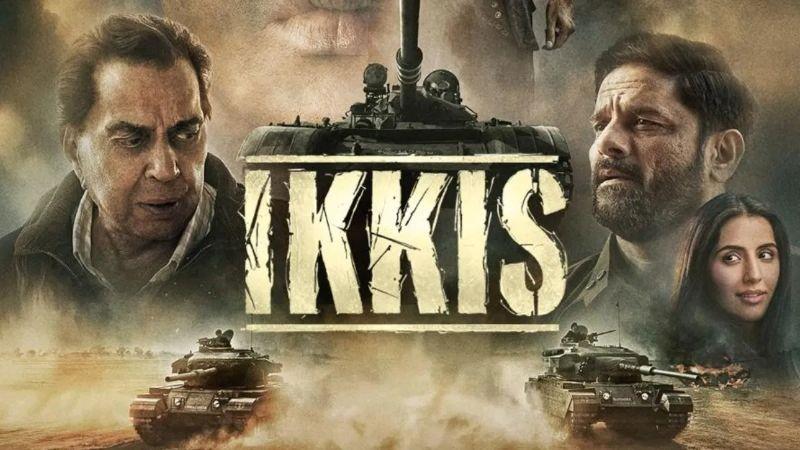
Ikkis narrates the real-life story of Second Lieutenant Arun Khetarpal, a 21-year-old Indian Army officer who displayed extraordinary courage during the 1971 Indo-Pak war and was posthumously awarded the Param Vir Chakra. Rather than framing the narrative as a conventional war spectacle, the film focuses on Arun’s inner world, his family, his formative years at the academy, first love, and the irreversible emotional cost of war on those left behind. The story moves between the battlefield and the home front, showing how heroism often coexists with profound personal loss.
Overview
Directed by Sriram Raghavan, Ikkis deliberately breaks away from chest-thumping nationalism and hyper-masculine action tropes. It opts instead for a restrained, humane lens that views war as deeply personal and generationally traumatic. The film’s first half is tender, intimate, and emotionally immersive, while the second half attempts to juggle multiple timelines and perspectives, slightly diluting its emotional impact. At its core, Ikkis is less about victory and more about sacrifice, memory, and moral reflection.
Performances
- Agastya Nanda delivers a sincere and affecting performance as Arun Khetarpal. His portrayal is marked by innocence, quiet bravery, and emotional honesty, allowing the character’s courage to feel organic rather than performative. This role firmly establishes him as a promising actor after earlier mixed responses.
- Dharmendra lends immense gravitas to the film as Arun’s father, an ex-army officer grappling with irreversible loss. His performance is understated yet devastating, making Ikkis feel like a poignant late-career milestone.
- Jaideep Ahlawat is dependable, especially in his emotionally charged scenes with Dharmendra, though his casting as a Pakistani commander feels slightly misaligned. Debutant Simar Bhatia impresses with warmth and charm, capturing the vulnerability of first love. Supporting actors Vivaan Shah, Sikandar Kher, and Rahul Dev add texture and credibility.
Technical Aspects
Sriram Raghavan’s direction is controlled and sensitive, prioritizing emotional realism over spectacle. The cinematography effectively contrasts the warmth of home with the cold brutality of war zones. Production design remains authentic without romanticizing conflict. Sound design subtly reinforces tension and grief, never overpowering the narrative.
Music
The music is sparingly used and emotionally aligned with the film’s tone. The opening use of Kaifi Azmi’s poetry immediately establishes the film’s reflective mood. Background scoring supports the drama without manipulating emotions, allowing silence and pauses to speak volumes.
Editing
Editing is crisp in the first half, maintaining intimacy and narrative flow. However, the second half’s timeline shifts slightly disrupt emotional continuity, weakening what could have been a more powerful climax.
Positives
- Strong central performances, especially by Agastya Nanda and Dharmendra
- Sensitive, humanistic portrayal of war and its aftermath
- Avoidance of jingoism and forced patriotism
- Well-written family and academy sequences
- Moral clarity and emotional restraint
Negatives
- Second half loses emotional momentum
- Timeline shifts dilute impact
- Some casting choices feel uneven
- Climax lacks the expected emotional payoff
Analysis
Ikkis succeeds because it treats war not as spectacle but as tragedy. It emphasizes that heroism does not erase grief and that patriotism need not be loud to be profound. The film’s strongest stance lies in its belief that wars destroy futures, families, and generations. By showing respectful Pakistani characters and questioning political motivations, it adopts a rare, humane perspective in contemporary war cinema.
Bottomline: Quietly powerful
Rating: 3.5 / 5