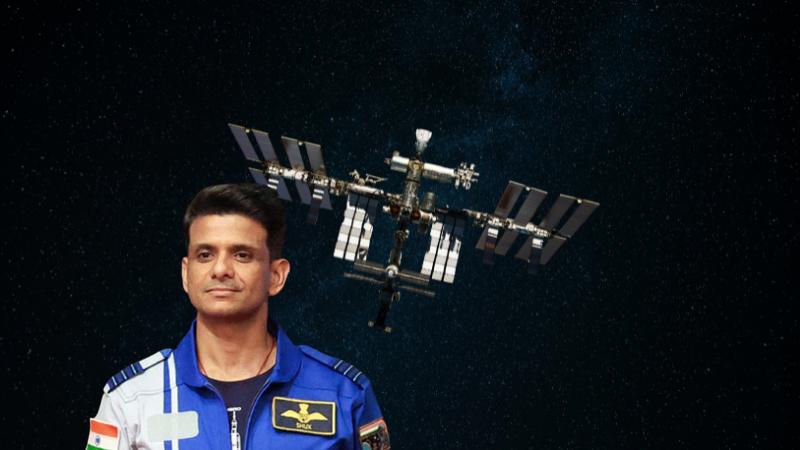
Indian astronaut Shubhanshu Shukla is set to return to Earth after a landmark mission aboard the International Space Station (ISS) as part of the Axiom-4 crew. The mission, which included extensive scientific research, marked several historic firsts for India. Shukla became the first Indian to visit the ISS and only the second Indian astronaut in space, following Wing Commander Rakesh Sharma's 1984 mission. His return, scheduled for July 14 via the Dragon spacecraft, is part of a well-orchestrated procedure designed to ensure crew safety and scientific cargo recovery.
The Dragon capsule, docked on the space-facing side of the ISS's Harmony module, will undock at 4:30 pm IST with all four astronauts on board. The journey back to Earth is expected to take 22.5 hours, with splashdown anticipated on July 15 off the coast of California in the Pacific Ocean. This controlled descent involves a complex series of steps to maintain atmospheric integrity and secure all onboard systems.
Returning to the spacecraft is not as simple as boarding and detaching. First, the Axiom-4 crew, led by veteran astronaut Peggy Whitson, performs critical checks of the Dragon capsule, including its life support, communication, and propulsion systems. Before undocking, the team must load experimental samples, personal items, and essential cargo. The crew seals the capsule hatch several hours in advance, maintaining airtight conditions throughout departure and descent.
Once sealed, the capsule disconnects from the ISS, starting with the release of data and power cables and 12 physical latches. This triggers the soft-capture stage, followed by a sequence of thruster burns to distance the capsule from the ISS. The first of these, called "Burn Zero," ensures a safe separation. It is followed by "Departure Burn One" to place the capsule on a precise reentry trajectory. Although the process is automated, astronauts monitor it closely and are trained to take over if necessary.
Shukla’s return comes after a highly productive mission where the crew conducted more than 60 experiments in areas such as biomedical science, advanced materials, neuroscience, agriculture, and space technology. Among Shukla's final contributions was a study observing how microgravity affects plant growth. He monitored and documented the germination of moong and methi seeds in petri dishes and stored the results for analysis back on Earth. These biological studies could offer future breakthroughs in both space farming and Earth agriculture.
Shukla's farewell message from the ISS captured the emotional and symbolic importance of the mission. Speaking during the crew's parting ceremony, he reflected on India’s evolving role in space. He paid homage to Rakesh Sharma, while confidently stating that modern India looks ambitious, fearless, confident, and proud from space. His statement, “Today’s India still looks 'saare jahan se acha',” resonated with patriotic fervor and space-age optimism.
In both Hindi and English, Shukla conveyed gratitude to his country and those who supported his journey. He extended heartfelt thanks to ISRO for developing mission protocols and outreach, and to NASA, Axiom Space, and SpaceX for training and operational support. He emphasized that while this chapter was concluding, India’s journey in space has only just begun.
Shukla’s sentiments echo the broader goal of India's growing ambitions in the space sector. As ISRO prepares for future manned missions under the Gaganyaan program, Shukla's mission serves as a stepping stone in training, collaboration, and research. The data and experiences gathered during this mission are expected to contribute significantly to upcoming projects.
Commanded by Peggy Whitson, the Axiom-4 team also included Slawosz Uznanski from Poland, representing the European Space Agency, and Tibor Kapu from Hungary. These astronauts worked closely together on research initiatives that could influence health care, environmental monitoring, and technological innovation back on Earth.
The safe return of the crew and the Dragon spacecraft marks not just the end of a journey, but the beginning of a new era in international collaboration and Indian participation in space exploration. Once the capsule splashes down, recovery teams will retrieve it and transport the astronauts and research material for further evaluation.
As the countdown to splashdown continues, global audiences watch closely. Shubhanshu Shukla’s space mission has not only expanded scientific boundaries but also ignited national pride and sparked curiosity in the next generation of explorers. This return, filled with precision, preparation, and promise, symbolizes India’s deeper commitment to space science and international cooperation in human spaceflight.