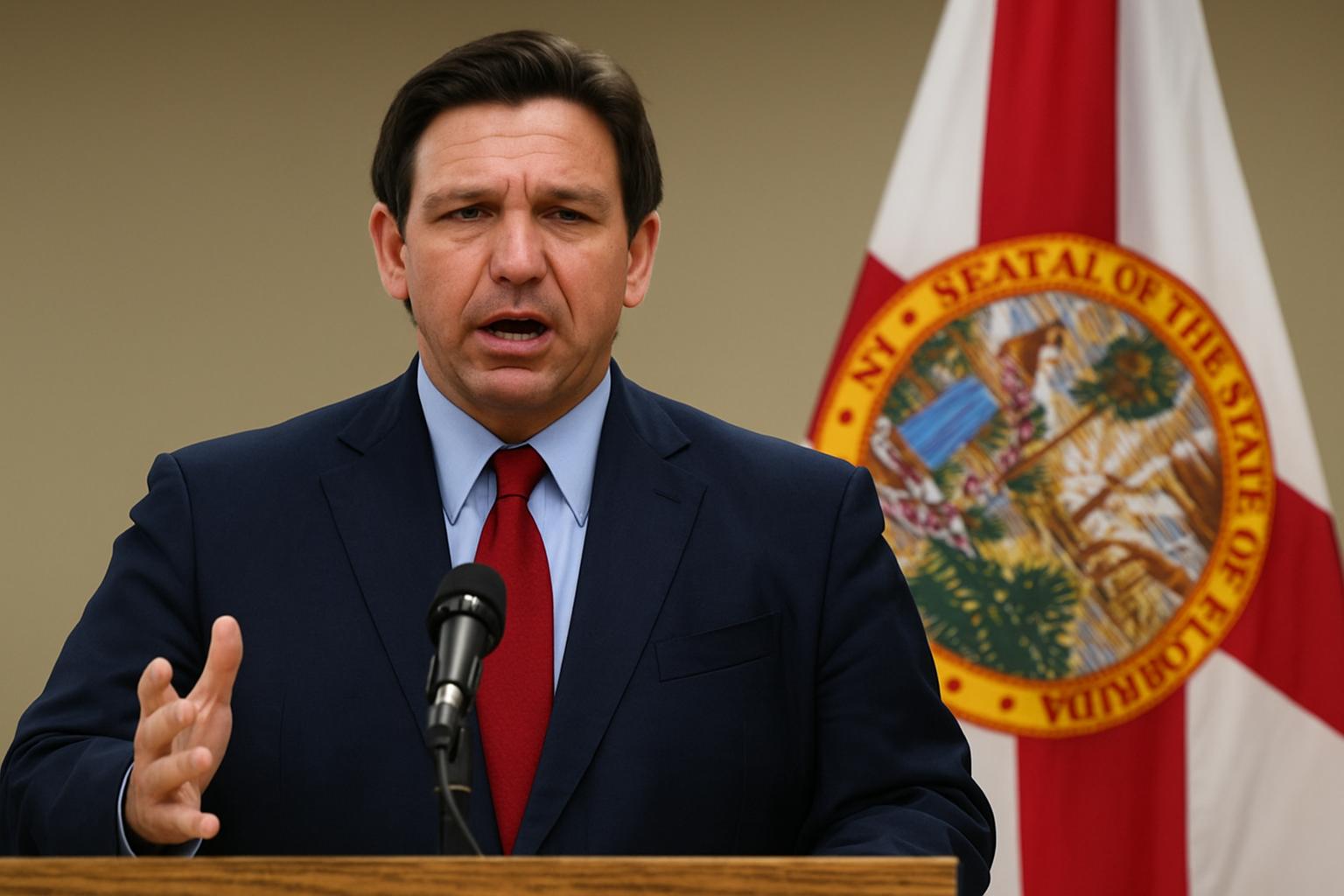
Florida Governor Ron DeSantis has directed the state’s Board of Governors to prohibit the use of H-1B visas across Florida’s public colleges and universities. The move, announced during a press conference, marks one of the most restrictive state-level actions against the employment of foreign nationals in higher education. DeSantis argued that state-funded institutions should prioritize American citizens for all available positions, declaring that if universities cannot find qualified U.S. candidates, “the problem lies somewhere else.”
The announcement follows months of online campaigns urging Florida officials to scrutinize visa-based hiring practices in academia. DeSantis questioned why Florida universities needed to recruit foreign professionals at all, insisting that jobs should go to “Florida residents or Americans.” He expressed skepticism toward the idea that certain academic or administrative roles required foreign talent, calling for greater oversight and transparency in university hiring.
The decision has caused immediate concern among Florida’s higher education institutions, which rely heavily on international faculty, researchers, and specialized support staff. According to U.S. Citizenship and Immigration Services (USCIS) data, more than 1,900 employers in Florida sponsor over 7,200 H-1B workers as of mid-2025. Within the education sector alone, 78 employers are associated with 677 H-1B visa holders. Among the top university sponsors are the University of Florida, the University of Miami, and the University of South Florida, which collectively employ hundreds of foreign professionals in critical academic and research roles.
While H-1B visas are often associated with technology firms, universities across the United States depend on these skilled workers for a wide range of positions, including professors, lab technicians, medical researchers, and campus administrators. In Florida, DeSantis cited examples of H-1B visa holders working as assistant professors, coaches, coordinators, marketers, and analysts from countries such as the United Kingdom, China, Spain, Canada, and India. He questioned how such roles could qualify as “specialty occupations” under federal law, suggesting that the H-1B program in academia may have expanded beyond its original intent.
The governor’s directive has reignited debate over whether American universities should continue to recruit internationally or focus solely on domestic talent. Critics argue that the policy could diminish the global standing of Florida’s education system, restricting access to world-class expertise and undermining research collaboration. Online commentators warned that the measure could turn Florida’s academic hiring pool into one limited to “national elites,” excluding the global scholars who contribute significantly to innovation and learning.
DeSantis rejected those arguments, asserting that many of the reviewed H-1B positions were “far from elite.” He specifically cited assistant athletic coaches and media relations specialists among the visa holders, questioning whether such roles should justify sponsorship under a program intended for high-skilled professionals.
The decision’s impact on Indian students and other international graduates could be significant. Many foreign students studying in Florida enter the U.S. on F-1 visas, complete their degrees, and transition to Optional Practical Training (OPT) programs before applying for H-1B sponsorship through universities or employers. With Florida institutions now ordered to stop offering H-1B sponsorships, that career pathway could narrow sharply. Graduates may find fewer job opportunities after their OPT period ends, forcing many to return home or relocate to more visa-friendly states.
Current H-1B staff in Florida universities may also face difficult circumstances if their visa renewals are denied or if their institutions discontinue sponsorship. Legal experts suggest universities might seek clarification from federal authorities, since immigration and work visas fall under federal jurisdiction rather than state control. Some institutions could consider legal challenges, arguing that DeSantis’s directive oversteps state authority. However, even before any legal proceedings unfold, the governor’s message is clear: Florida intends to reduce its reliance on foreign workers in higher education.
Observers warn that the move may have long-term consequences for Florida’s academic competitiveness. Universities known for attracting international researchers and faculty could find it harder to recruit globally recognized talent. Students from countries like India, China, and Canada, who often choose U.S. universities for their strong research environments, may now prefer alternative destinations such as Canada, the United Kingdom, or Australia, where immigration pathways are more predictable.
As global competition for skilled graduates intensifies, DeSantis’s policy may reshape Florida’s academic landscape for years to come. Whether the directive strengthens opportunities for American workers or isolates Florida’s universities from the global academic network remains to be seen. What is certain, however, is that the decision sends a strong signal — Florida’s public education system is set to prioritize local talent over global recruitment, regardless of the broader implications for international collaboration and innovation.