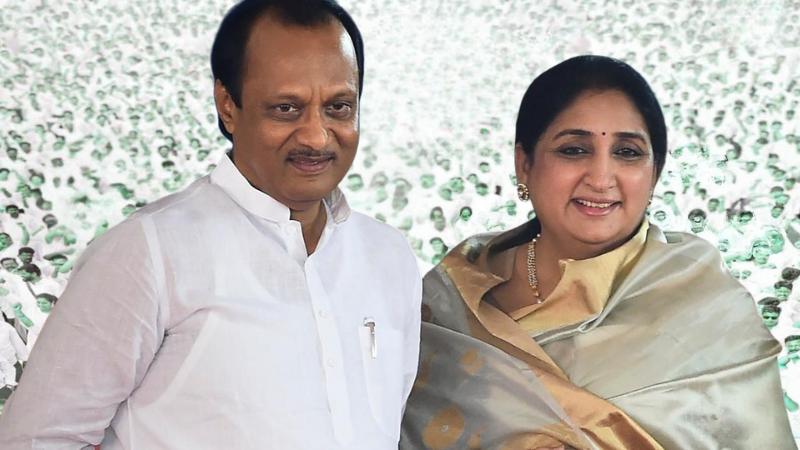
The sudden death of Maharashtra Deputy Chief Minister Ajit Pawar in a tragic air crash has sent shockwaves across the state’s political landscape, leaving the Nationalist Congress Party facing deep uncertainty. As leaders, cadres, and voters struggle to come to terms with the loss, attention has swiftly shifted to a name that until recently stayed away from daily political combat: Sunetra Pawar. A Rajya Sabha Member of Parliament and Ajit Pawar’s wife, she is now being widely discussed as a possible new centre of gravity within the Ajit Pawar-led faction of the NCP. In a party long defined by strong male leadership and the famous Sharad–Ajit Pawar dynamic, this moment could mark a historic turning point.
Sunetra Pawar hails from a politically influential family in Maharashtra’s Marathwada region and is the sister of former minister and Lok Sabha MP Padamsinh Patil. Married to Ajit Pawar in 1985, she was for decades known largely as part of the powerful Pawar household rather than as an active political figure herself. That perception has changed in recent years. Her entry into electoral politics during the 2024 Lok Sabha elections from Baramati, though unsuccessful against Supriya Sule, signaled her readiness to step into the public arena. Soon after, her unopposed election to the Rajya Sabha gave her a national platform and formal authority within the party structure.
Sunetra Pawar’s growing relevance is not limited to sympathy following personal tragedy. Over the years, she has built an independent profile through her work in education, social initiatives, and environmental advocacy. As chairperson of the Baramati Textile Company, she has been associated with an industry critical to the regional economy. Through her Environmental Forum of India, she has promoted organic farming, sustainable development, and conservation, earning recognition and awards for her work. Her role as a trustee of Vidya Pratishthan and as a senate member of Savitribai Phule Pune University further strengthens her image as an administrator with policy experience.
Within the Ajit Pawar faction of the NCP, there are several senior leaders with long political resumes. However, none combine legacy, organizational access, national visibility, and public sympathy in the way Sunetra Pawar currently does. The emotional impact of the Baramati tragedy has positioned her uniquely at a time when party workers are seeking stability and direction. Her connections across political, social, and business circles could help hold the faction together during a delicate transition, especially amid ongoing speculation about a possible reunification of rival NCP groups.
Her rise would also represent a symbolic shift in Maharashtra politics, where women from political families have often remained in supporting roles. While younger members of the Pawar family, including Parth Pawar and Rohit Pawar, may also be seen as future leaders, Sunetra Pawar’s seniority, experience, and current standing give her an immediate edge. Whether she chooses to take on an active leadership role or remain a guiding force behind the scenes, her influence is set to grow.
The coming weeks will be crucial for the NCP and for Maharashtra’s broader political equation. Sunetra Pawar’s decisions will not only shape the future of Ajit Pawar’s faction but could also impact alliances, leadership structures, and governance in the state. With a Rajya Sabha seat, a strong network, and unprecedented public attention, she stands at the threshold of a new political chapter. Whether she emerges as the undisputed matriarch of the NCP or as a consensus builder during a period of transition, Sunetra Pawar is now firmly at the center of Maharashtra’s political conversation.