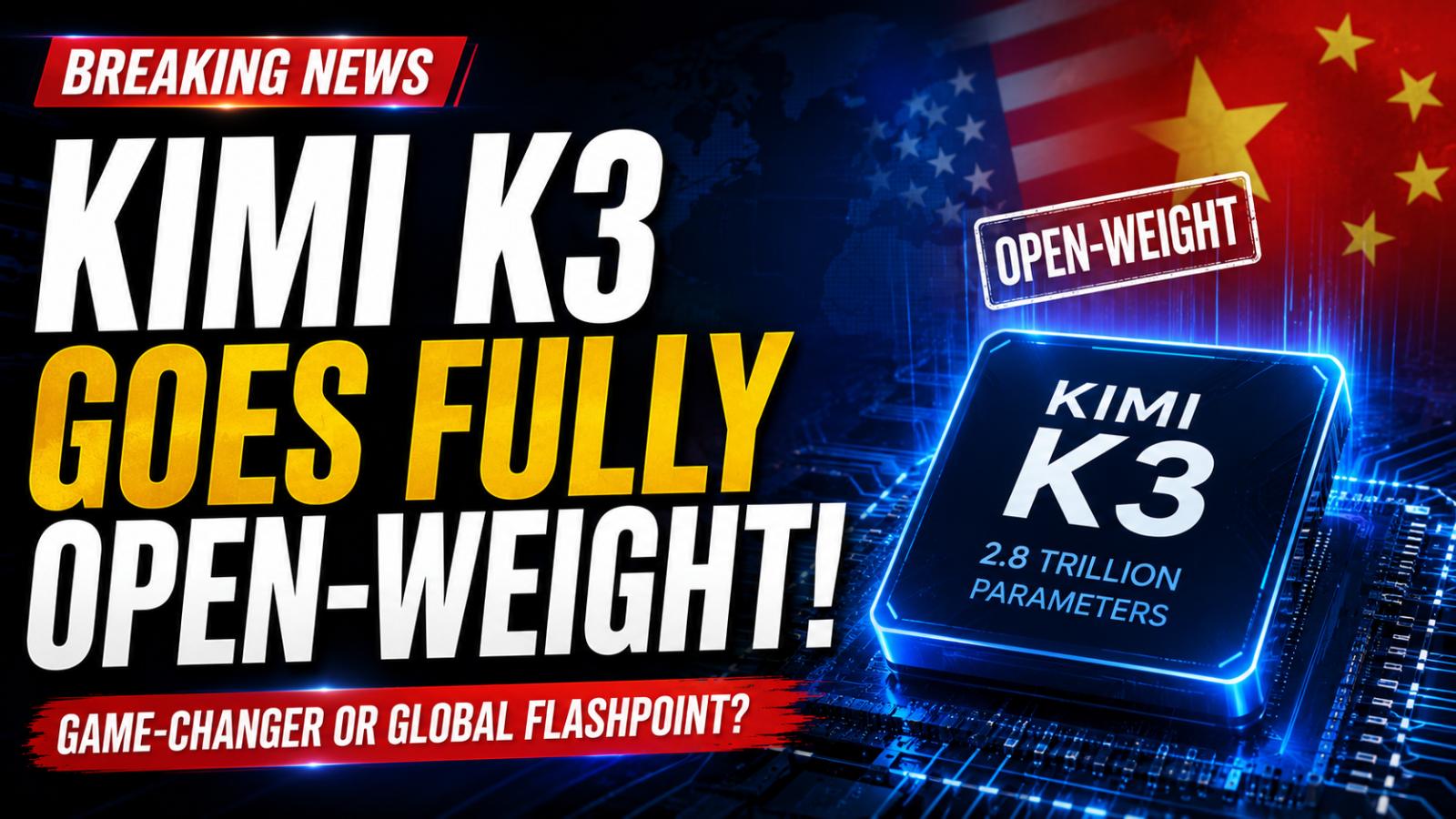
Moonshot AI has released Kimi K3, a 2.8-trillion-parameter open-weight model built for advanced reasoning, coding and knowledge work. Its arrival expands access to frontier-scale AI while intensifying a US-China dispute over alleged model distillation and intellectual property.
Kimi K3 open-weight release expands access
Moonshot introduced Kimi K3 on July 16 and scheduled the complete model-weight release for July 27. The company describes it as a natively multimodal system with a one-million-token context window designed for long-horizon coding, research and complex reasoning tasks. Moonshot’s official website confirms the 2.8-trillion-parameter scale and the large context capacity.
The release matters because an open-weight model gives qualified developers greater control than an API-only service. Organizations with enough computing infrastructure can inspect, host, customize and fine-tune the model without routing every request through Moonshot’s servers.
However, open-weight does not automatically mean fully open source. Model weights may be available while training data, full development methods and other technical details remain undisclosed. That distinction should be clear in coverage.
Related Reading
While Kimi K3 expands access through open weights, Anthropic is betting on premium performance. Read our analysis of Claude Opus 5 pricing and features to see how Anthropic is positioning its flagship AI model in the evolving market.
2.8T model sets a new scale benchmark
Moonshot says Kimi K3 is the first open-weight system to approach three trillion parameters. The company has positioned it as the world’s largest publicly released open-weight AI model by total parameter count. Independent reporting also identifies it as a 2.8-trillion-parameter system aimed at competing with leading American frontier models.
Scale alone does not guarantee better intelligence. Parameters represent values learned during training, but architecture, data quality, post-training and inference design also shape performance. Running a model of this size will remain impractical for most individual developers because it requires costly chips, memory and power.
The release will still benefit cloud providers, universities, governments and large companies that can operate substantial AI infrastructure. It may also support smaller teams through hosted versions and optimized derivatives.
AI dispute grows over distillation allegation
The launch has become part of a wider technology dispute between Washington and Beijing. White House science and technology policy director Michael Kratsios said the US government had information indicating that Moonshot used Anthropic’s Claude Fable 5 outputs while developing Kimi K3.
Kratsios alleged that Moonshot operated a system for large-scale distillation and changed access methods to avoid detection. Treasury Secretary Scott Bessent later warned that sanctions or placement on the US Commerce Department’s Entity List could be considered if authorities establish intellectual-property violations.
Moonshot has rejected the suggestion that distillation produced Kimi K3’s gains. The company has said its performance came from original architectural improvements. The US allegations remain claims rather than publicly proven findings, and no released evidence has yet established how much any outside model contributed to Kimi K3.
Model weights enable outside examination
The public release gives researchers a better opportunity to study Kimi K3’s structure, behavior and technical characteristics. Model weights alone cannot reveal every part of the training process, but they allow more detailed testing than an API interface.
Researchers can now examine safety behavior, benchmark reliability, hardware requirements and possible similarities with other systems. Such analysis may inform the distillation debate, although it cannot automatically prove which training data or model outputs Moonshot used.
The release could therefore increase transparency without resolving the political dispute. Any conclusion about intellectual-property theft will require stronger evidence than performance similarities or benchmark comparisons.
Open AI competition pressures closed labs
Kimi K3 also increases commercial pressure on companies that keep their strongest models behind paid APIs. Moonshot’s model combines frontier-scale ambitions with downloadable weights and comparatively low hosted-service pricing.
That does not remove costs. Self-hosting transfers spending from API charges to GPUs, electricity, engineering and maintenance. For many businesses, a paid API will remain cheaper and easier than operating a 2.8-trillion-parameter model.
Even so, Kimi K3 changes the competitive calculation. American laboratories must now compete not only on model quality but also on price, control, transparency and deployment freedom. The result may accelerate cheaper services and more open releases, while also deepening government concern over how advanced AI systems spread across borders.