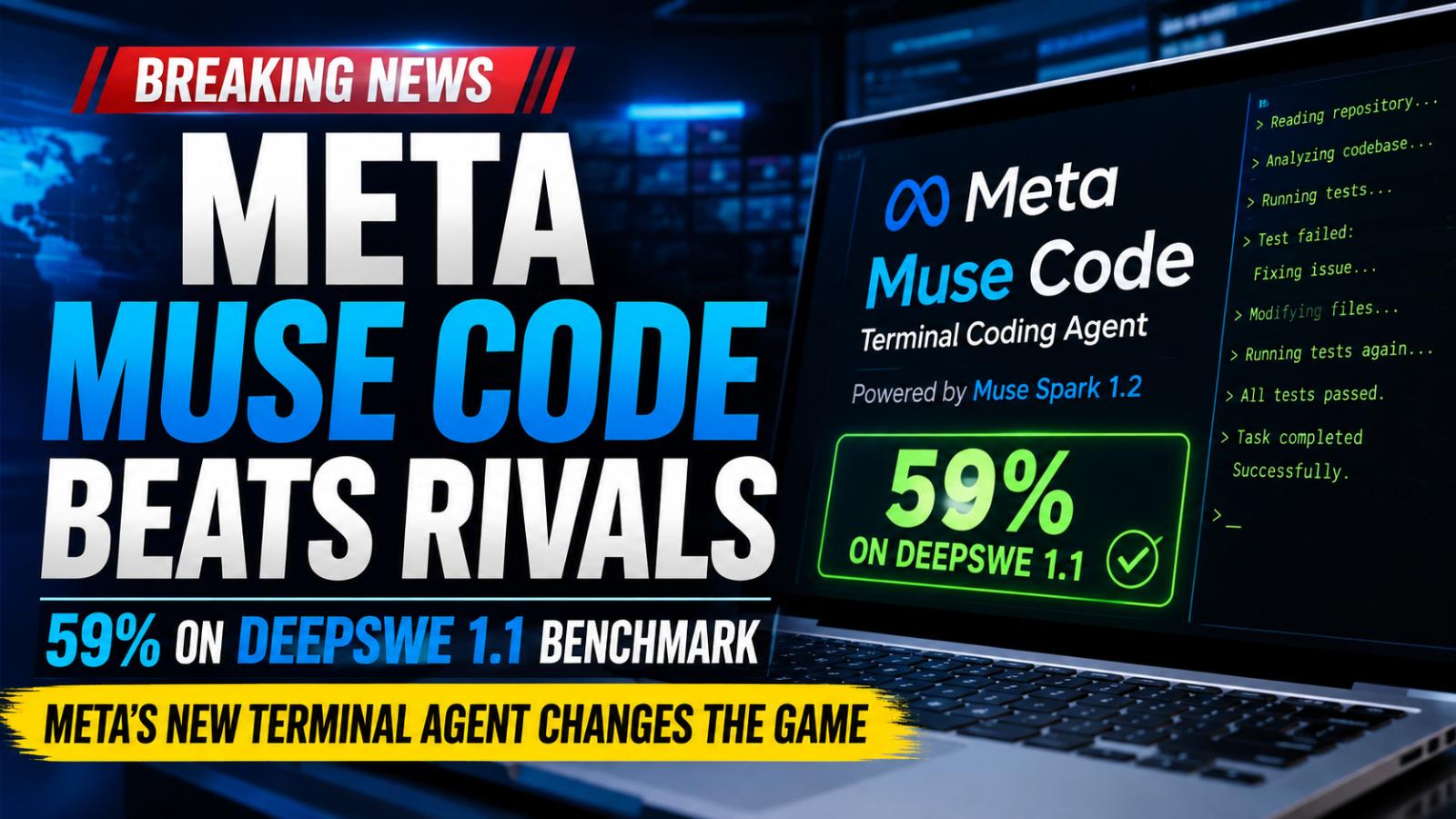
Meta Muse Code enters the AI coding race as a terminal-based agent powered by Muse Spark 1.2. With a reported 59% DeepSWE 1.1 score, the Muse Code agent highlights Meta's growing push into terminal AI and developer tools, though independent benchmark verification remains important.
Meta Muse Code Enters the Competitive AI Coding Race
Meta has introduced Muse Code, a terminal-based coding agent powered by Muse Spark 1.2, pushing the company deeper into the fast-growing AI developer tools market. Meta says the coding agent scored 59% on DeepSWE 1.1, placing it ahead of comparable tools from xAI and Google on that benchmark.
Unlike a conventional chatbot that generates code for developers to copy into an editor, Muse Code operates directly from the command line. It can work with project files, execute programming tasks and participate in the test-and-fix cycle that makes agentic coding tools increasingly useful for software development.
Muse Code Agent Works Directly From the Terminal
The terminal is becoming an important battleground for AI coding agents because it gives software access to the environment where developers build and test applications.
A capable terminal AI can inspect files, modify code, execute tests, analyze error messages and continue working after a failure. This moves AI development tools beyond code suggestions toward completing multi-step engineering tasks with less manual intervention.
Meta says Muse Code achieved a 59% score on DeepSWE 1.1, a benchmark designed to evaluate software engineering task completion. According to the reported comparison, the result puts the Meta coding AI ahead of xAI's Grok Build 4.5 and Google's Gemini 3.6 Flash on the same measure.
The result should still be treated as a vendor-reported benchmark until it receives broader independent verification.
Muse Spark 1.2 Signals Meta's Changing AI Strategy
Muse Code also reflects a wider change in Meta's approach to artificial intelligence.
Meta spent years emphasizing openly available AI research and models. More recently, the company has started building commercial model services and finished products aimed directly at developers.
Muse Code takes that strategy further by packaging the underlying Muse Spark technology into a dedicated coding product rather than offering developers only model access.
That puts Meta into more direct competition for developer adoption as AI companies race to make their models part of everyday software engineering workflows.
AI Coding Tools Become a Major Commercial Battleground
Coding has emerged as one of the clearest commercial applications for generative AI. Businesses can measure engineering costs, development time and productivity improvements more easily than they can quantify the benefits of many other enterprise AI applications.
That measurable return has intensified competition among AI laboratories. Companies including OpenAI, Anthropic, Google, xAI, Alibaba and other emerging AI developers are increasingly competing through coding models, autonomous agents, lower pricing and stronger software-engineering benchmark results.
The shift also changes what developers expect from AI. The competition is moving from tools that simply answer programming questions toward agents capable of carrying out longer workflows inside real development environments.
DeepSWE 1.1 Benchmark Result Needs Independent Verification
The 59% DeepSWE 1.1 score gives Muse Code an attention-grabbing introduction, but benchmark rankings should not be confused with guaranteed real-world performance.
AI benchmark results can vary depending on evaluation environments, resource limits, testing harnesses and implementation choices. Vendor-published scores therefore provide a useful starting point for comparison, but independent testing remains important.
Muse Code's larger significance may ultimately depend less on one benchmark number and more on how reliably it handles real repositories, debugging, testing and long-running development tasks.
If Meta can translate its reported benchmark performance into dependable everyday use, Muse Code could become a serious challenger in the rapidly expanding AI coding agent market.