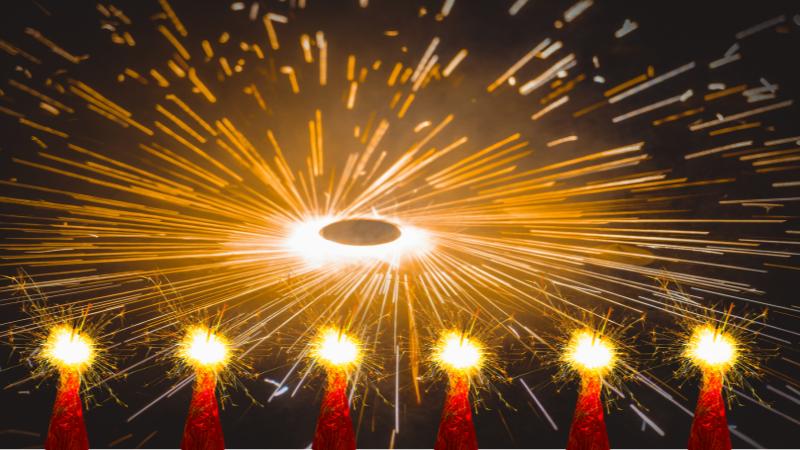
The Supreme Court of India has allowed the use of green firecrackers in Delhi and the National Capital Region (NCR) during the Diwali season under strict regulations. The court’s decision permits their use between October 18 and 21, but only during specific time slots—between 6 am and 7 am, and from 8 pm to 10 pm on the day before Diwali and the day of the festival. The move is part of an effort to strike a balance between cultural celebrations and environmental protection amid growing concerns over air pollution in the capital.
The bench clarified that only green firecrackers—those approved by the Council of Scientific and Industrial Research–National Environmental Engineering Research Institute (CSIR-NEERI)—can be used. It also instructed authorities to restrict the sale and use of crackers imported or smuggled from outside the NCR region. Any manufacturer found selling counterfeit or non-compliant products could face immediate license cancellation. The court described its decision as a “balanced approach” that permits traditional festivities in moderation without compromising environmental safeguards.
Green firecrackers, developed by CSIR-NEERI, are designed to produce significantly lower emissions than traditional ones. These eco-friendly alternatives feature smaller shell sizes, use fewer raw materials, and are made without ash. They also incorporate dust-suppressing additives that reduce the release of harmful gases, including particulate matter, sulphur dioxide, and nitrogen dioxide. In traditional crackers, toxic metals such as lead, barium, and chromium are responsible for a large share of pollution. In contrast, green firecrackers replace these with less hazardous chemical compounds that minimize health risks.
According to CSIR-NEERI, heavy metal-based compounds have historically been the main contributors to pollution from fireworks. The agency’s research introduced multifunctional additives such as zeolite and iron oxide in the manufacturing process, helping to control emissions and limit toxic releases. This scientific innovation allows green crackers to emit up to 30 percent less particulate matter compared to conventional versions.
Despite being an improvement, experts emphasize that green firecrackers are not completely pollution-free. They still emit smoke and particulates, though at substantially lower levels. The term “green” refers to their reduced environmental footprint, not total elimination of pollutants. Airborne particulate matter—classified as PM10, PM2.5, PM1, and ultrafine particles—is a major cause of respiratory illnesses in densely populated regions like Delhi-NCR. Smaller particles, such as PM2.5, can penetrate deep into the lungs and even enter the bloodstream, posing serious long-term health hazards.
There are three primary categories of green firecrackers, each developed with specific safety and environmental goals. SWAS (Safe Water and Air Releaser) types release fine water vapour that helps absorb dust and minimize smoke. SAFAL (Safe Minimal Aluminium) crackers contain limited quantities of aluminium, resulting in less sound and reduced emissions. STAR (Safe Thermite Cracker) versions are manufactured without potassium nitrate and sulphur, both of which are key sources of dense smoke and lingering odour.
The Supreme Court’s latest ruling highlights the ongoing challenge of balancing festive traditions with environmental responsibility. Delhi and surrounding regions have long struggled with severe air pollution during the winter months, which worsens around Diwali due to large-scale fireworks use combined with crop residue burning and vehicular emissions. The introduction and regulation of green firecrackers aim to mitigate these impacts while allowing citizens to celebrate responsibly.
Officials have been instructed to monitor cracker sales closely and ensure that only certified green variants are distributed. The court’s order underscores that manufacturers and sellers violating the prescribed norms will face legal consequences, including cancellation of business licences.
By enforcing time limits and approving only low-emission products, the Supreme Court aims to reduce the air quality deterioration that typically follows Diwali celebrations. Authorities hope that this controlled approach will set a precedent for environmentally conscious festivities across India.
As the festival approaches, environmental groups and government agencies are urging citizens to choose eco-friendly firecrackers or, better yet, celebrate through light-based traditions such as diyas and lanterns. While the debate over fireworks and air quality continues, the latest ruling marks a step toward sustainable celebration—an effort to preserve both cultural heritage and clean air in India’s most polluted region.