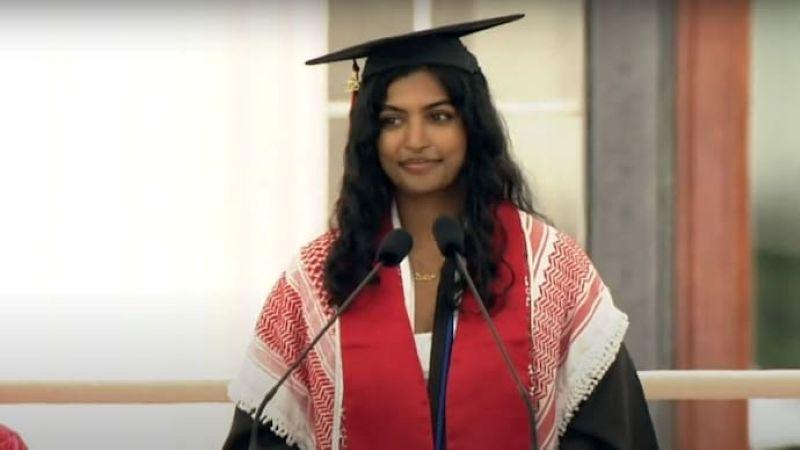
Indian-American student Megha Vemuri, who served as president of MIT’s Class of 2025, has been banned from participating in the Massachusetts Institute of Technology’s undergraduate commencement ceremony. The decision came after she delivered a strongly worded pro-Palestine speech during a campus event held just one day prior to graduation.
Vemuri was set to play a prominent role as marshal during the ceremony, but the university’s chancellor, Melissa Nobles, blocked her from attending, citing violations of MIT’s rules on campus expression. In a letter reportedly sent to Vemuri and obtained by The Boston Globe, Nobles stated that the student "deliberately and repeatedly misled Commencement organizers" and had disrupted an official institute event by leading a protest from the stage. Additionally, Vemuri and her family were barred from campus for most of the graduation day.
During her speech, Vemuri wore a red keffiyeh a symbol of Palestinian solidarity and condemned both Israel’s military actions in Gaza and MIT’s research ties with the Israeli military. She accused MIT of being complicit in what she described as a genocide and urged fellow graduates to take a stand against it. "We are watching Israel try to wipe Palestine off the face of the earth, and it is a shame that MIT is a part of it," she declared. She also praised MIT students who had voiced support for Palestine, referring to earlier votes by the undergraduate body and Graduate Student Union to sever institutional ties with the Israeli military.
Born in Alpharetta, Georgia, Megha Vemuri graduated from Alpharetta High School in 2021 and went on to pursue her undergraduate studies at MIT. She majored in computer science, neuroscience, and linguistics, and rose to become the president of her graduating class. Vemuri has been actively involved in campus activism and is a member of Written Revolution, a student group at MIT that promotes revolutionary and critical discourse. She also gained research experience during a stint at the UCT Neuroscience Institute in South Africa.
Vemuri’s case highlights the growing tensions on U.S. college campuses over the Israel-Gaza conflict, with many students increasingly taking outspoken stances despite administrative pushback. Her removal from the graduation ceremony has sparked a broader conversation about freedom of expression, institutional censorship, and the rights of students to protest political issues at academic events.