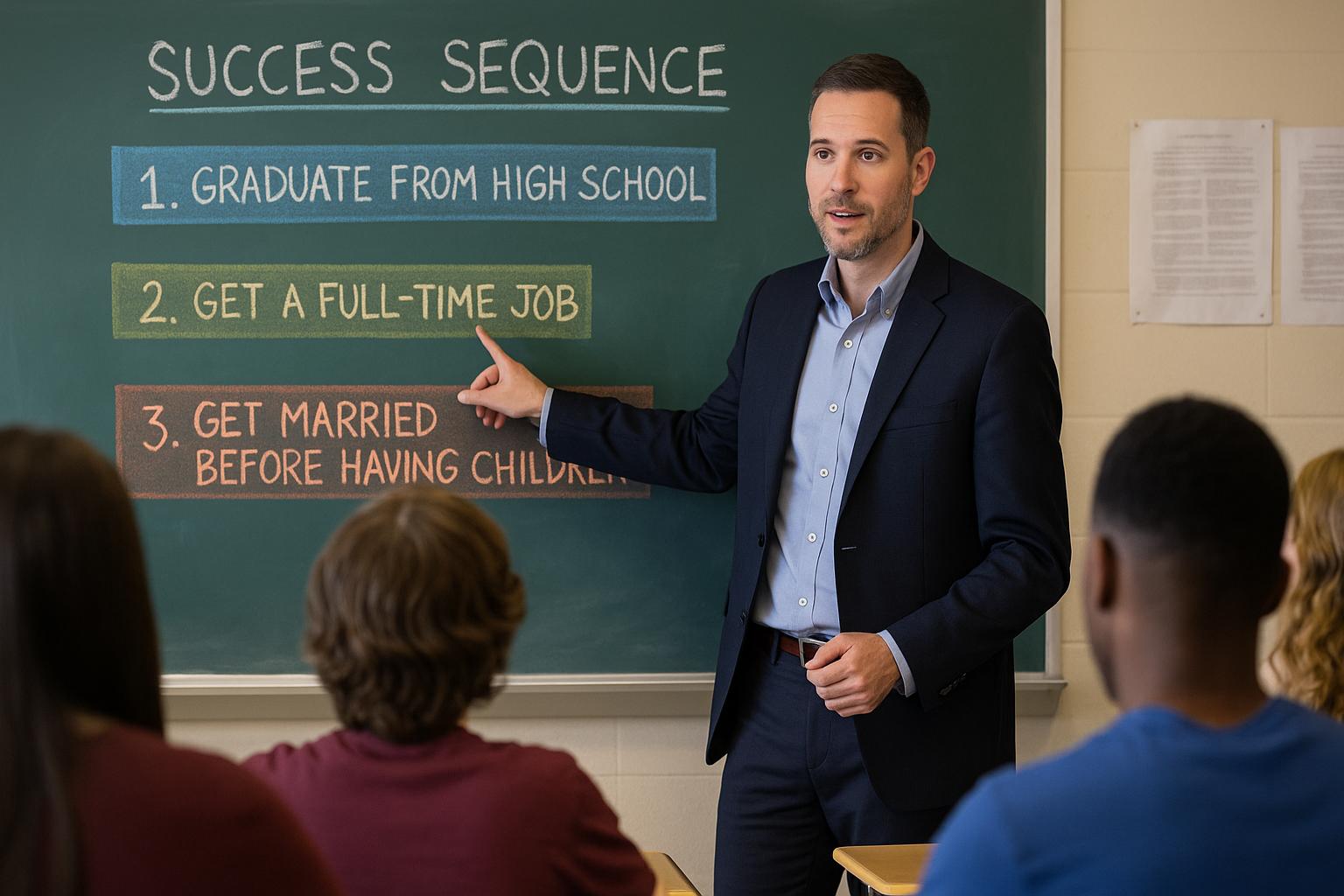
COLUMBUS, Ohio — The Ohio Senate has passed a controversial education bill that would introduce a new course for middle and high school students centered on what lawmakers are calling the “Success Sequence.” Supporters say the proposed curriculum offers young people a roadmap to financial independence and reduced poverty, while critics argue it simplifies complex economic issues and risks stigmatizing those who struggle.
The legislation, sponsored by Republican State Senator Al Cutrona, passed in a 24–9 vote along strict party lines. All Republican senators voted in favor, while Democrats opposed it. The proposal now moves to the Ohio House for consideration, with a final vote expected next year. If approved, the Ohio Department of Education would be tasked with developing a curriculum that outlines a three-step plan for achieving economic stability: completing high school, securing full-time employment, and getting married before having children.
Senator Jerry Cirino, a Republican who supports the bill, said the goal is to provide students with clear guidance for building a successful life. “I think the success sequence is a great program,” Cirino said. “We’ve spent enormous resources fighting poverty for decades, but we also need to look at cultural norms and give young people a practical roadmap to success.” Cirino emphasized that the proposal is intended to inspire, not impose, a particular lifestyle on students.
Democratic lawmakers, however, pushed back, saying the measure misrepresents the causes of poverty. State Senator Kent Smith called the approach “an oversimplification of deep systemic issues.” He argued that poverty stems more from public policy failures than personal choices. “You’re selling people a version of the American Dream that, frankly, doesn’t exist for everyone,” Smith said. “When people remain in poverty, this narrative implies it’s their fault rather than the result of structural inequities. Poverty is not a failure of personal responsibility—it’s a failure of public policy.”
Smith urged lawmakers to address the root causes of poverty through economic reforms, such as raising the minimum wage, expanding affordable childcare, and strengthening worker protections. “If you actually provide working-class Ohioans with support—better wages, affordable childcare, and access to healthcare—you give them a real path to financial independence,” he said. “That’s what reduces poverty, not simply following a checklist.”
If enacted, the new curriculum would be developed locally with input from school boards, parents, educators, and community stakeholders. Cirino said the collaborative approach ensures that lessons reflect community values while maintaining educational integrity. “It can only help students,” he said. “Our hearts are in the right place. We want to help students succeed, not control their choices. This is about empowerment, not enforcement.”
The push for the Success Sequence comes amid persistent concerns about poverty across Ohio. In Cuyahoga County, nearly one in five residents lives below the poverty line, according to United Way of Greater Cleveland. Child poverty rates are even higher in certain neighborhoods, where limited access to jobs, transportation, and quality education continue to hinder families. Lawmakers on both sides agree that these challenges demand attention, but they remain sharply divided over how best to address them.
Supporters of the bill argue that the course would equip students with practical knowledge that transcends academics. By emphasizing responsibility, planning, and perseverance, they say the program encourages young people to take charge of their future. Opponents counter that such lessons overlook the systemic barriers—such as wage stagnation, housing insecurity, and racial inequality—that make poverty difficult to escape.
The debate over the Success Sequence underscores broader ideological divides about how to tackle poverty in America. Conservatives tend to favor initiatives promoting personal responsibility and family structure, while progressives prioritize expanding social safety nets and addressing income inequality through government policy. Ohio’s proposed curriculum places those philosophies in direct contrast within the classroom.
For now, the bill’s fate rests with the Ohio House, where debate is expected to intensify in the coming months. If approved, the curriculum could be introduced as early as the 2026–2027 school year. Regardless of the outcome, the conversation has already reignited questions about the role of education in addressing social and economic inequality. As Ohio lawmakers continue to deliberate, the central question remains: Can teaching a formula for success truly change the cycle of poverty, or does it risk overlooking the deeper issues at its core?