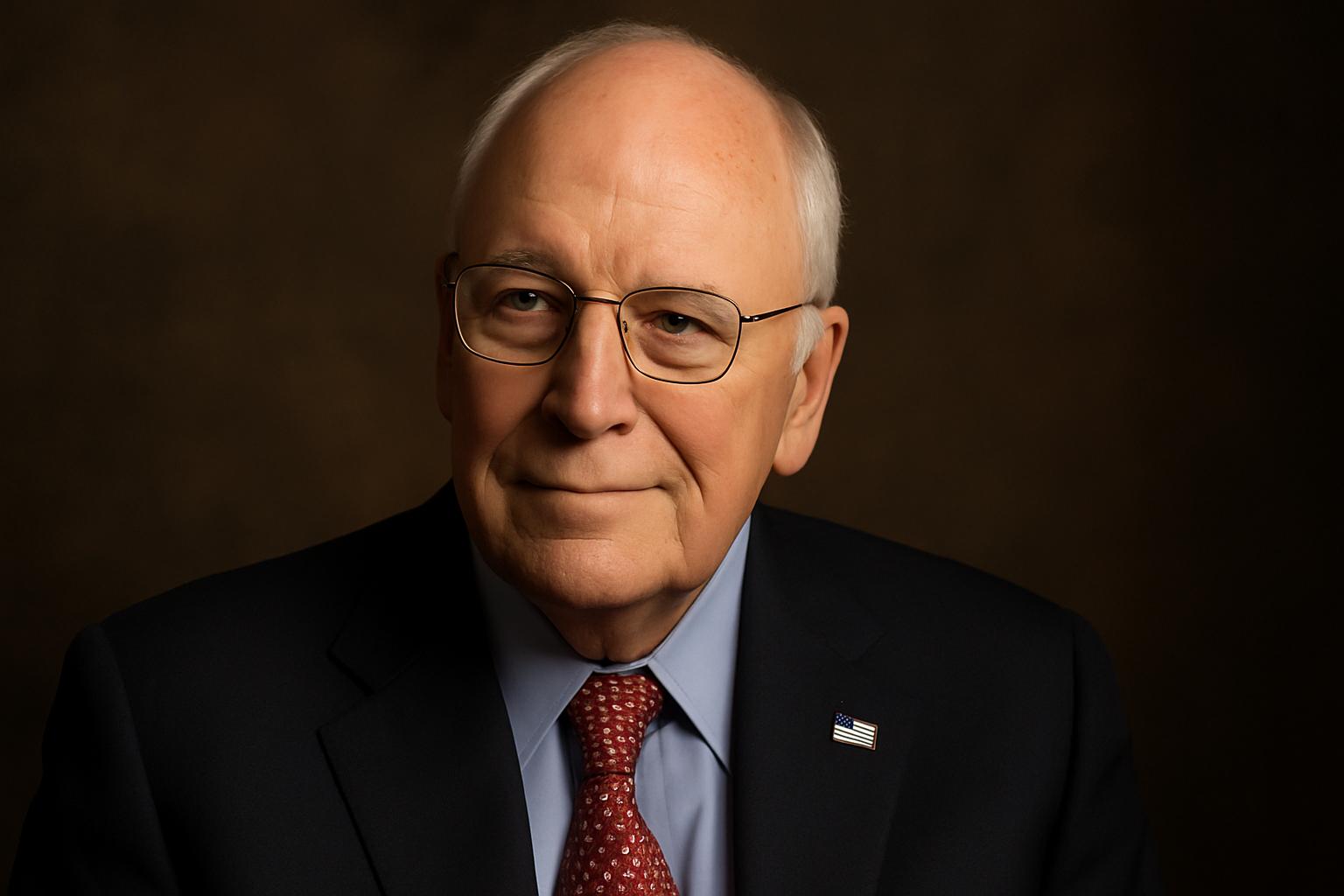
Former United States Vice President Richard B. “Dick” Cheney, one of the most influential and controversial figures in modern American politics, has died at the age of 84. Cheney passed away from complications related to pneumonia and cardiac and vascular disease, his family confirmed. Widely regarded as one of the most powerful vice presidents in US history, Cheney’s political career shaped America’s foreign policy and national security doctrines in the early 21st century.
Cheney served as the 46th Vice President of the United States under President George W. Bush from 2001 to 2009. His tenure coincided with the September 11, 2001 terrorist attacks, the subsequent wars in Afghanistan and Iraq, and the global War on Terror — events that defined both the Bush administration and Cheney’s enduring legacy. President Bush, in a statement, described Cheney as “a decent, honourable man” and said his death marked “a loss to the nation.” He added, “History will remember him as among the finest public servants of his generation — a patriot who brought integrity, high intelligence, and seriousness of purpose to every position he held.”
On the morning of 9/11, while President Bush was at an elementary school in Florida, Cheney was at the White House. When the attacks began, he was quickly escorted to the Presidential Emergency Operations Center beneath the White House. As chaos unfolded, Cheney was briefed on potential threats, including reports of hijacked planes heading toward Washington, D.C. Acting on Bush’s authorization, he gave military officials permission to shoot down any aircraft that posed a danger to national security — a moment that highlighted his command role during one of America’s darkest days.
The 9/11 attacks would go on to define Cheney’s vice presidency. For him and other senior administration figures such as Defense Secretary Donald Rumsfeld, National Security Advisor Condoleezza Rice, and Secretary of State Colin Powell, the attacks justified a new era of assertive military intervention. Cheney became the leading advocate for the “War on Terror,” arguing that the only way to protect the nation was to stay on the offensive. His view was summed up in what came to be known as the “Cheney Doctrine” — the belief that even a 1% chance of a catastrophic threat must be treated as a certainty.
This philosophy underpinned two major US military interventions: the invasion of Afghanistan in 2001 to dismantle the Taliban, and the 2003 invasion of Iraq to overthrow Saddam Hussein. Cheney insisted that Iraq possessed weapons of mass destruction and maintained links to Al-Qaeda — claims that were later discredited. Despite growing criticism as the war dragged on, he defended the decision to invade, saying it was based on the “best available intelligence.”
Cheney’s role in promoting “enhanced interrogation techniques” — including waterboarding and indefinite detention at Guantanamo Bay — made him one of the most divisive figures in post-9/11 America. While he called these measures necessary to protect national security, human rights advocates and critics argued that they amounted to torture and undermined America’s moral authority. Cheney, however, remained unapologetic, famously declaring, “I would do it again in a minute.”
As years passed, many of his predictions and assurances — such as claims that US troops would be “greeted as liberators” in Iraq or that the insurgency was “in its final throes” — proved incorrect. Yet, Cheney refused to recant his views, insisting that the administration acted decisively in an era of unprecedented threat.
Beyond his foreign policy influence, Cheney was a strong proponent of expanding presidential power under the theory of the “unitary executive.” He believed that the executive branch must have wide latitude to act independently in national security matters, often at odds with legislative and judicial oversight. “We have to work the dark side,” he once said, reflecting his conviction that secrecy and decisiveness were essential tools in defending the nation.
By the time he left office in 2009, Cheney had become a deeply polarizing figure. His approval ratings hovered around 30%, and many within both parties viewed him as a symbol of overreach and secrecy. However, in the years that followed, particularly during the Trump era, Cheney’s image experienced a partial reassessment. His outspoken criticism of former President Donald Trump — whom he accused of undermining democracy — drew praise from some of his former detractors.
Cheney and his daughter, Liz Cheney, emerged as some of the most vocal Republican critics of Trump after the January 6, 2021 Capitol riot. “In our nation’s 246-year history, there has never been an individual who was a greater threat to our republic than Donald Trump,” Cheney declared. “He tried to steal the last election using lies and violence to keep himself in power. He is a coward. A real man wouldn’t lie to his supporters.”
In 2024, Cheney made headlines once again when he revealed that he had voted for Democratic candidate Kamala Harris, citing a “duty to put country above partisanship.” His stance highlighted the deep divisions within the Republican Party and underscored his continuing influence on American political discourse even after retirement.
Dick Cheney’s death marks the end of an era defined by power, secrecy, and conviction. To his supporters, he was a patriot who made difficult decisions to protect his country in extraordinary times. To his critics, he was the architect of policies that damaged America’s moral standing and destabilized global politics.
Either way, Cheney’s impact on the trajectory of American policy and the presidency itself remains undeniable. His legacy — both celebrated and condemned — will continue to shape how future generations assess the balance between national security, morality, and political power in the modern era.