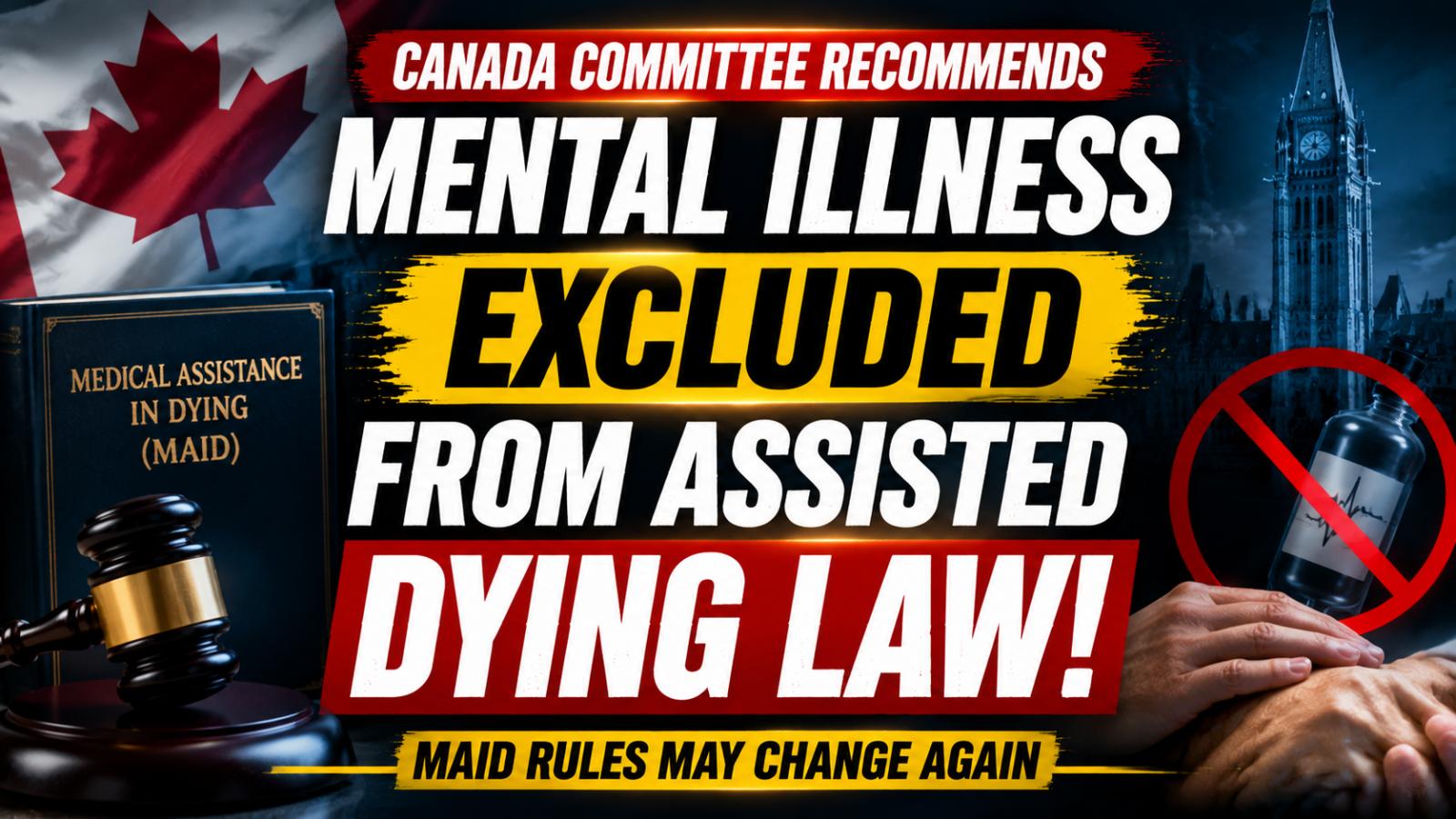
Canada Reconsiders Assisted Dying Eligibility Rules
A Canadian parliamentary committee has recommended that individuals whose only medical condition is a mental illness should be excluded from eligibility for medical assistance in dying (MAID), marking a significant development in the country’s ongoing debate over assisted death laws. The recommendation was issued by a 17-member panel reviewing the legal and ethical framework governing assisted dying in Canada.
Committee Calls for Legal Amendment
The committee proposed that the Criminal Code be amended to indefinitely prevent people whose sole underlying condition is a mental disorder from accessing assisted death. Although the recommendation is not legally binding, it is expected to strongly influence the government’s policy direction as lawmakers continue to evaluate the planned expansion of eligibility criteria.
Expanding Framework Under Review
Medical assistance in dying has been legal in Canada since 2016 for individuals with serious medical conditions near the end of life. In 2021, the law was expanded to include patients suffering from severe and incurable illnesses even when death was not reasonably foreseeable. A further planned expansion, set to include individuals whose only condition is a mental disorder, has already been postponed to 2027, following concerns about readiness in the mental health care system.
Rising Use of Assisted Death
Official data shows a steady increase in the use of MAID in recent years. Between 2019 and 2022, assisted deaths grew at an annual rate exceeding 30 percent. In 2024, 16,499 Canadians received medically assisted deaths, accounting for about 5.1 percent of all deaths in the country. While most cases involved individuals with a foreseeable natural death, a smaller portion involved patients who did not meet that condition.
Legal and Ethical Foundations
Canada’s assisted dying framework originates from a 2015 Supreme Court ruling that struck down the prohibition on assisted suicide, declaring it unconstitutional. The ruling came into effect in 2016, establishing nationwide access to MAID. Since then, the law has undergone multiple revisions, each reflecting ongoing legal, ethical, and medical debates.
Ongoing National Debate
The latest committee recommendation highlights continuing divisions over how mental illness should be treated within assisted dying laws. Supporters of stricter limits argue that safeguards are necessary to protect vulnerable individuals, while critics caution against excluding mental health conditions from end-of-life choices. The government is expected to review the report as it considers future amendments to the legislation.