Elon Musk’s Tesla Roadster flying demo has drawn contrasting reactions from technology leaders. Google CEO Sundar Pichai praised the spectacle, while AI scientist Yann LeCun questioned whether its compressed-air thrusters could ever support practical flying transport.
Tesla Roadster Flying Demo Stuns Viewers
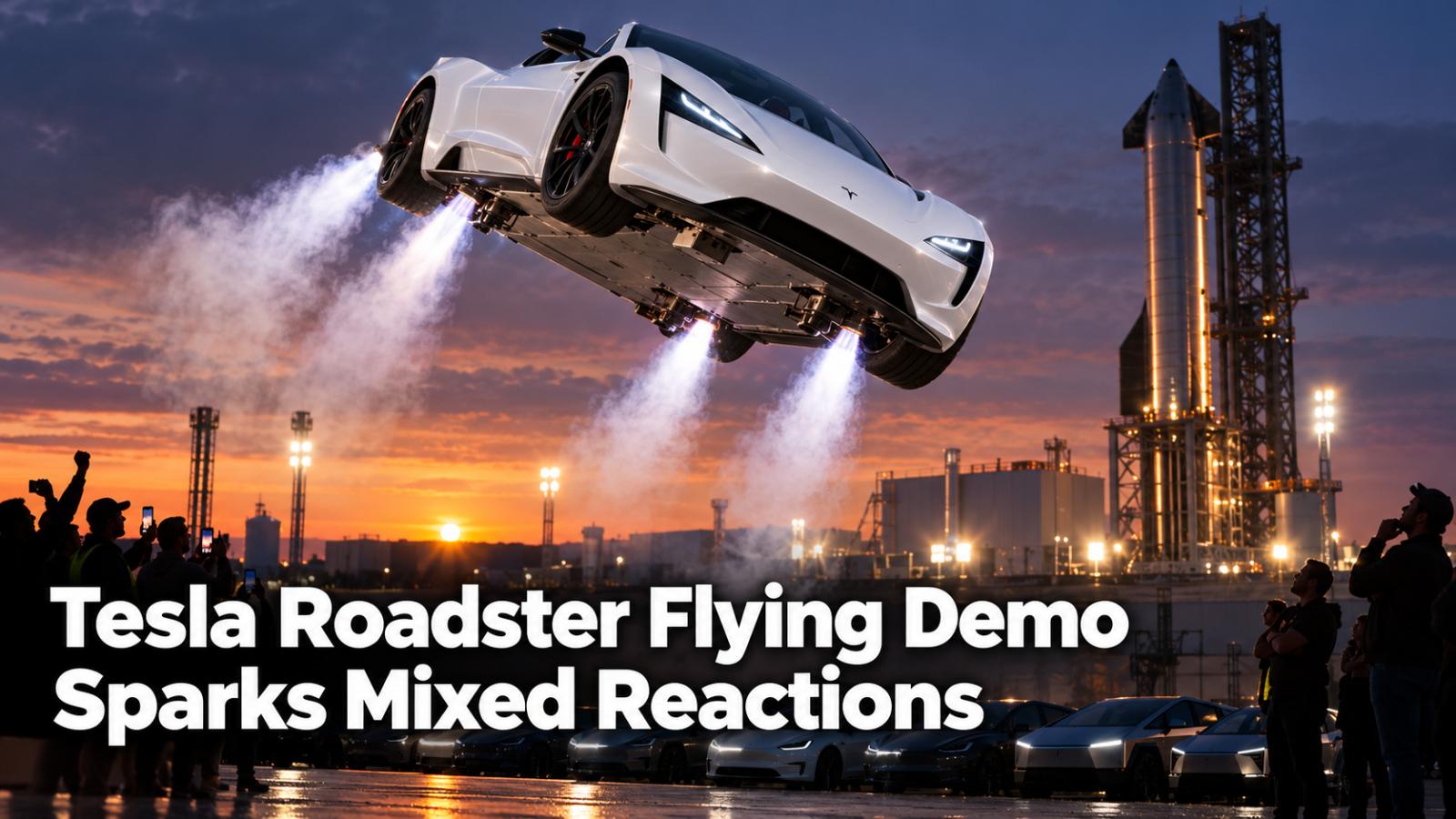
Unveiled on October 15, 2026, at SpaceX’s test facility in McGregor, Texas, the second-generation Roadster used cold-gas thrusters to leap above parked Tesla vehicles, including a Semi, flip in mid-air and land. Another stunt showed it driving upside down on a curved ramp with help from a suction system. The car operated without anyone aboard during the demonstrations.
Sharing the footage on X, Musk wrote, “Turns out the future does have flying cars.” Pichai joked, “The FSD version of this will be something:) congrats!” Musk thanked him and praised the engineers behind the project.
Yann LeCun Questions Compressed-Air Thrusters
LeCun, Meta’s former chief AI scientist, focused on the physics rather than the spectacle. After initially considering hydrogen peroxide propulsion, he identified the system as compressed-air thrusters and argued that its low efficiency would sharply restrict useful flight time.
He estimated a specific impulse below 50 seconds. This measures how efficiently a propulsion system uses its propellant, not the actual duration of flight. Even assuming compressed air accounted for half the car’s mass, LeCun calculated fewer than 10 seconds of useful thrust, possibly closer to five. He called it a “cute demo, but totally impractical.”
Why Brief Flight Is Not Everyday Transport
LeCun compared the system with hydrogen peroxide rockets used in older jetpacks, which he said could deliver around 150 seconds of specific impulse. Compressed-air jets also lose thrust as tank pressure drops. The thick vapour around the Roadster, he suggested, could be condensation caused by rapid depressurisation.
Tesla’s demonstration proved that a specially equipped car can make controlled airborne jumps, but it did not establish sustained flight, passenger safety or everyday usability. The thruster-equipped Rocket version is not approved for public roads, and Tesla says consumer production of the new Roadster is not expected to begin before 2028.