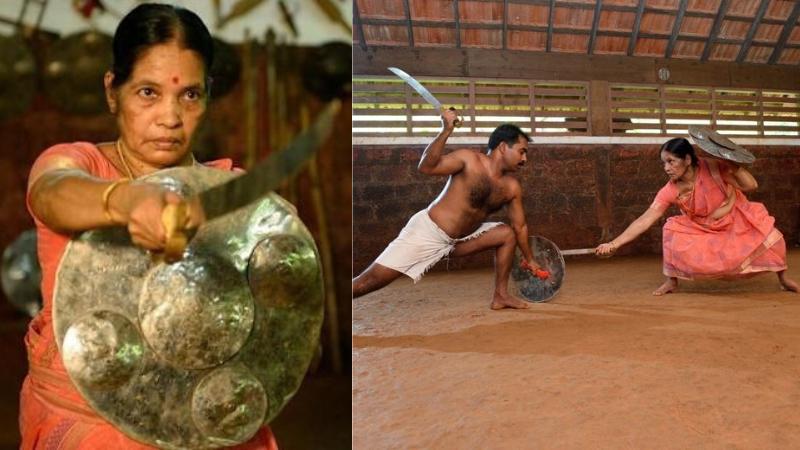
In the quiet town of Vadakara in Kerala, a remarkable woman continues to defy both age and convention. Meenakshi Raghavan, affectionately known as Meenakshi Amma, is 82 years old and still going strong as a master and teacher of Kalaripayattu – India’s oldest martial art. In a world where retirement is often expected at her age, Amma has no such intentions. "I'll probably practise Kalari until the day I die," she says, her voice brimming with quiet determination and grace. Kalaripayattu, with roots dating back over 3,000 years, is believed to have originated in Kerala. Its name derives from two Malayalam words: "Kalari," meaning battleground, and "Payattu," meaning fight. More than just a martial art, Kalaripayattu is a holistic system aimed at building physical strength, mental discipline, and effective self-defense skills. It incorporates body conditioning, armed and unarmed combat, and the ancient science of vital points, known as marmashastra.
Though now hailed as a local legend, Meenakshi Amma’s journey began humbly. She was seven when she first stepped into the Kalari – the traditional red-earth arena where the martial art is practised. Recognizing her grace as a dancer, her guru, VP Raghavan, encouraged her father to allow her to train. This moment would change her life forever. As a member of the Thiyya community, she was part of a lineage that often faced social exclusion. In fact, her future husband and guru, Raghavan, was only 15 when he and his brothers opened their own Kalari school after being denied admission due to caste discrimination. Amma’s training, which began in an era when girls were typically expected to stop physical education upon reaching puberty, was unique. Her father’s support allowed her to continue beyond societal expectations, eventually leading to a lifelong partnership with Raghavan in both marriage and martial arts. They taught hundreds of students, many of whom came from economically disadvantaged families. Payment was rarely monetary, with students often offering dakshina – a traditional tribute – as a token of respect.
The school they built together was founded in 1950, and today Meenakshi Amma continues to run it, holding classes from five in the morning until noon. Her son Sanjeev, now 62, also teaches at the school and is poised to take the reins when his mother is ready to step back. "She's still my toughest opponent," he admits, acknowledging both her skill and her dedication. Kalaripayattu training is structured across four main stages. It begins with meypattu, involving oil massages and physical exercises that prepare the body. After nearly two years, students advance to kolthari, which involves combat with wooden sticks. The next stage, angathari, includes the use of metal weapons. Finally, students reach verumkai – a sophisticated level of unarmed combat that takes several years to master.
Although Kalaripayattu is less globally known than Chinese martial arts like Kung Fu, it is believed to have significantly influenced them. Historians and martial arts experts suggest that the Indian Buddhist monk Bodhidharma brought principles of Kalari, including breathing techniques and marmashastra, to China in the 6th century, shaping the practices of Shaolin monks. Despite being in her ninth decade, Meenakshi Amma remains an active performer and continues to travel for demonstrations. She’s become a cultural icon in Kerala, often invited to public events and honored by politicians and public figures alike. During a recent interview, three local politicians visited her home to request her presence at an awards ceremony. With characteristic humility, she accepted.
Her students speak of her with deep reverence. Former student KF Thomas recalls her unique combination of affection and discipline. "She's an inspiration to women everywhere – a rare person who shows love and affection to her students, yet remains a strict disciplinarian when it comes to Kalari," he says. Over the decades, many of her students have gone on to open their own Kalari schools, helping spread the ancient art form across Kerala and beyond. Their success is a source of great pride for Meenakshi Amma, who sees their achievements as an extension of her own legacy.
While she acknowledges that one day she will hand over the responsibility of the school to her son, there is no indication that she plans to slow down anytime soon. Her devotion to Kalaripayattu remains as fierce as it was when she was a young girl stepping into the Kalari for the first time. Meenakshi Amma stands not only as a living embodiment of India’s martial traditions but also as a beacon of strength, resilience, and lifelong learning. Her story continues to inspire a new generation of warriors – both men and women – to take up the art of Kalaripayattu, proving that age is truly no barrier when passion leads the way.