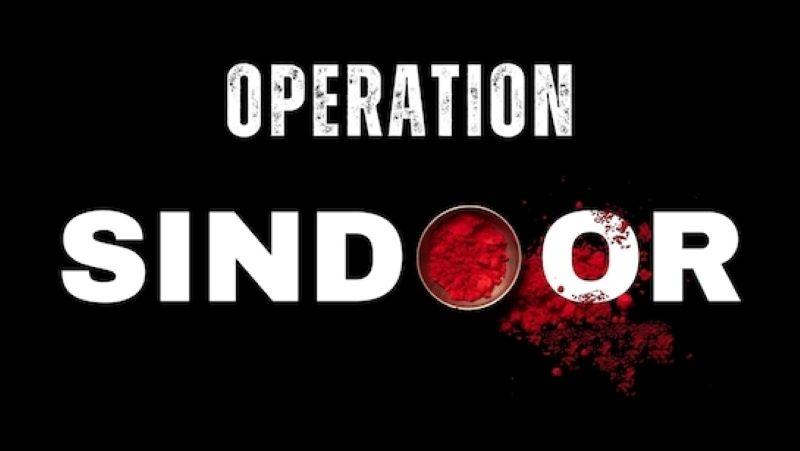
The Indian Army released a symbolic image of the operation’s title Operation Sindoor in bold block letters. One of the letters, ‘O’, was represented by a bowl of vermilion, some of which appeared to spill over, mirroring the trauma and bloodshed the victims experienced. The caption on the image read, “Justice is served. Jai Hind.”
The attack in Pahalgam crossed multiple red lines. Tourists were directly targeted, and religion was used as a basis for mass execution. The visual aftermath was shared widely on social media and news platforms. A heartbreaking image showed newlywed Himanshi Narwal, still wearing her wedding chooda, sitting beside the lifeless body of her husband, Indian Navy officer Lieutenant Vinay Narwal. Another devastating scene involved Pallavi Rao, who just a day before had recorded a joyful video with her husband Manjunath Rao on a shikara, now seen crying for help after he was gunned down.
Other families also suffered irreparable loss Shital Kalathiya lost her husband Shailesh, Sohini Adhikari lost Bitan, Aishanya lost Lieutenant Shubham Dwivedi, and Pragati Jagdale lost Santosh Jagdale. These losses united the country in sorrow, and the military response was seen as a message of justice.
Several of the widows expressed emotional support and gratitude toward the government and Prime Minister Narendra Modi. Aishanya, grieving the loss of her husband, said the Prime Minister had honored their faith. “Wherever my husband is, he will be at peace today,” she said after hearing about Operation Sindoor. Sangita Ganbote, wife of Kaustubh Ganbote, echoed this sentiment, calling it a befitting reply. “The government has honored those of us who lost our husbands,” she said.
Pragati Jagdale was moved to tears upon hearing the name of the operation. “It’s a fitting response after they erased our sindoor. When I heard the operation’s name, I cried. I thank the government sincerely,” she said. For the first time since the 1971 war, India carried out a tri-services operation involving the Indian Army, Navy, and Air Force. The strikes were launched at 1:44 a.m. and targeted key terror infrastructure inside Pakistan and Pakistan-Occupied Kashmir (PoK). The targets included bases linked to Lashkar-e-Taiba and The Resistance Front, both of which are believed to be behind the Pahalgam killings.
Sources revealed that Prime Minister Modi was closely monitoring the operation as it unfolded. His earlier warning that the perpetrators would face unimaginable consequences was a precursor to the strike. In his statement following the Pahalgam tragedy, he declared the attack to be not only against tourists but against the very soul of India. “From Kargil to Kanyakumari, there is grief and rage,” he had said. The Indian government clarified that the strikes were focused, deliberate, and non-escalatory. No Pakistani military infrastructure was hit. The statement emphasized that the objective was to demonstrate restraint while delivering justice. “We are living up to the commitment that those responsible for this attack will be held accountable,” the government said.
Pakistan, in retaliation, began cross-border firing and artillery shelling, resulting in the death of three Indian civilians. Lt Gen Ahmed Sharif Chaudhary, the Director General of ISPR in Pakistan, confirmed that Indian strikes had hit sites in Kotli, Muridke, Bahawalpur, Chak Amru, Bhimber, Gulpur, Sialkot, and two sites in Muzaffarabad. Many of these locations are known hubs for terror outfits. Muridke houses Lashkar-e-Taiba’s headquarters, while Bahawalpur is the base of Jaish-e-Mohammad.
Indian Defence Minister Rajnath Singh posted “Bharat Mata Ki Jai” on his X account shortly after the operation. The Indian Army followed with “Justice is served. Jai Hind.” Meanwhile, Pakistani Prime Minister Shehbaz Sharif responded by labeling the strike an act of war and stated that Pakistan reserved the right to retaliate.
India’s decision to name the operation after a symbol of marital bond, and thus human loss, underscores the emotional weight carried by the attack and its victims. Operation Sindoor isn’t just a name it represents the nation’s grief, resilience, and determination to bring justice to those who commit inhuman acts of terror.