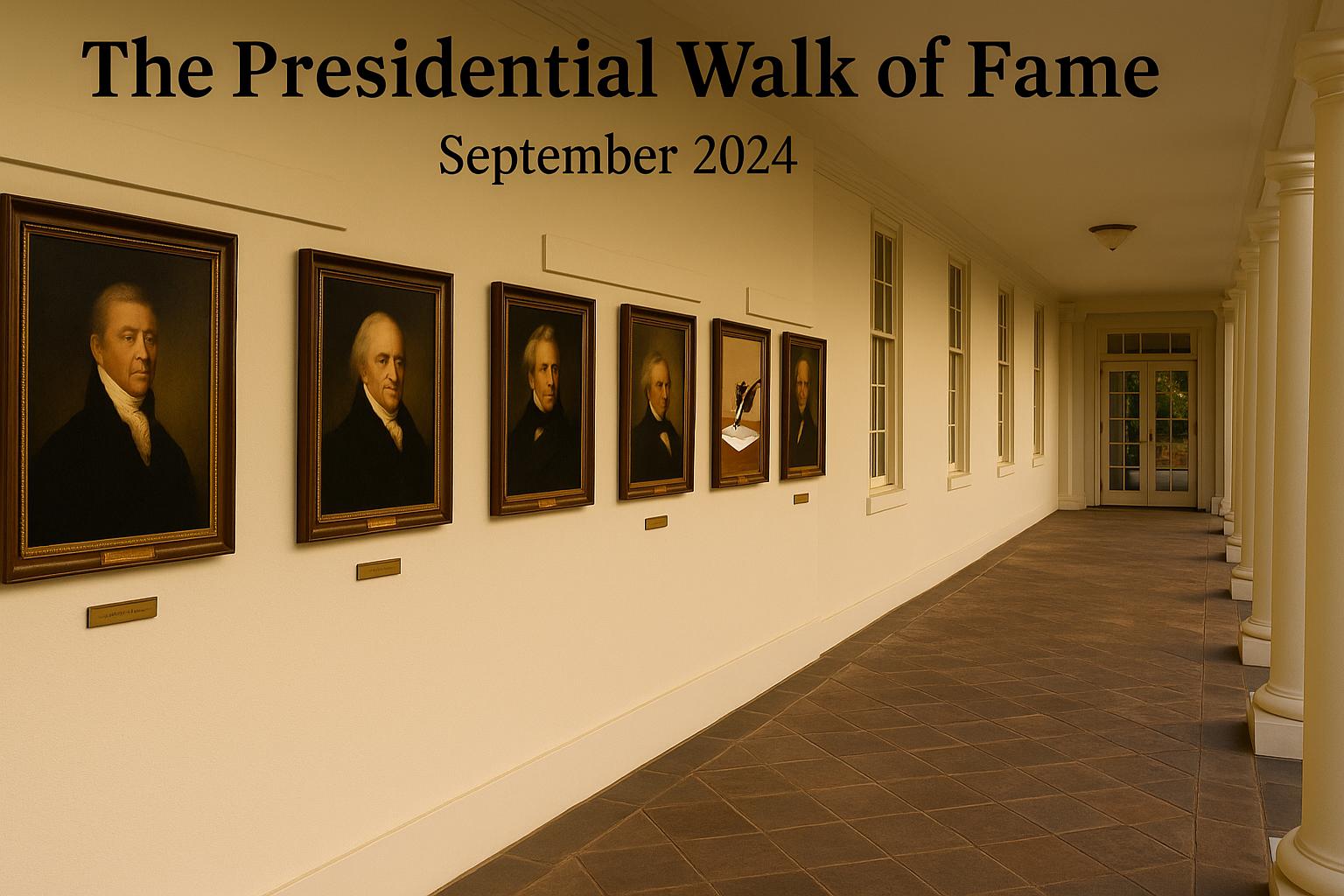
Former United States President Donald Trump has unveiled a new addition to the White House grounds that he is calling the “Presidential Walk of Fame.” The walkway, located along the West Wing Colonnade, is lined with framed portraits of every past commander in chief of the nation. The feature has already sparked sharp debate because of the striking omission of President Joe Biden, who instead of being represented with a headshot like his predecessors is symbolized by a photograph of an autopen machine signing his name. The deliberate replacement was ordered directly by Trump, who has often mocked Biden’s reliance on aides and his use of the autopen for official duties.
The walkway was presented with great fanfare as Trump guided a group of reporters and staffers through the colonnade, highlighting the framed images of Washington, Lincoln, Roosevelt, Kennedy, Reagan, Obama and others. Each president had a designated space meant to symbolize continuity of leadership across more than two centuries. However, when reaching the space reserved for Joe Biden, observers saw the image of an autopen, the mechanical device used to replicate signatures, instead of his official portrait. This move was interpreted immediately as a jab at Biden’s legitimacy, echoing Trump’s repeated claims that Biden is unfit for office and overly dependent on staff support.
The timing of the unveiling added fuel to the controversy. It came just days after Trump addressed the United Nations General Assembly, where he once again repeated his false assertions of voter fraud in the 2020 election while mocking Biden in front of a global audience. By introducing the walkway so soon after that speech, critics argue Trump deliberately sought to extend his message of ridicule beyond the world stage into the very grounds of the White House. For his supporters, the gesture represented a symbolic correction of what they view as an illegitimate presidency, while opponents described it as disrespectful and an insult to the office itself.
Trump has hinted for months that he would find a way to insert the autopen image into a symbolic display of American leaders. He has long alleged, without proof, that Biden allowed aides to sign documents in his place using the autopen, including legislation, pardons and executive orders. These claims have been dismissed by experts as baseless, since the autopen has been used by multiple administrations from both political parties, dating back decades. Presidents have relied on the device to authorize official business when travel or scheduling made it impractical to sign documents in person. Despite this history, Trump has turned the practice into a political weapon against Biden.
Adding another dimension to the issue, a Republican-led House committee is currently investigating Biden’s use of the autopen. The committee is seeking records of when the device was employed, who authorized its use, and whether important legislation or pardons were signed without Biden’s direct involvement. The investigation has added political weight to Trump’s symbolic replacement of Biden’s portrait. Supporters of the inquiry argue that transparency is necessary to preserve the sanctity of the presidency, while critics maintain that the probe is politically motivated and intended to discredit Biden ahead of future elections.
The unveiling of the walkway has once again underscored the continuing polarization in American politics. For Trump’s allies, the gallery is celebrated as a reminder of presidential strength and legacy, with Biden’s autopen photo standing as a message of weakness. For Biden’s supporters, the exclusion is seen as a petty act that undermines the tradition of honoring all elected leaders regardless of party. The broader public has been left to debate whether this move is a harmless political stunt or a dangerous precedent in how presidents treat their predecessors.
Observers note that while Trump’s addition to the White House may not be permanent, the controversy ensures it will remain in public conversation for weeks to come. Questions also remain about whether the display will be preserved or altered by future administrations. As with many of Trump’s symbolic gestures, the Presidential Walk of Fame reveals less about history than it does about the sharp divisions of the present day.