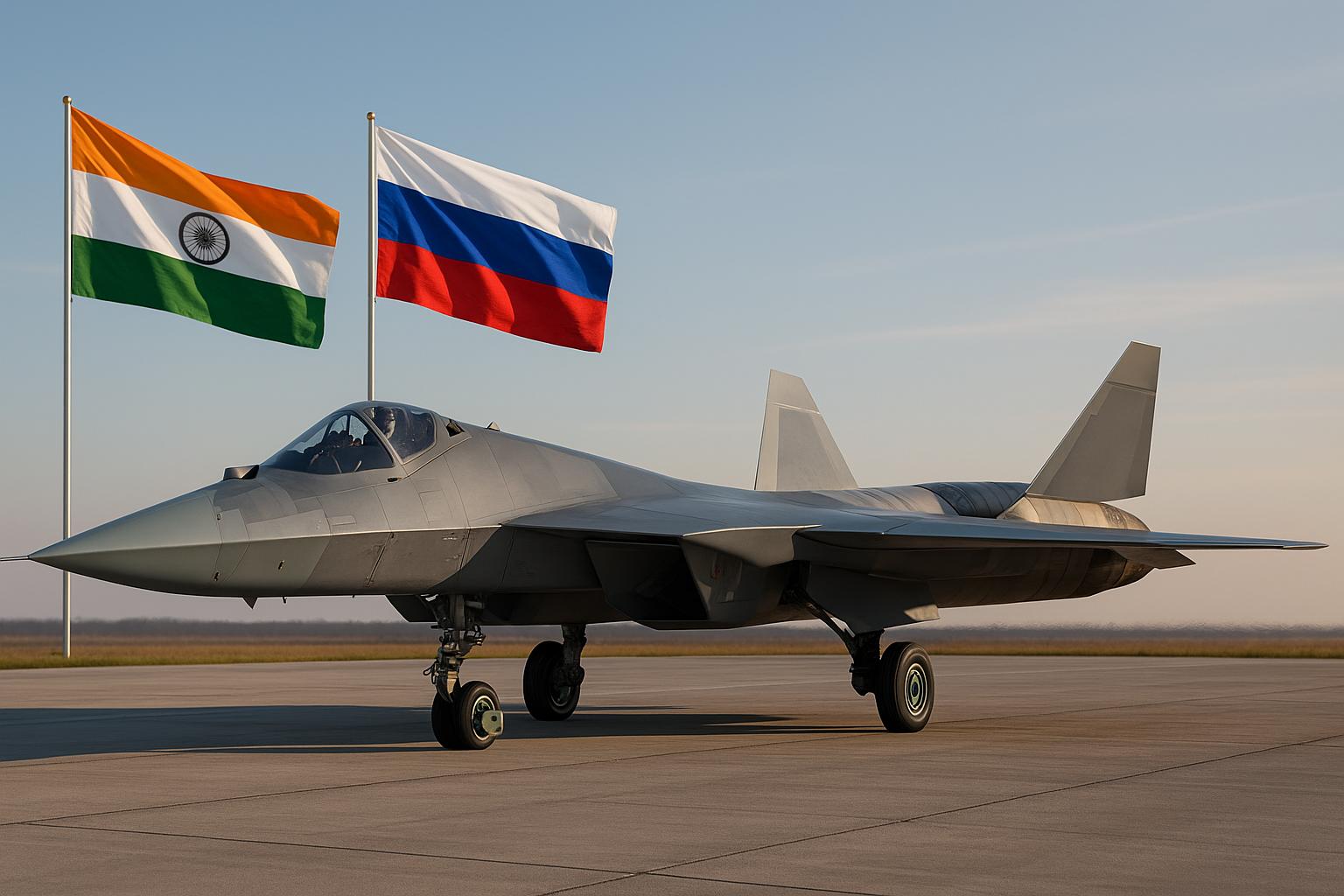
Russia has reportedly proposed a wide-ranging technology transfer package for its fifth-generation Su-57 stealth fighter jet, signalling that defence cooperation may take centre stage when President Vladimir Putin visits India next month. The offer comes as New Delhi continues to balance long-standing strategic ties with Moscow while facing Western scrutiny over its neutral stance on the conflict in Ukraine. The proposal, according to officials familiar with the matter, could strengthen India’s air combat capabilities at a crucial time for the Indian Air Force.
The Su-57, developed by Sukhoi, is Russia’s flagship fifth-generation fighter and a direct rival to the American F-35. Its export version, the Su-57E, showcased its capabilities at the Dubai Airshow 2025, featuring a combination of stealth, high manoeuvrability and advanced avionics. The aircraft’s twin engines and thrust-vectoring technology allow it to perform complex aerial manoeuvres at low speeds and high angles of attack, offering an advantage in close-range combat. At the air show, the jet also displayed its internal weapons bay for the first time, with mock-ups of the Kh-58 anti-radiation missile and R-74M2 air-to-air missile, drawing attention from global defence observers.
Speaking at the sidelines of the event, Sergey Chemezov, chief executive of Russia’s state defence corporation Rostec, emphasised the long-standing defence partnership between the two nations. He stated that Moscow is willing to supply India with any military equipment it requires and reaffirmed Russia’s readiness to support New Delhi’s strategic needs. Chemezov said the relationship has remained stable over decades, including during periods when India faced international sanctions.
Russian officials have indicated that the Su-57 offer includes unrestricted technology transfer. The plan proposes that India initially purchase jets manufactured in Russia while gradually shifting production to Indian facilities. According to representatives from Rosoboronexport, Moscow is prepared to transfer a wide range of technologies, from engine systems and low-signature materials to optics, artificial intelligence components, AESA radar and advanced air weapons. Russian officials have also noted that India’s technical requirements have been taken into account and described them as entirely acceptable.
The proposal arrives at a time when India is developing its own fifth-generation fighter, the Advanced Medium Combat Aircraft (AMCA). Although the indigenous programme remains a priority, India continues to evaluate foreign platforms to bridge the capability gap until AMCA becomes operational. The Indian Air Force currently operates 29 fighter squadrons, well below the sanctioned strength of 42. Air Chief Marshal AP Singh recently stated that the force needs to induct around 35 to 40 aircraft annually over the next two decades to meet long-term goals under India’s Roadmap 2047.
A comprehensive technology transfer for the Su-57 would, according to defence analysts, offer India unprecedented access to sensitive fighter aircraft systems that Western nations have been reluctant to share. Such an agreement could accelerate India’s domestic aerospace capabilities and enhance its ability to build advanced stealth platforms independently. However, the move could also complicate strategic ties with the United States, which has been encouraging India to consider the F-35 while deepening defence cooperation in the Indo-Pacific.
As preparations continue for the December meeting between Prime Minister Narendra Modi and President Putin, the Su-57 proposal highlights the evolving nature of India–Russia defence relations. Whether New Delhi chooses to pursue the offer will depend on cost, long-term industrial benefits and the impact on its broader diplomatic strategy, but the proposal underscores Moscow’s intent to remain a central defence partner for India in the coming decades.