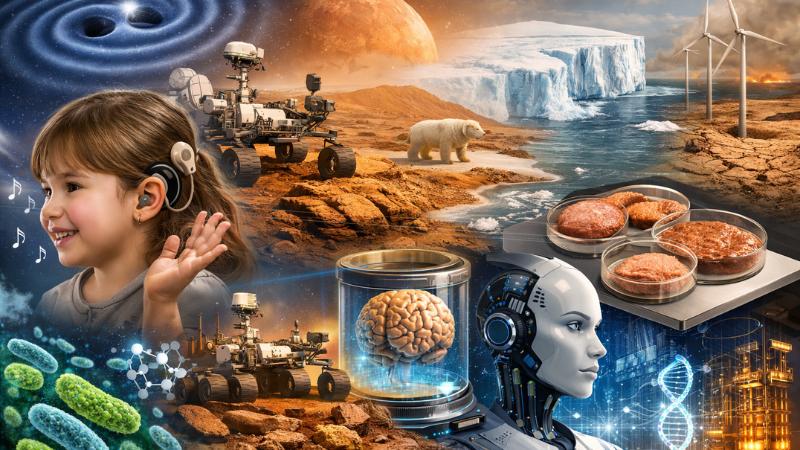
A century ago, the notion of restoring lost senses or detecting ancient life beyond Earth belonged firmly to science fiction. In 2025, such ideas moved decisively into reality as a series of scientific breakthroughs reshaped long-standing assumptions across medicine, space science, climate research, and artificial intelligence. These advances did not arrive as distant promises or speculative theories, but as working solutions that delivered measurable results and altered how science interacts with daily life.
One of the year’s most striking developments came from gene therapy research that restored hearing in individuals born with profound genetic deafness. Through a single inner-ear injection targeting a faulty gene, patients who had never perceived sound began to hear speech, music, and environmental noise within weeks. This marked a significant shift in medical science, demonstrating that inherited sensory loss can be addressed at its biological source rather than managed with assistive devices. Researchers say the success of this approach may open doors to future treatments for other genetic conditions affecting vision, movement, and neurological function.
Artificial intelligence also played a decisive role in advancing medicine. As antibiotic resistance continued to undermine conventional drug discovery, AI-driven models explored chemical structures beyond the reach of traditional methods. These systems identified entirely new antibiotic compounds that showed early effectiveness against drug-resistant bacteria. By reducing discovery timelines from decades to months, this approach offered renewed hope in the global effort to combat infections that threaten modern healthcare systems.
In space science, researchers detected a previously unknown type of gravitational wave event, pointing to the merger of unusually massive black holes. The signal challenged existing theories about how stars evolve and collapse, while also refining the tools used to observe the universe. Scientists say such findings strengthen humanity’s ability to study cosmic phenomena that shape galaxies and influence the structure of space itself.
Mars research delivered equally compelling developments. Data collected by robotic exploration revealed organic molecules and mineral formations closely associated with biological processes on Earth. While researchers stopped short of declaring definitive evidence of past life, the consistency of these findings moved Mars closer to being recognized as a world that may once have supported living organisms. This has renewed debate about the uniqueness of life on Earth and the potential for biology elsewhere in the solar system.
On Earth, scientific inquiry also influenced ethics and policy. Studies examining animal behavior and neural responses provided strong evidence that fish and some invertebrates experience pain in complex ways. These conclusions extended beyond academic circles, shaping discussions around animal welfare laws, fishing practices, and research standards. The findings prompted policymakers to reconsider how humans interact with other species, blending scientific insight with moral responsibility.
Quantum computing crossed a practical threshold during the year as researchers achieved significant improvements in error correction. These advances allowed quantum systems to perform longer and more reliable calculations, bringing practical applications closer to reality. Scientists anticipate impacts ranging from improved climate modeling to more accurate drug simulations, while also raising questions about the future of digital security.
Climate research delivered some of the most sobering conclusions of 2025. Analyses combining satellite observations and long-term models suggested that certain environmental tipping points, including polar ice loss and changes in ocean circulation, may no longer be reversible within human timescales. Researchers emphasized that these findings were grounded in data rather than advocacy, underscoring the urgency of adaptation strategies as well as mitigation efforts.
Artificial intelligence also began to influence how science itself is conducted. In several research settings, AI systems moved beyond data analysis to propose original, testable hypotheses. Some of these ideas were later validated through human-led experiments, raising new questions about authorship, credit, and the evolving nature of discovery. Scientists increasingly view AI not just as a tool, but as a collaborative participant in research.
Food technology saw a breakthrough as well, with lab-grown meat and fermented proteins reaching price levels close to conventional animal products. This shift moved alternative proteins from niche markets toward mainstream consumption, carrying implications for emissions, land use, and animal welfare. Researchers suggest that changes in food production could have lasting effects on both environmental sustainability and global diets.
Taken together, these developments illustrate how science in 2025 became more directly connected to human experience. From restoring lost senses to uncovering traces of ancient life, the year’s discoveries reshaped how people understand health, responsibility, and humanity’s place in the universe. What once seemed impossible not only became achievable, but began influencing decisions that will define the years ahead.