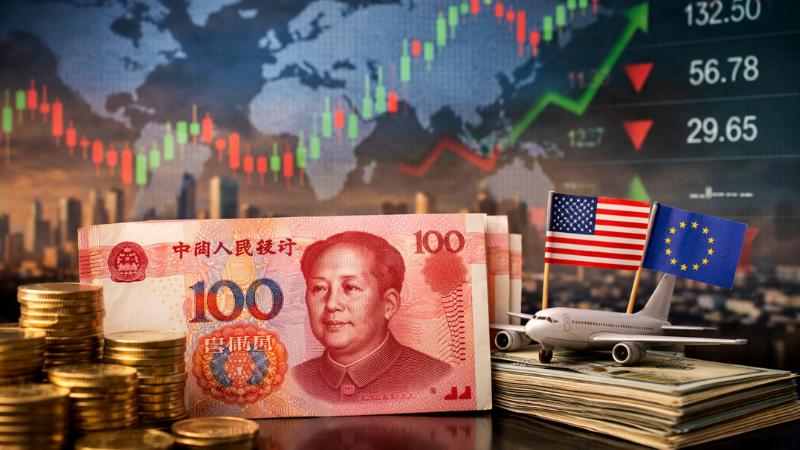
China’s record-breaking trade surplus is increasingly reshaping global financial markets as export earnings that once accumulated primarily in state reserves are now being redirected into private investments overseas. The shift marks a notable departure from Beijing’s traditionally centralized management of foreign exchange inflows and introduces new dynamics into global capital movements at a time of heightened sensitivity over trade imbalances and financial stability.
Last year’s trade surplus, estimated at $1.2 trillion, was no longer absorbed mainly by the central bank. Instead, close to two-thirds of the foreign assets generated through trade were taken up by companies, households, and state-linked financial institutions operating outside the official reserve system. This reallocation reflects broader changes in China’s financial framework, including greater flexibility for the yuan and expanded channels for private entities to deploy capital abroad.
Data from China’s currency market regulator show that investors in the non-official sector increased their overseas asset holdings by more than $1 trillion in the first three quarters of last year. That pace of expansion was more than double the average annual increase recorded over the past decade, highlighting the scale and speed of the shift. The funds were directed into a range of international assets, from equities to fixed income instruments and managed investment products.
Estimates indicate that Chinese private investment in overseas securities rose by about $535 billion during the year, encompassing purchases of US stocks, European bonds, and global mutual funds. While comprehensive country-level data remain unavailable, the magnitude of these flows underscores China’s growing influence on international financial markets beyond traditional trade channels.
This movement of capital represents a clear break from China’s long-standing approach of recycling export earnings into official reserves, which were then deployed largely through government-directed strategies. As private investors assume a greater role, global markets are becoming more exposed to shifts in Chinese investment sentiment and domestic policy changes within the country.
Economists note that the growing footprint of Chinese private capital is likely to deepen China’s role in global liquidity conditions. As these investments become embedded across major markets, fluctuations in China’s currency policy or economic outlook could have broader international consequences. The trend also introduces new vulnerabilities, particularly the risk of sudden capital reversals that are less directly controlled by authorities.
A rapid appreciation of the yuan could trigger exporters to convert foreign currency holdings back into domestic funds, potentially setting off a chain reaction of inflows and altering capital flow directions. Such a scenario could strain both overseas markets and China’s own financial system, especially if movements occur abruptly.
At the same time, the expanding presence of Chinese institutions within the core infrastructure of global finance may complicate oversight. With greater autonomy in deploying capital abroad, these entities are becoming more resilient to external pressures while posing challenges for international regulators seeking transparency.
As China continues to rebalance how it manages the wealth generated by its trade dominance, the durability of this shift will depend largely on domestic economic conditions and policy decisions. What is already evident is that the transformation is altering the flow of global capital, reinforcing China’s influence while introducing new risks into an interconnected financial system.