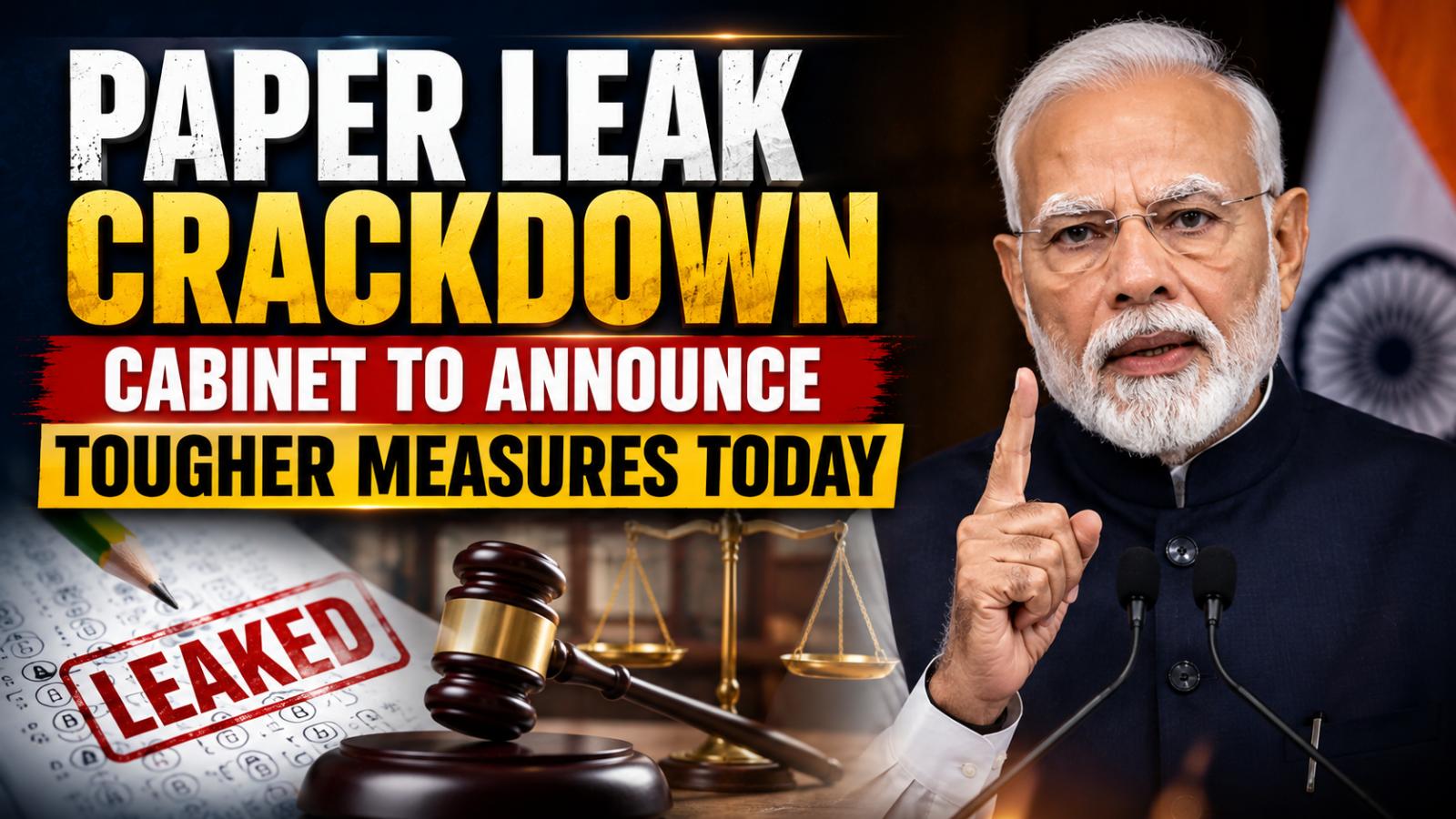
The Union Cabinet will review a draft paper leak bill proposing fast-track courts and stricter punishment for examination fraud. PM Modi said the measures aim to protect students, prevent academic-year losses and strengthen action after the alleged NEET paper leak.
Paper Leak Bill: Cabinet to Review Tougher Measures Today
The Union Cabinet is set to discuss a draft proposal aimed at strengthening action against examination paper leaks, Prime Minister Narendra Modi announced in a late-night video message. The proposed measures include fast-track courts and tougher punishment for people involved in leaking question papers or disrupting public examinations.
The Prime Minister said paper leaks were not a minor matter because they caused distress to lakhs of candidates and their families. The government’s immediate responsibility following the alleged NEET-UG paper leak, he said, was to ensure that affected students did not lose an entire academic year.
The official Press Information Bureau confirmed that stricter action against paper leaks would be considered by the Cabinet on Friday, July 24. The announcement came as demonstrations over examination irregularities continued in Delhi and other parts of the country.
Paper Leak Bill to Include Fast-Track Courts
Modi said government departments had been directed to prepare provisions for dedicated fast-track courts so that paper leak cases could be completed without prolonged delays. Officials worked on the proposal through Thursday and submitted a draft to the Prime Minister late that night.
According to the announcement, the Cabinet will examine provisions covering faster trials and more stringent punishment. Suggestions made by Cabinet ministers will be incorporated before the proposal receives its final form.
The exact penalties, jurisdiction of the proposed courts and types of examinations covered by the new provisions had not been publicly detailed at the time of the announcement. These aspects are expected to become clearer after the Cabinet meeting and the introduction of the Bill in Parliament.
Paper Leak Bill May Reach Parliament Next Week
The government intends to introduce the legislation during the second week of the ongoing Monsoon Session, which begins on Monday, July 27. Modi said efforts would be made to secure passage in both Houses of Parliament at the earliest.
India already has the Public Examinations (Prevention of Unfair Means) Act, 2024, which covers question-paper leaks, organised cheating, impersonation and other offences connected with notified public examinations. The new proposal is expected to reinforce the existing legal framework, particularly through quicker trials and stricter consequences, although the final relationship between the proposed Bill and the 2024 law remains to be disclosed.
Once introduced, the Bill will need parliamentary approval before becoming law. Opposition parties are also expected to seek a wider debate on examination security, accountability and the handling of the alleged NEET irregularities.
Paper Leak Case Action and NEET Re-Examination
Modi said several people linked to the alleged leak had already been arrested and sent to jail. However, he argued that arrests alone were insufficient and that a stronger institutional system was required to deter organised examination fraud.
The Prime Minister said the government mobilised its administrative machinery to arrange a fresh examination for nearly 22 lakh students. The results were declared on July 19, allowing candidates to continue with the academic admission process without losing a year.
The government has presented the re-examination and investigation as evidence of swift action. Protesters and Opposition parties, however, have continued to demand greater accountability, a transparent investigation and the resignation of Union Education Minister Dharmendra Pradhan.
Paper Leak Protests Keep Pressure on Government
The proposed legislation comes amid nationwide anger over the alleged NEET paper leak and repeated disruptions during the Monsoon Session. Student groups have argued that examination irregularities affect careers, family finances and confidence in the recruitment and education systems.
The government maintains that those responsible are being prosecuted and that additional reforms will make examination procedures more secure. Fast-track courts could reduce delays in paper leak trials, but their effectiveness will depend on the final provisions, investigative capacity and implementation across jurisdictions.
The Cabinet’s decision will therefore be closely watched by students, parents and examination authorities. Until the approved draft is released, the exact punishment, court structure and implementation timeline should be treated as pending rather than final.