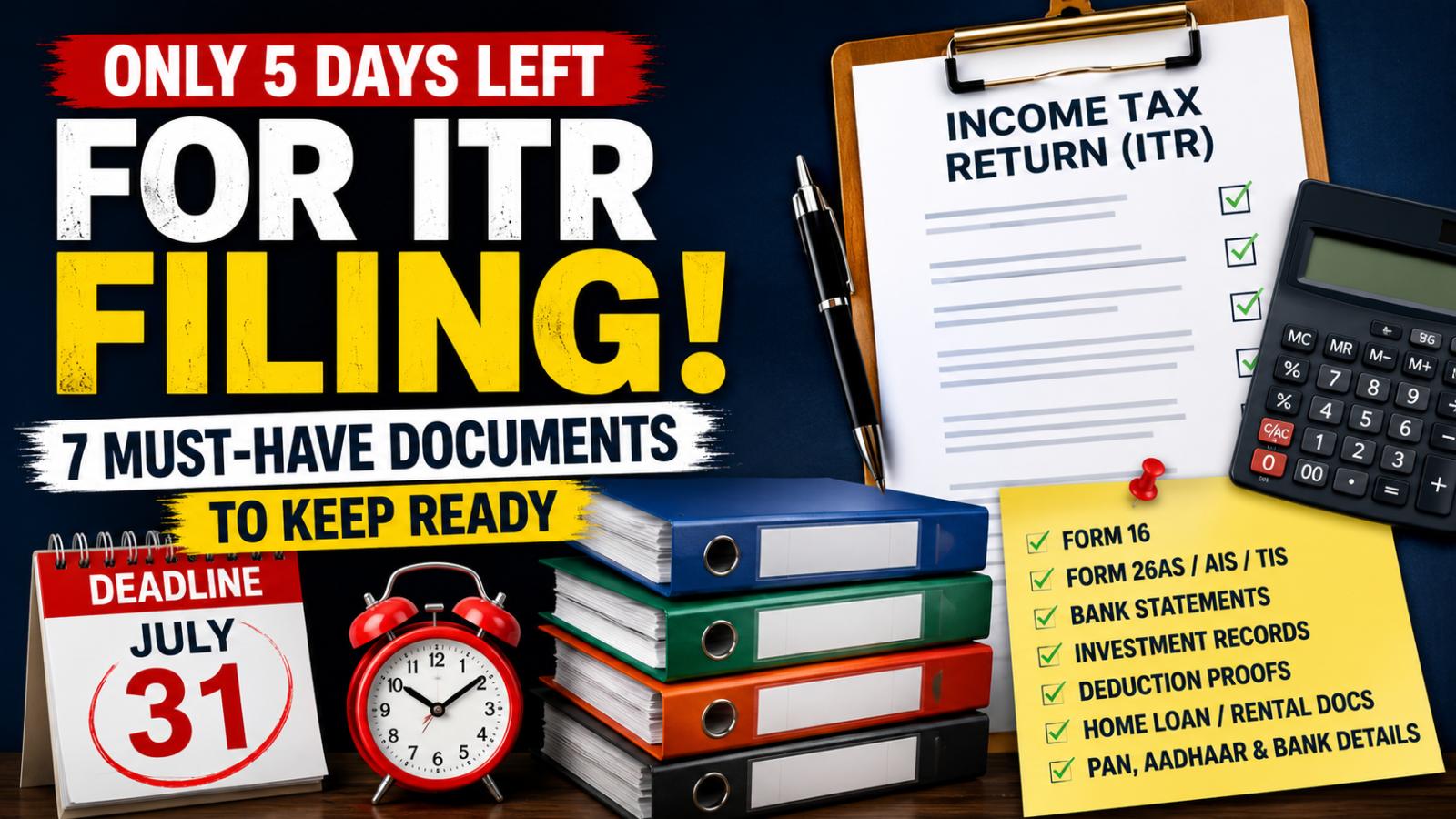
Taxpayers whose applicable ITR deadline is July 31, 2026, should organise their income, investment and tax records before starting the filing process. Keeping seven essential sets of documents ready can prevent incorrect disclosures, delayed refunds, missed deductions and possible tax notices.
ITR Deadline Nears For Eligible Taxpayers
With the July 31, 2026, income tax return deadline approaching for eligible taxpayers, individuals should avoid waiting until the final day to collect their records. The Income Tax Department has also advised relevant Assessment Year 2026–27 filers to submit returns early and avoid the last-day rush.
The deadline is not necessarily identical for every taxpayer or return form. Individuals should confirm their applicable ITR form and due date on the official e-filing portal. For example, the department currently lists August 31, 2026, as the due date for ITR-4 for AY 2026–27.
Although most income tax returns are annexure-less and supporting papers are generally not uploaded with the return, taxpayers must retain them in case the department seeks evidence during an assessment or inquiry.
Form 16 And Tax Statements Must Be Reconciled
The first document salaried taxpayers should collect is Form 16, which contains salary and tax deducted at source details. Anyone who changed jobs during FY 2025–26 should obtain Form 16 from every employer and combine the salary figures before filing.
Form 16 should then be matched with Form 26AS, the Annual Information Statement and the Taxpayer Information Summary. Form 26AS primarily displays TDS and TCS information, while AIS provides a broader record of reported financial transactions. Taxpayers can also submit online feedback when AIS contains incorrect or duplicate information.
Relying only on Form 16 may result in bank interest, dividends, capital gains or other income being missed. Any significant difference between personal records, AIS and Form 26AS should be examined before the return is submitted.
Bank, Investment And Deduction Records Are Essential
Taxpayers should keep bank statements and interest certificates for savings accounts, fixed deposits and recurring deposits. Interest income may need to be reported even when it does not appear in Form 16.
Those who sold shares, mutual funds, bonds or property should collect broker statements, contract notes, capital gains reports and purchase-and-sale documents. These records help establish acquisition cost, sale value and the correct taxable gain.
Taxpayers claiming deductions should retain investment receipts, insurance premium certificates, donation receipts and education-loan interest statements. Homeowners should keep their home-loan interest certificate, while those reporting rental income should preserve rent agreements, rent receipts and municipal tax records.
PAN, Aadhaar And Refund Account Details Need Checking
The seventh document set includes PAN, Aadhaar and bank account details. Taxpayers should confirm that their personal information is accurate and that PAN-Aadhaar requirements have been completed wherever applicable. An inoperative PAN can affect return processing and refunds.
The bank account selected for a refund should be linked with PAN, validated on the e-filing portal and nominated for receiving the refund. The Income Tax Department states that a refund cannot be credited to a bank account that is not linked with the taxpayer’s PAN.
Taxpayers with foreign income or overseas assets must also gather the relevant account statements, income records and disclosure details. A final review of all income sources, tax credits and deductions before filing can reduce errors and help the return move through processing more smoothly.