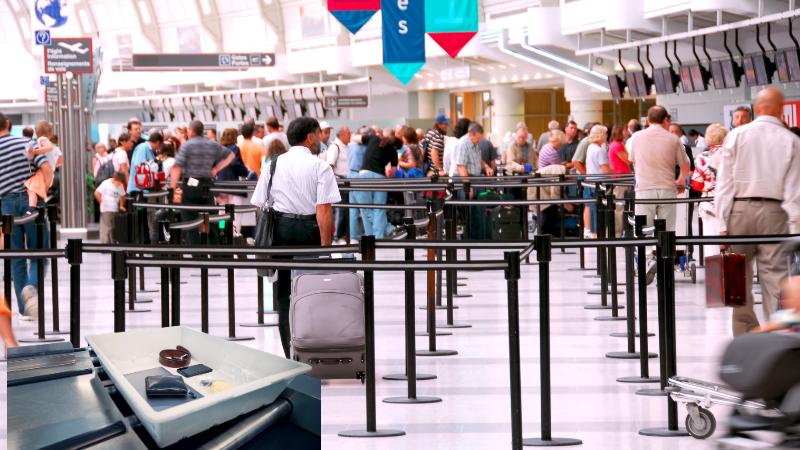
A nearly two-decade-old Transportation Security Administration policy requiring passengers to remove their shoes during airport screenings may soon become a thing of the past. According to senior officials, the TSA is in the early stages of phasing out the mandatory shoe removal rule for travelers going through standard security checks at select airports across the United States.
The updated security procedure marks a significant shift in post-9/11 travel protocols that have long been part of the airport experience. The change has already been implemented in some locations, with reports confirming that airports like Montgomery Regional Airport in Alabama have adopted the new policy. There, officials stated the revised procedure took effect across all TSA federalized airports. Although the new rule allows most passengers to keep their shoes on, TSA agents may still ask individuals to remove footwear if a situation calls for further inspection.
This transition is part of a broader effort by the TSA and the Department of Homeland Security to enhance traveler convenience without compromising security. While the new measure is being piloted at select locations for now, officials have suggested that if successful, it could be rolled out on a national scale in the near future. The move is being welcomed by many travelers who have long found shoe removal one of the more cumbersome aspects of airport security.
TSA emphasized that even with the shoe policy relaxed, security protocols remain robust and multi-layered. Core screening components such as identity verification, Secure Flight passenger vetting, and advanced scanning technologies continue to play essential roles in airport safety. Footwear scanning, though still used in specific instances, will now be approached with more flexibility depending on the assessed threat level and traveler profile.
For years, shoe removal has been standard procedure for passengers who do not qualify for expedited programs like TSA PreCheck. Those enrolled in PreCheck have been allowed to bypass certain steps, including removing shoes, belts, light jackets, and laptops, making their screening process faster and less intrusive. With the new update, standard screening passengers may now enjoy a similarly streamlined experience.
The TSA first introduced mandatory shoe removal in 2006, following the 2001 incident involving Richard Reid, the so-called “shoe bomber.” Reid attempted to detonate explosives hidden in his shoes aboard a flight from Paris to Miami. Although the attempt failed, the incident led to a major overhaul of screening procedures to guard against similar threats. For many, the shoe rule has come to symbolize the heightened security measures of the post-9/11 travel environment.
The decision to revisit and revise this policy comes amid a growing focus on improving the overall passenger experience without diluting essential safety standards. The TSA continues to explore ways to integrate newer technologies and smarter procedures to strike a balance between efficiency and security. Airport security remains a high priority, but evolving threat assessments and modern tools have enabled adjustments like the potential elimination of universal shoe removal.
At this point, the TSA has not made a formal announcement regarding when the policy will be fully implemented nationwide, but travelers flying through select pilot airports may already experience the change. The agency has indicated that any broader rollout will be communicated through official channels to avoid confusion among travelers and airport personnel.
Until then, travelers are advised to follow all posted instructions at security checkpoints and comply with any directions given by TSA agents. While the shift may feel small, it reflects a larger trend toward refining the airport screening process in a way that recognizes both modern threats and passenger comfort.
As the policy continues to evolve, many are hopeful this change will lead to a more efficient and pleasant airport experience, particularly for families, elderly passengers, and individuals with mobility challenges who find shoe removal difficult. With technological advancements and a deeper understanding of threats, the future of airport security may look quite different from the one travelers have known for nearly 20 years.