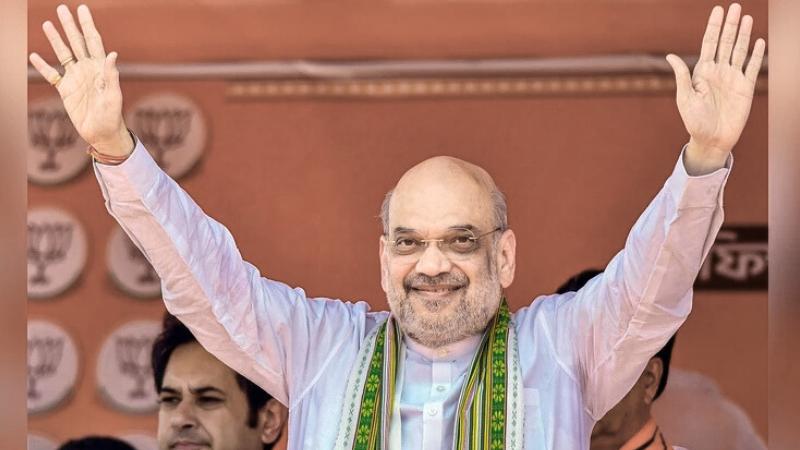
The tally in the 2025 Bihar Assembly election is tilting sharply in favour of the National Democratic Alliance (NDA) as early counting shows the coalition leading in 162 seats, confirming the prediction of Amit Shah. At around 10.15 am, the NDA was ahead in 162 out of 243 seats while the opposition led by the Rashtriya Janata Dal (RJD) and the Indian National Congress stood at 77 seats.
Shah had earlier declared confidently that the NDA would cross the 160-seat mark and form a government with a two-thirds majority. His remark came during the Bihar Power Play summit and again in a follow-up interview where he dismissed any internal rifts within the five-party NDA coalition. The alliance includes the Bharatiya Janata Party (BJP), the Janata Dal (United) (JDU) led by Nitish Kumar, the Lok Janshakti Party (LJP), the Hindustani Awam Morcha (HAM) and the Rashtriya Lok Samta Party (RLSP).
Exit polls from multiple agencies had already given the NDA a clear edge, projecting seat ranges from 133 up to 167 for the alliance while the opposition was expected to struggle to cross 100 seats. The projections matched what we’re now seeing in early counts. The big story is not just that the NDA leads but how the JDU is experiencing a resurgence. In 2020 the party had slumped to 43 seats compared to the BJP’s 74; this time it is projected to make a sharp comeback with around 74 seats. Simultaneously the RJD appears set to lose its claim as the largest single party, having won 75 in 2020, and now falling noticeably behind.
If the trend holds, the NDA will secure more than the simple majority mark of 122 seats and move into the territory of two-thirds majority, which would give the alliance a strong and stable mandate. The early lead suggests the alliance’s strategy of unity, strong leadership and emphasis on governance is translating into voter support. Opposition voters and analysts will now be watching closely to see if any late swing or surprise affects the final tally. The coming hours of counting will reveal whether the projected landslide becomes a reality or there are unexpected twists.
Shah had earlier declared confidently that the NDA would cross the 160-seat mark and form a government with a two-thirds majority. His remark came during the Bihar Power Play summit and again in a follow-up interview where he dismissed any internal rifts within the five-party NDA coalition. The alliance includes the Bharatiya Janata Party (BJP), the Janata Dal (United) (JDU) led by Nitish Kumar, the Lok Janshakti Party (LJP), the Hindustani Awam Morcha (HAM) and the Rashtriya Lok Samta Party (RLSP).
Exit polls from multiple agencies had already given the NDA a clear edge, projecting seat ranges from 133 up to 167 for the alliance while the opposition was expected to struggle to cross 100 seats. The projections matched what we’re now seeing in early counts. The big story is not just that the NDA leads but how the JDU is experiencing a resurgence. In 2020 the party had slumped to 43 seats compared to the BJP’s 74; this time it is projected to make a sharp comeback with around 74 seats. Simultaneously the RJD appears set to lose its claim as the largest single party, having won 75 in 2020, and now falling noticeably behind.
If the trend holds, the NDA will secure more than the simple majority mark of 122 seats and move into the territory of two-thirds majority, which would give the alliance a strong and stable mandate. The early lead suggests the alliance’s strategy of unity, strong leadership and emphasis on governance is translating into voter support. Opposition voters and analysts will now be watching closely to see if any late swing or surprise affects the final tally. The coming hours of counting will reveal whether the projected landslide becomes a reality or there are unexpected twists.