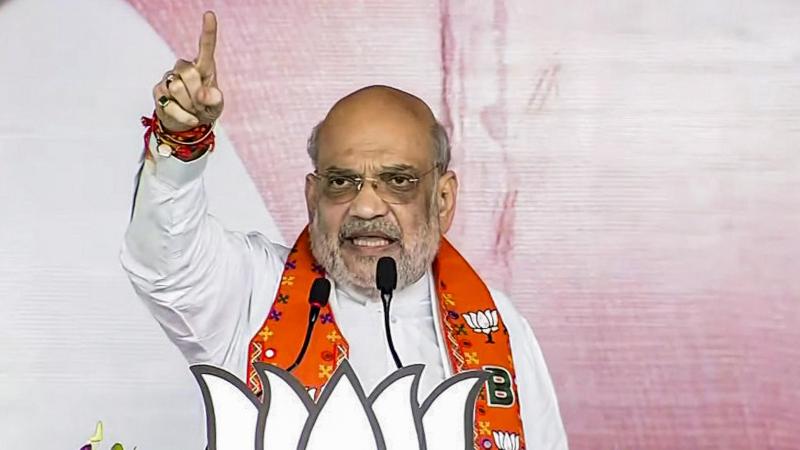
Union Home Minister Amit Shah, in his first public remarks following the deadly terror attack in Pahalgam, Jammu and Kashmir, issued a stern warning to the perpetrators and reaffirmed the Indian government’s unwavering resolve to root out terrorism. Addressing an event in New Delhi today, Shah declared that those responsible for killing 26 civilians on April 22 would be “hunted down” and held accountable.
The Home Minister was speaking at a ceremony to unveil a statue of Upendra Nath Brahma, a revered leader of Assam’s Bodo community, and to rename a Delhi road in his honor. The event was also attended by Delhi Lieutenant Governor VK Saxena, Chief Minister Rekha Gupta, Assam Chief Minister Himanta Biswa Sarma, and Bodoland Territorial Council’s Chief Executive Member Promod Boro.
In a fiery speech, Shah stated, “Whoever carried out the dastardly terror attack in Pahalgam will not be spared. We will hunt down each and every perpetrator of the Pahalgam terror attack. Don't think that you have won by killing 26 people. Every one of you will be made answerable.” He further asserted, “Har vyakti ko chun chun ke jawab bhi milega, jawab bhi diya jayega… This is the Narendra Modi government; no one will be spared. It is our resolve to uproot terrorism from every inch of this country and it will be accomplished.”
The attack in Pahalgam, which claimed the lives of 26 innocent civilians, has shocked the nation and intensified calls for swift and decisive action. At the event, a moment of silence was observed in memory of those killed. The mass killing has once again brought into focus the persistent threat of cross-border terrorism and its devastating impact on Indian civilians.
Tensions have escalated between India and Pakistan following the Pahalgam attack. The Cabinet Committee on Security (CCS), chaired by Prime Minister Narendra Modi, convened its first meeting on the matter last week. Intelligence briefings reportedly informed the CCS of significant cross-border linkages connected to the terrorists involved in the April 22 massacre. This revelation has led to increased scrutiny of Pakistan’s role in supporting or harboring militant groups that operate in Jammu and Kashmir. India has consistently maintained that Pakistan-based terror outfits pose a direct threat to its national security.
The current diplomatic strain is reminiscent of the post-Pulwama scenario in February 2019, when a suicide bomber attacked a CRPF convoy, resulting in over 40 deaths. That incident triggered India’s airstrike on a terror camp deep inside Pakistan-Occupied Kashmir (PoK), leading to a brief but intense escalation in military and diplomatic hostilities between the two nuclear-armed neighbors. The Pahalgam attack has revived fears of similar escalations, especially if credible evidence of Pakistan’s involvement becomes public. While India has not yet taken any retaliatory military action, Amit Shah’s comments suggest that a strong response may be forthcoming.
Shah’s speech appears aimed at both internal and external audiences—reassuring the Indian public of the government’s determination, while also sending a message to Pakistan and terror networks operating from across the border. At the same time, security has been tightened across Jammu and Kashmir, and intelligence agencies have ramped up surveillance operations to track potential collaborators and prevent any further acts of violence. As India grieves the loss of innocent lives in Pahalgam, the government’s response in the coming days will likely shape the regional security narrative and determine whether the post-attack phase leads to diplomatic tension or direct retaliation.