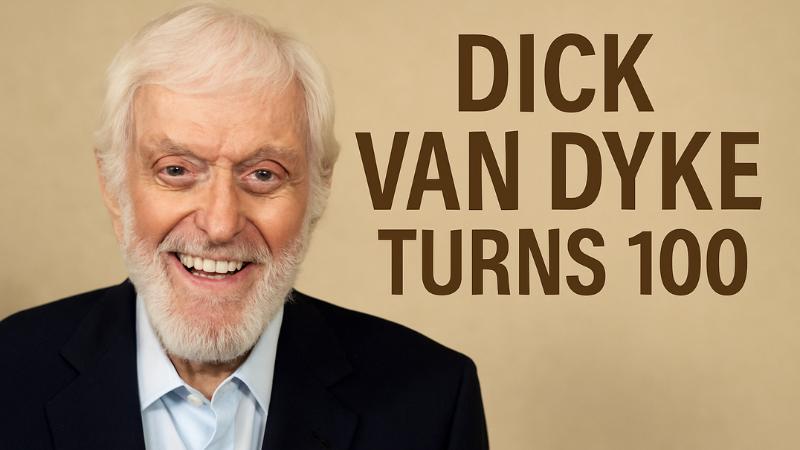
Few figures in Hollywood history have reached the age of 100 with their reputation not only intact but warmly cherished. Dick Van Dyke reaches that milestone today, standing as a rare constant in an industry defined by reinvention and impermanence. Once known for tripping over an ottoman on television and dancing with animated penguins on film, he has outlived many of his contemporaries and even the criticisms that once followed his most famous performances.
Van Dyke’s career spans nearly the entire modern history of American screen entertainment. He began performing during the second world war, entertaining troops before transitioning into television, film and Broadway. Over decades, he worked alongside towering figures of entertainment, from Phil Silvers to Walt Disney, absorbing influences from vaudeville, music hall slapstick and classic screwball comedy. That blend shaped a persona that felt timeless even in its own era.
Born in Danville, Illinois, the son of a travelling salesman, Van Dyke did not follow a conventional path into showbusiness. He left high school early and educated himself through movies, comedy routines and stage work. Friends and collaborators often described his purpose simply: to make people happier. That sense of mission has guided his career choices and perhaps explains why, even in advanced age, he has continued to appear in public projects, television and music videos.
Although his pace of work has slowed, Van Dyke has remained culturally visible in recent years. He has appeared on competitive television, featured in high-profile music projects and spoken publicly about political issues he believes affect future generations. Approaching his tenth decade, he has increasingly come to represent living memory itself, a direct link to Hollywood’s formative years.
His screen image helped bridge eras of entertainment. Van Dyke cultivated a persona that combined physical comedy with decency and intelligence, often playing characters who appeared clumsy but revealed emotional depth and moral clarity. Though he was nearly 40 when major fame arrived through The Dick Van Dyke Show and Mary Poppins, his performances carried an irrepressible youthfulness. In films such as Chitty Chitty Bang Bang, he projected boundless energy, often alongside younger or similarly aged co-stars cast as elders.
The actor famously avoided darker roles, including turning down projects that conflicted with his preference for optimistic storytelling. He has described his screen presence as wholesome, though his personal life included challenges, including a long struggle with alcoholism that unfolded during his most successful years. Even so, a restless vitality always animated his performances, giving his work an edge that prevented it from ever feeling complacent or conservative.
On television, his chemistry with Mary Tyler Moore redefined the sitcom marriage, introducing warmth, wit and a sense of equality that was unusual for its time. His film characters, from distracted inventors to mischievous performers, embodied joy and imperfection in equal measure. Perhaps none is more iconic than Bert from Mary Poppins, whose unconventional accent has long since been reclaimed as a beloved quirk rather than a flaw.
Now 100, Van Dyke no longer resembles the eternal boy he once portrayed. Instead, he has become an emblem of fulfilled longevity, marked by humor, reflection and gratitude. He has even shared his thoughts on aging in print, though he resists presenting himself as an authority on health. He credits good fortune, strong relationships and a positive outlook for sustaining him across a century.
Reflecting on his life, Van Dyke has described it as a privilege, defined by the freedom to pursue work he loved and to share it widely. His journey from energetic outsider to revered elder mirrors the evolution of American entertainment itself. At 100, he remains both ancient and evergreen, a figure whose legacy continues to inspire admiration across generations.