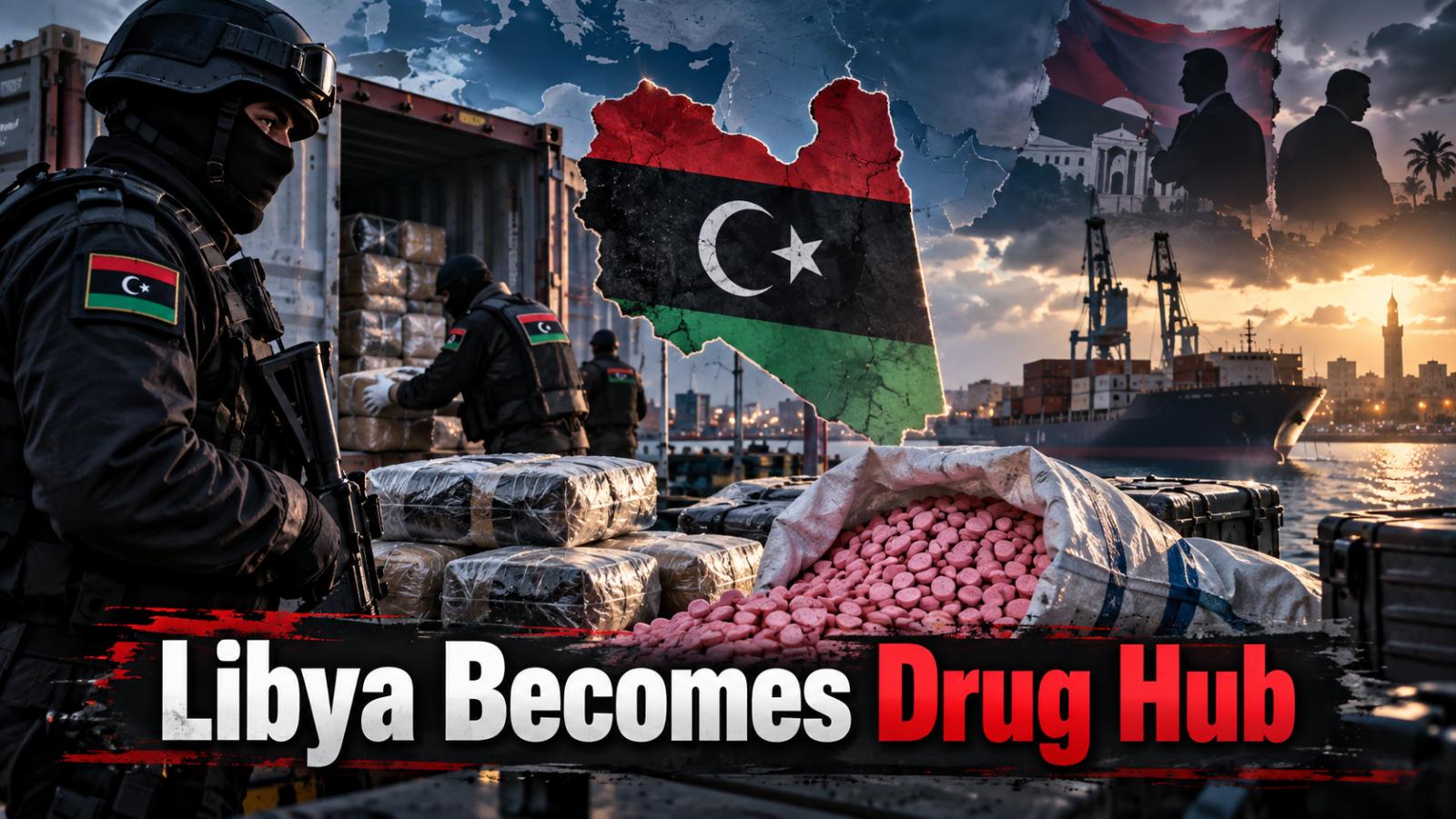
Libya's role as a regional drug trafficking hub is attracting renewed attention after authorities announced the seizure of 100,000 ecstasy tablets hidden inside a cargo vehicle. The case comes as United Nations research warns that Libya's fractured political and security environment has helped trafficking networks expand routes linking North Africa, Europe and the Middle East.
Libya ecstasy seizure exposes expanding drug routes
Libya's Deterrence Agency for Combating Terrorism and Organised Crime said on September 12 that investigators seized 100,000 XTC tablets hidden inside a Renault Master cargo vehicle. The agency said it began tracking the shipment after receiving information that a trafficking network planned to move narcotics through a European country before bringing them into Libya by sea.
Authorities intercepted the vehicle after it entered through a Libyan seaport and referred suspects to prosecutors. Images circulating with reports of the operation showed brown tablets moulded in the likeness of former Libyan leader Muammar Gaddafi, giving the seizure unusual public attention.
Libya cocaine routes grow amid prolonged instability
The seizure fits a broader pattern identified by the United Nations Office on Drugs and Crime. In its January 2026 assessment of drug trafficking in Libya and North Africa, UNODC said the country has become an increasingly important transit point for cocaine and synthetic drugs moving toward regional and international markets.
The agency estimated that recorded cocaine seizures in Libya during 2024 had a combined street value of between $3.7 million and $7.8 million. UNODC also warned that recorded seizures represent only detected shipments, meaning the actual scale of the market could be considerably larger.
Libya's geography gives trafficking groups access to Mediterranean ports, long land borders and routes connecting the Sahel with North Africa. Years of institutional fragmentation have also complicated policing, border enforcement and coordination between agencies.
Libya synthetic drug trade challenges divided institutions
Libya has struggled with political division since the upheaval that toppled Muammar Gaddafi in 2011. The western-based Government of National Unity led by Abdul Hamid Dbeibah operates from Tripoli, while eastern authorities are backed by forces associated with Khalifa Haftar.
UNODC says Libya's security environment is closely linked to its expanding role in drug trafficking. The agency has called for stronger intelligence sharing, better coordination between institutions, improved border controls and a long-term criminal justice strategy aimed at weakening organised drug markets.
Libya election deal could reshape security cooperation
Political rivals took a potentially significant step on August 30 when representatives signed a UN-facilitated agreement aimed at creating conditions for presidential and legislative elections within no more than 24 months. The framework also addresses electoral laws and changes to Libya's election commission.
The United Nations has described the agreement as an important step rather than a final solution. Successful implementation will still depend on cooperation among rival institutions and progress toward a single executive authority.
For Libya, the connection between political stability and organised crime is increasingly difficult to ignore. The latest ecstasy seizure shows that traffickers continue to test maritime routes and institutional weaknesses, while UN findings suggest that reducing the drug trade will require stronger governance as much as stronger policing.