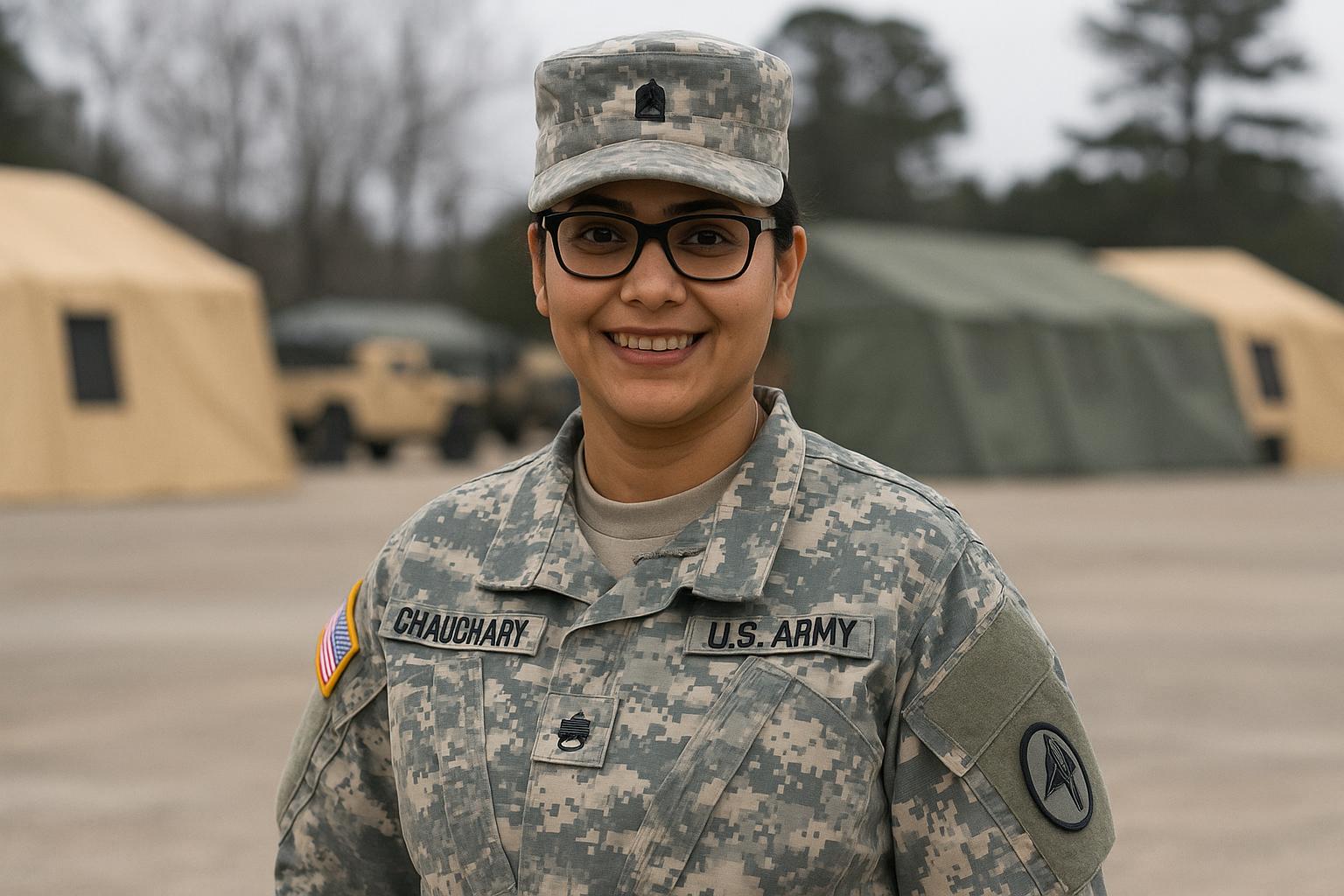
At 38, Delhi-born Shilpa Chaudhary has taken a path few imagine — trading a civilian routine for military fatigues in the United States Army. An Indian citizen and lawful permanent resident of the US, Chaudhary chose to serve the country that became her adopted home, reflecting both courage and complexity in an era where immigration debates remain deeply polarized.
As a Green Card holder, Chaudhary was eligible to enlist under a long-standing US Department of Defense policy that allows permanent residents to serve in the armed forces. Today, she wears the uniform proudly, posting about her training, responsibilities, and experiences through her growing presence on social media platforms such as YouTube, Instagram, and TikTok. Her journey stands as a symbol of resilience, ambition, and the global appeal of military service.
In a political climate often marked by anti-immigrant rhetoric, particularly during the second term of President Donald Trump, Chaudhary’s service as an Indian-origin soldier might seem ironic. The administration’s stricter immigration policies, including tougher H-1B visa procedures and increased deportations, created a sense of uncertainty among many immigrants. Yet, the military’s continued acceptance of lawful residents like Chaudhary underscores a fundamental truth — the US Armed Forces have long relied on the dedication of immigrants to fill critical ranks.
Chaudhary currently serves as a Chemical, Biological, Radiological, and Nuclear (CBRN) specialist, a role that requires advanced training and readiness for high-risk scenarios. Her 74 Delta unit responds to chemical or biological threats, providing protective measures and guidance for civilian and military personnel. On social media, she offers insights into military life, from fitness tests and marksmanship drills to the benefits and opportunities that come with serving in uniform.
She explains that an entry-level soldier in the E1 rank earns around $2,000 per month, with additional allowances such as housing and subsistence for married personnel. Education support is another major incentive — soldiers and their spouses are eligible for an annual $4,000 tuition benefit, and after four years of service, they can pursue full higher education through the GI Bill, a long-standing program for veterans.
According to US Congressional data from February 2024, more than 40,000 foreign nationals currently serve in active and reserve roles across the US Armed Forces, and another 115,000 veterans who were once non-citizens now live as American residents. Many of them, like Chaudhary, view military service as both a profession and a gateway to a secure future.
The US military’s openness to immigrants is rooted in practical necessity. The Army, Navy, and Air Force have struggled to meet recruitment targets in recent years. In both 2022 and 2023, the Army fell short by about 25 percent, missing roughly 15,000 recruits annually. Only by reducing its 2024 target by over 10,000 soldiers did it manage to meet its goal. Similarly, the Navy achieved its recruitment numbers only after relaxing entry standards, while nearly half of new recruits scored below average in aptitude assessments.
The decline in enlistments contrasts sharply with America’s expanding global military presence. From over 12 million active-duty personnel after World War II, the number has fallen to just 1.3 million today, despite a much larger population and broader defense responsibilities. Analysts argue that the inclusion of immigrants helps offset manpower shortages while promoting diversity within the ranks.
For lawful permanent residents, military service offers a unique path to expedited citizenship. Under Section 328 of the Immigration and Nationality Act, those who serve honorably for one year during peacetime can apply for citizenship without meeting the usual five-year residence requirement. During wartime, Section 329 allows immediate eligibility for those who have served honorably, even without a Green Card. Applicants must still undergo background checks and civics tests but are exempted from certain filing fees and waiting periods.
Despite these benefits, a 2022 report by the Government Accountability Office found that some branches fail to adequately inform non-citizen servicemembers of their rights. In some cases, veterans mistakenly believed they had automatically gained citizenship after enlistment, highlighting the need for consistent guidance.
Chaudhary’s own story has inspired thousands of viewers who see her as an example of perseverance and adaptability. Her videos — which have garnered millions of views — answer practical questions about recruitment, eligibility, and training. She also offers candid reflections on the discipline, mental strength, and patriotism required to serve in the military of another country while staying true to one’s roots.
For many Indian-origin drivers, engineers, and workers in the US, her experience symbolizes an alternative route to belonging in a nation that can be both welcoming and exclusionary. As immigration policies tighten, the US military remains one of the few institutions offering immigrants not only employment but also an accelerated path to inclusion and recognition.
Shilpa Chaudhary’s uniform may bear the American flag, but her story resonates deeply with countless others who dream of building a life through service, sacrifice, and determination. Her journey reminds the world that loyalty and courage know no borders — and that for some, defending a nation becomes the truest expression of becoming part of it.