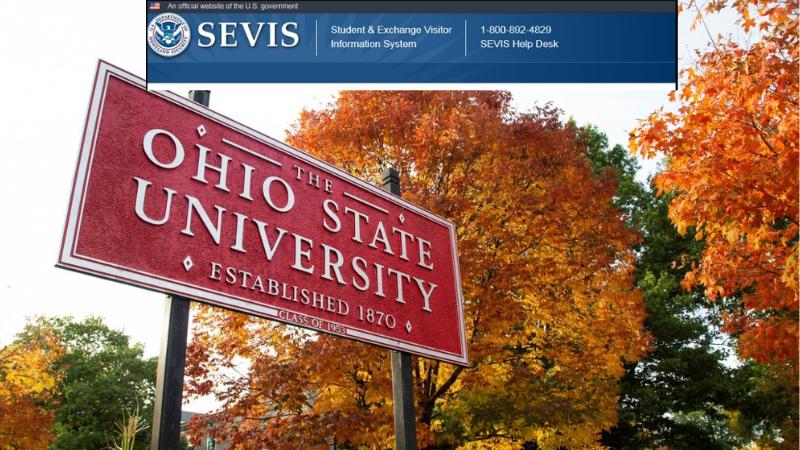
An Indian Ph.D. student studying agricultural engineering at Ohio State University has had her international student status temporarily reinstated by a federal judge after the federal government revoked her SEVIS record without prior notice. This development comes amid growing concern over recent removals of student visa records that have impacted students across the United States.
U.S. District Court Judge Algenon L. Marbley issued a ruling last week that reinstates the student’s F-1 status under the Student and Exchange Visitor Information System (SEVIS), a federal tracking system managed by the Department of Homeland Security. The decision sets the stage for a preliminary injunction hearing scheduled for May 8, which could determine whether the reinstatement becomes permanent or not.
SEVIS is used by the U.S. government to monitor international students studying under F-1 visas, which grant foreign nationals permission to stay in the country legally while pursuing their education. The student, whose name is not being released publicly due to privacy concerns, was one of nearly a dozen at Ohio State and among hundreds nationwide affected by a recent, unexplained purge of SEVIS records under new federal immigration actions.
According to documents filed in court, the student learned on April 8 through an email from Ohio State’s Office of International Affairs that her SEVIS record had been deleted. The email cited a general reason category, stating “Other — Individual identified in criminal records check and/or has had their VISA revoked,” and claimed that the government believed the student had violated her F-1 status.
The student maintains that her visa is still valid and disputes the government's assertion. She is contesting what she describes as an arbitrary and unjustified decision to remove her from SEVIS. She acknowledges a misdemeanor traffic violation from 2020—a defective equipment charge in Missouri for which she paid a fine—but argues that this minor offense does not warrant the revocation of her SEVIS status.
This case is not isolated. Another Ohio State graduate student, Ahwar Sultan, along with the OSU chapter of Students for Justice in Palestine, has also filed suit against the Trump administration. Sultan’s F-1 visa was reportedly revoked following his involvement in pro-Palestinian protests on campus in April 2024. These developments raise broader questions about freedom of speech and political expression for international students on U.S. soil.
University officials have expressed concern over the situation. Ohio State President Ted Carter confirmed that the university was not informed in advance about the revocations and that they are working to identify ways to support the affected students. The lack of communication from federal authorities has complicated efforts to provide timely guidance and legal recourse.
The situation has also gained political visibility. Carter, an Ohio State alumnus who recently accompanied the school’s football team on a celebratory visit to the White House, has not publicly commented on whether the issue of student visas was addressed during meetings with President Donald Trump or Vice President JD Vance.
The sudden and unexplained deletions of SEVIS records appear to reflect a shift in immigration enforcement priorities, possibly linked to security concerns or political signaling. Critics argue that the lack of due process in these removals, particularly for individuals with no serious criminal background, sets a troubling precedent and undermines the principles of fairness and transparency.
Legal analysts following the case suggest that Judge Marbley’s ruling could have broader implications for how immigration enforcement actions are administered and challenged in court. If the court ultimately rules in favor of the student, it may prompt a review of similar cases and possibly restrict future removals of SEVIS records without detailed justification and notice.
The broader academic community is watching closely. Universities across the country depend on international students, who not only bring global perspectives to classrooms but also contribute significantly to research, innovation, and local economies. A chilling effect from actions like these could deter future students from enrolling in American institutions, potentially affecting higher education funding and international collaboration.
As the preliminary injunction hearing approaches, advocates are hoping for a favorable outcome that upholds the student’s legal rights and restores her ability to continue her doctoral work uninterrupted. For the student, her academic future and lawful presence in the country now hang in the balance of the upcoming court proceedings. This case underscores the fragile nature of international student status under evolving immigration policies, and highlights the importance of judicial oversight in ensuring that rights are protected, regardless of one’s origin or background.
U.S. District Court Judge Algenon L. Marbley issued a ruling last week that reinstates the student’s F-1 status under the Student and Exchange Visitor Information System (SEVIS), a federal tracking system managed by the Department of Homeland Security. The decision sets the stage for a preliminary injunction hearing scheduled for May 8, which could determine whether the reinstatement becomes permanent or not.
SEVIS is used by the U.S. government to monitor international students studying under F-1 visas, which grant foreign nationals permission to stay in the country legally while pursuing their education. The student, whose name is not being released publicly due to privacy concerns, was one of nearly a dozen at Ohio State and among hundreds nationwide affected by a recent, unexplained purge of SEVIS records under new federal immigration actions.
According to documents filed in court, the student learned on April 8 through an email from Ohio State’s Office of International Affairs that her SEVIS record had been deleted. The email cited a general reason category, stating “Other — Individual identified in criminal records check and/or has had their VISA revoked,” and claimed that the government believed the student had violated her F-1 status.
The student maintains that her visa is still valid and disputes the government's assertion. She is contesting what she describes as an arbitrary and unjustified decision to remove her from SEVIS. She acknowledges a misdemeanor traffic violation from 2020—a defective equipment charge in Missouri for which she paid a fine—but argues that this minor offense does not warrant the revocation of her SEVIS status.
This case is not isolated. Another Ohio State graduate student, Ahwar Sultan, along with the OSU chapter of Students for Justice in Palestine, has also filed suit against the Trump administration. Sultan’s F-1 visa was reportedly revoked following his involvement in pro-Palestinian protests on campus in April 2024. These developments raise broader questions about freedom of speech and political expression for international students on U.S. soil.
University officials have expressed concern over the situation. Ohio State President Ted Carter confirmed that the university was not informed in advance about the revocations and that they are working to identify ways to support the affected students. The lack of communication from federal authorities has complicated efforts to provide timely guidance and legal recourse.
The situation has also gained political visibility. Carter, an Ohio State alumnus who recently accompanied the school’s football team on a celebratory visit to the White House, has not publicly commented on whether the issue of student visas was addressed during meetings with President Donald Trump or Vice President JD Vance.
The sudden and unexplained deletions of SEVIS records appear to reflect a shift in immigration enforcement priorities, possibly linked to security concerns or political signaling. Critics argue that the lack of due process in these removals, particularly for individuals with no serious criminal background, sets a troubling precedent and undermines the principles of fairness and transparency.
Legal analysts following the case suggest that Judge Marbley’s ruling could have broader implications for how immigration enforcement actions are administered and challenged in court. If the court ultimately rules in favor of the student, it may prompt a review of similar cases and possibly restrict future removals of SEVIS records without detailed justification and notice.
The broader academic community is watching closely. Universities across the country depend on international students, who not only bring global perspectives to classrooms but also contribute significantly to research, innovation, and local economies. A chilling effect from actions like these could deter future students from enrolling in American institutions, potentially affecting higher education funding and international collaboration.
As the preliminary injunction hearing approaches, advocates are hoping for a favorable outcome that upholds the student’s legal rights and restores her ability to continue her doctoral work uninterrupted. For the student, her academic future and lawful presence in the country now hang in the balance of the upcoming court proceedings. This case underscores the fragile nature of international student status under evolving immigration policies, and highlights the importance of judicial oversight in ensuring that rights are protected, regardless of one’s origin or background.