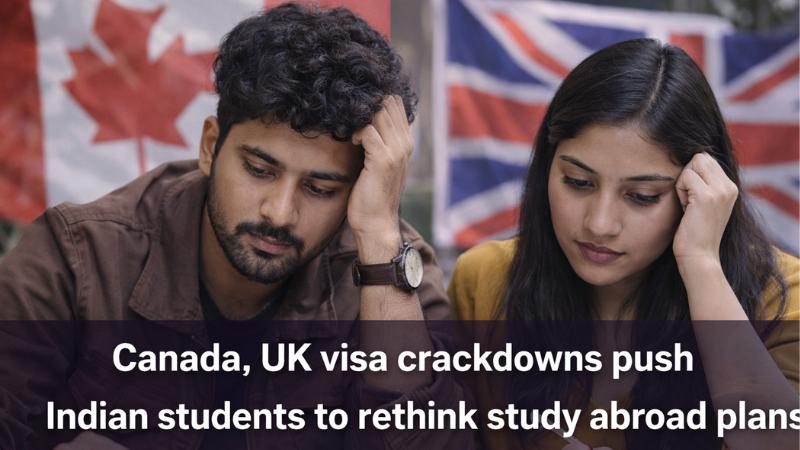
Canada and the United Kingdom emerged as dependable alternatives for Indian students seeking overseas education, especially as uncertainty around US work visas grew. Clear post-study work routes, predictable immigration rules, and relatively stable visa approval trends helped both countries attract hundreds of thousands of Indian students. However, policy changes in 2025 are reshaping that confidence and forcing students and families to reassess long-held assumptions about studying abroad.
Canada’s sharp rise in student visa rejections and proposals allowing authorities to cancel already-issued study permits have unsettled many families, particularly in states like Punjab that send large numbers of students overseas. At the same time, the UK has tightened work visa routes, raised salary thresholds, and shortened post-study work pathways, narrowing options that once appeared reliable. Together, these shifts have triggered a broader rethink of overseas education strategies among Indian students.
Despite alarming headlines, education experts say the response on the ground has been measured rather than chaotic. Students and parents are not abandoning plans outright but recalibrating them. Counsellors report that families are seeking clearer information, applying earlier, and paying closer attention to eligibility, documentation, and long-term outcomes.
Data has played a decisive role in driving this change. Canada’s rejection rate for Indian student visas has climbed dramatically, rising from around 32 percent in 2023 to nearly 74 percent by mid-2025. Applications have fallen sharply in parallel, reflecting a growing awareness that approvals are no longer assured. While this has dented short-term confidence, experts say it has also brought realism into decision-making.
Rather than relying on agents’ assurances or social media narratives, families are increasingly demanding evidence on employability, regional labour demand, and housing availability. Many see Canada’s tighter stance as a shift towards quality and alignment with labour needs rather than a permanent shutdown. Interest in the country remains strong, but expectations are more grounded.
With visas harder to secure and work routes more competitive, return on investment has moved to the centre of planning. Indian students typically spend close to USD 39,000 annually on tuition, accommodation, and living expenses, making outcomes critical. Course selection is now being judged not just on university rankings but on relevance to job markets, clarity of post-study work rules, and overall affordability.
In the UK, recent immigration reforms have added to uncertainty. Reduced opportunities in sectors such as healthcare and IT, combined with shorter graduate work routes, mean students must secure employment faster and meet stricter thresholds. This reflects a wider global shift away from education-led migration, where study is no longer seen as an automatic pathway to long-term work rights.
As a result, parallel planning is becoming the norm. While Canada, the UK, and Australia remain top destinations due to their scale and institutional depth, students are increasingly exploring alternatives such as Germany, France, Ireland, New Zealand, and the UAE. These options are not replacing traditional destinations but serving as backups to spread risk.
Experts stress that preparation is now the strongest safeguard in a volatile visa environment. Strong academic alignment, realistic financial planning, careful documentation, and awareness of policy changes are essential. The uncertainty of 2025 has not ended Indian student mobility, but it has transformed it. Aspirations remain strong, yet decisions are now driven less by promises and more by data, outcomes, and long-term clarity.