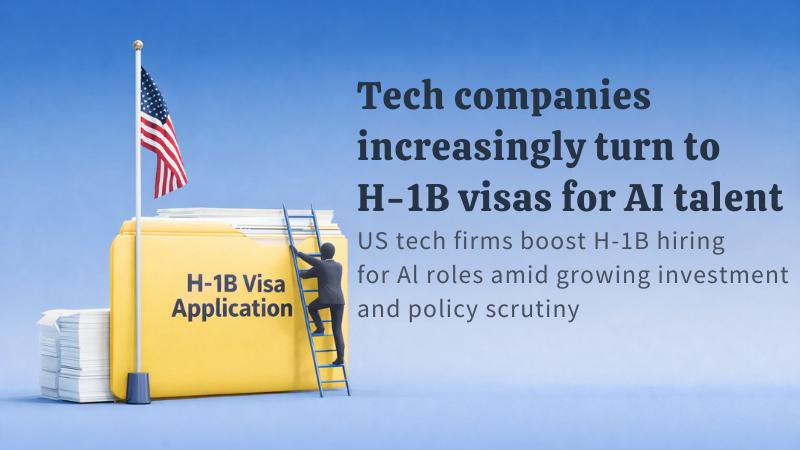
Major US technology companies are increasingly turning to the H-1B visa programme to recruit skilled foreign professionals as they accelerate investments in artificial intelligence and related digital infrastructure. New data show that a large share of visa petitions filed by leading firms are tied directly to AI-driven roles, underscoring how access to global talent has become central to their long-term strategy.
An analysis of labour condition applications indicates that more than 80 percent of certifications linked to new H-1B petitions in fiscal year 2025 at companies such as Amazon, Meta Platforms, Microsoft, Google and Apple were associated with artificial intelligence or advanced technology positions. The figures highlight how hiring priorities at the largest technology employers have shifted decisively toward specialised engineering and data-focused roles rather than broad-based recruitment.
Software developers accounted for the dominant share of these filings. Nearly 60 percent of certified H-1B positions at the five companies were for software development jobs, compared with roughly a quarter across US employers overall. Other prominent categories included computer and information research scientists, data scientists, business intelligence analysts and IT project managers. The concentration reflects the intensive technical expertise required to design, train and deploy AI systems at scale.
Among the top employers, Amazon recorded the highest number of approved petitions for initial employment, followed by Meta Platforms, Microsoft and Google, with Apple also ranking among the leading sponsors. The hiring uptick has coincided with a period of heavy capital spending on artificial intelligence tools, cloud computing infrastructure and advanced chips. Industry projections suggest that combined outlays on AI-linked investments could cross hundreds of billions of dollars annually, reinforcing the sector’s dependence on specialised workers.
The data also point to the growing importance of international students in the US talent pipeline. Universities report that a majority of graduate students in computer and information sciences, as well as a significant share in electrical and computer engineering, come from outside the United States. As these students complete their degrees, many transition to the workforce through the H-1B visa route, filling roles that companies say are difficult to staff domestically. This pattern has made the visa system a key bridge between higher education and high-technology employment.
Economists note that foreign-born professionals in science and engineering have historically contributed to productivity gains and innovation across the US economy. Investments in AI, they argue, have supported business expansion, research output and stock market performance, strengthening the case for maintaining steady flows of skilled immigration. At the same time, the rise in H-1B hiring comes amid heightened debate over immigration policy and work authorisations. Proposed regulatory changes and tighter rules have created uncertainty for employers, who warn that restrictions could slow recruitment or push certain operations overseas.
Taken together, the trends suggest that artificial intelligence is reshaping both workforce demand and immigration dynamics in the technology sector. As companies race to develop next-generation tools and platforms, their reliance on H-1B visas signals that global expertise remains a critical component of America’s innovation ecosystem and its efforts to stay competitive in the rapidly evolving digital economy.