In one of the wealthiest cities in the world, thousands of residents are living inside spaces barely larger than a mattress. Hong Kong, famous for its glittering skyline and ultra-luxury real estate, is also home to nearly 2 lakh people who survive in cramped 16-square-foot “coffin homes” hidden inside ageing buildings.
For 14 consecutive years, Hong Kong has ranked as the world’s most expensive housing market. Glass skyscrapers dominate the harbour, global financial firms operate from towering offices, and luxury apartments routinely sell for over 1 million US dollars. Yet beneath this image of prosperity lies a parallel reality where low-income workers, elderly residents, and migrants are squeezed into subdivided flats carved out of old residential buildings.
What Are Hong Kong’s Coffin Homes?
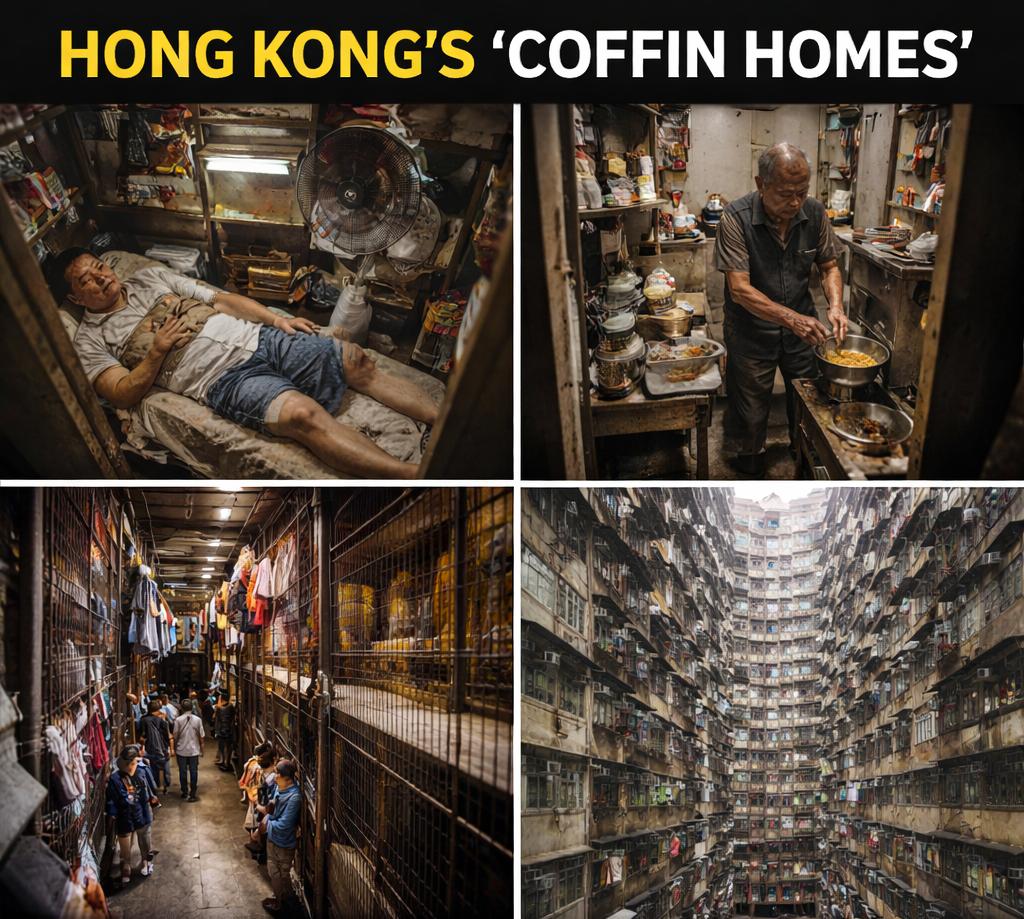
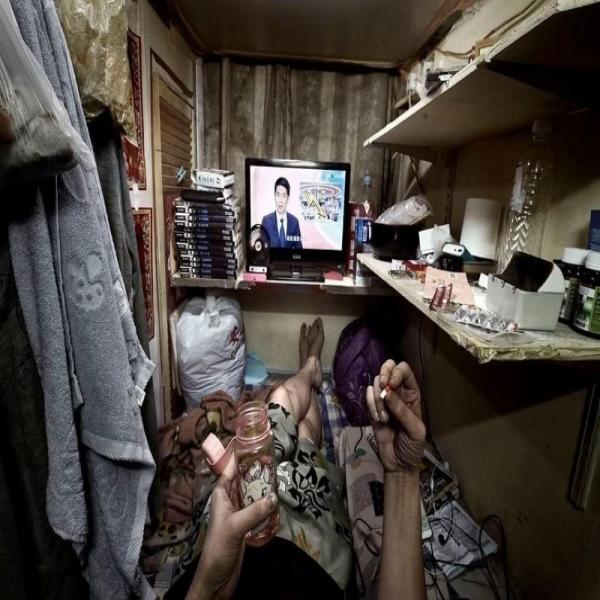
Coffin homes, also called bedspace apartments, can measure as little as 16 square feet roughly 4 feet by 4 feet. That space is barely enough for a thin mattress, leaving no room to stand upright or stretch one’s arms. In some 800-square-foot flats, as many as 30 such units are stacked side by side, separated by plywood or metal partitions.
Residents sleep, eat, scroll on their phones, and sometimes cook inside the same tiny enclosure. In several cases, tenants cannot fully close their doors because their shoulders extend beyond the narrow frame. Some units are so tight that even placing a proper mattress becomes impossible.
Rent for these units typically ranges between 230 and 450 US dollars per month, which converts to approximately Rs 20,000 to Rs 40,000. Despite the shocking size, demand remains high because public housing waiting times can stretch to five years or more.
Life Inside Subdivided Flats
Many of these units were created illegally by splitting floors into two levels, reducing ceiling height and cramming in additional partitions. Areas like Quarry Bay contain ageing buildings where entire floors have been converted into labyrinths of narrow corridors and stacked boxes.
Living conditions are harsh. Ventilation is minimal, natural light is rare, and summer heat can push indoor temperatures above 40 degrees Celsius. Overloaded electrical wiring increases fire risks, while mould, bed bugs, and cockroaches are common problems.
In some subdivided apartments, there are no kitchens. Residents prepare food in bathrooms, washing vegetables in sinks next to toilets. Hygiene concerns are constant, yet dining out regularly is financially out of reach for most occupants.
The contrast between Hong Kong’s billionaire wealth and these coffin homes highlights the city’s deep housing inequality. While a small group of tycoons controls a significant share of the territory’s wealth, nearly 2,00,000 to 2,20,000 people live in these extreme micro-units.
Hong Kong’s skyline tells a story of global prosperity. But hidden behind metal grilles and narrow staircases is another story — one of urban poverty, soaring property prices, and a housing system struggling to provide dignified living space for all.