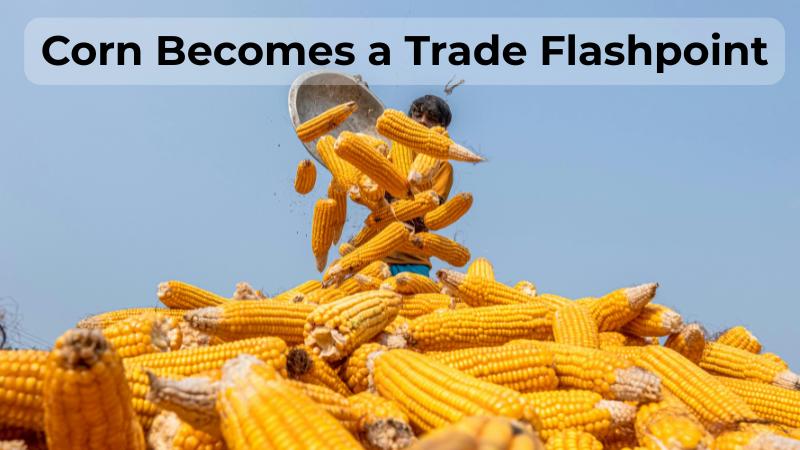
The latest flashpoint in India-US trade relations has surprisingly centered on corn. US commerce secretary Howard Lutnick recently targeted India over its unwillingness to import American maize, questioning why a nation of 1.4 billion people does not buy even a single bushel of US corn while continuing to export heavily to the United States. His comments came against the backdrop of resumed trade negotiations and reflect Washington’s growing desperation to find buyers for surplus grain.
Until recently, India was comfortably a maize exporter, producing around 42 million tonnes annually—about 3% of global output. In 2022-23 alone, India earned over $10 billion from maize exports. However, the government’s aggressive ethanol blending program transformed the dynamics. As part of its push to achieve 20% ethanol blending in petrol by 2025, India diverted a record 10 million tonnes of maize to ethanol production in 2024. This marked a sharp departure from earlier years when between two and four million tonnes of maize were exported annually.
The diversion coincided with drought-like conditions in Maharashtra and restrictions on sugarcane use for ethanol imposed in late 2023 to keep sugar prices stable. As a result, India became a net importer of maize in 2024 for the first time in decades. Imports were sourced from countries such as Myanmar and Ukraine, which supply non-genetically modified varieties acceptable under Indian law. This is a critical sticking point since over 90% of US corn is genetically modified, making it incompatible with India’s strict restrictions on GM imports.
Lutnick’s remarks, linking India’s refusal to buy US corn with broader trade issues such as tariffs and Russian oil purchases, struck many observers as ironic. Critics argued it reflected a neo-colonial mindset: pushing a self-sufficient country to import simply because the US has a surplus it cannot sell. Comparisons were drawn to the absurdity of asking oil-rich Saudi Arabia to import American crude.
The US’s urgency is rooted in its own agricultural surplus and shifting global markets. Corn cultivation spans more than 90 million acres in the US, concentrated in the Corn Belt across 11 states. Yet less than 10% of American corn enters food production, with most used for ethanol, animal feed, or processed products. China, once the largest buyer of US corn, has sharply cut imports, choosing instead to source from Brazil. American exports to China, which reached 31% of total shipments in 2020-21, fell below 6% in 2023-24. Brazil’s corn shipments to China rose to nearly 30% in the same period, displacing the US.
Meanwhile, India’s ethanol blending program, accelerated under the Modi government, has surged dramatically. Launched in 2003 but only gaining real traction after 2014, the program expanded ethanol production from 380 million liters in 2014 to more than 66 billion liters by mid-2025. Petroleum minister Hardeep Singh Puri recently announced that India had reached its E20 target five years ahead of schedule. While the policy reduces dependence on oil imports and lowers emissions, it has reshaped the maize supply chain.
Domestically, maize has long been crucial for poultry feed, accounting for nearly half of consumption, followed by cattle feed, starch, and other industries. The growing diversion to ethanol has sparked concern among traditional users who face shortages and rising prices. This disruption has added to India’s reluctance to open its markets to US corn, especially given the GM issue.
The US push to sell corn to India is also closely linked to broader trade talks. Trump administration officials had paused negotiations earlier over India’s refusal to open its dairy and farm sectors, alongside disputes about oil imports from Russia. Now, with India temporarily reliant on maize imports, Washington sees an opening to push its surplus onto Indian markets. Lutnick’s comments must be read in this light, as part of a larger campaign by the powerful corn and ethanol lobby that influences US trade policy.
Despite Washington’s pressure, India remains firm on its red lines. The government has consistently resisted attempts to relax restrictions on GM crops, citing food safety, farmer interests, and public resistance. India’s preference for sourcing non-GM maize from other countries underscores this stance. While the US seeks to frame India’s refusal as unfair protectionism, New Delhi sees it as safeguarding domestic priorities.
The clash over corn underscores the complexity of India-US trade relations. What appears to be a straightforward agricultural dispute is in fact intertwined with energy policy, climate commitments, global trade shifts, and political maneuvering. India’s success in achieving its ethanol goals has come with trade-offs, forcing temporary imports but not at the cost of compromising long-held positions on genetically modified crops.
For the US, struggling to find buyers for record harvests and facing shrinking demand from China, India represents a tempting target market. Yet unless Washington can align its exports with India’s regulatory framework and domestic priorities, its efforts may remain futile. Lutnick’s sharp words may grab headlines, but the underlying issues reflect a deeper mismatch between American surpluses and Indian strategies for self-reliance.
As trade talks resume, the corn dispute will likely remain a flashpoint. For India, it is about balancing energy needs, agricultural stability, and sovereignty. For the US, it is about salvaging markets for its farmers and projecting economic power. Whether the two sides can reconcile these competing interests will determine how this unusual corn war unfolds in the coming years.