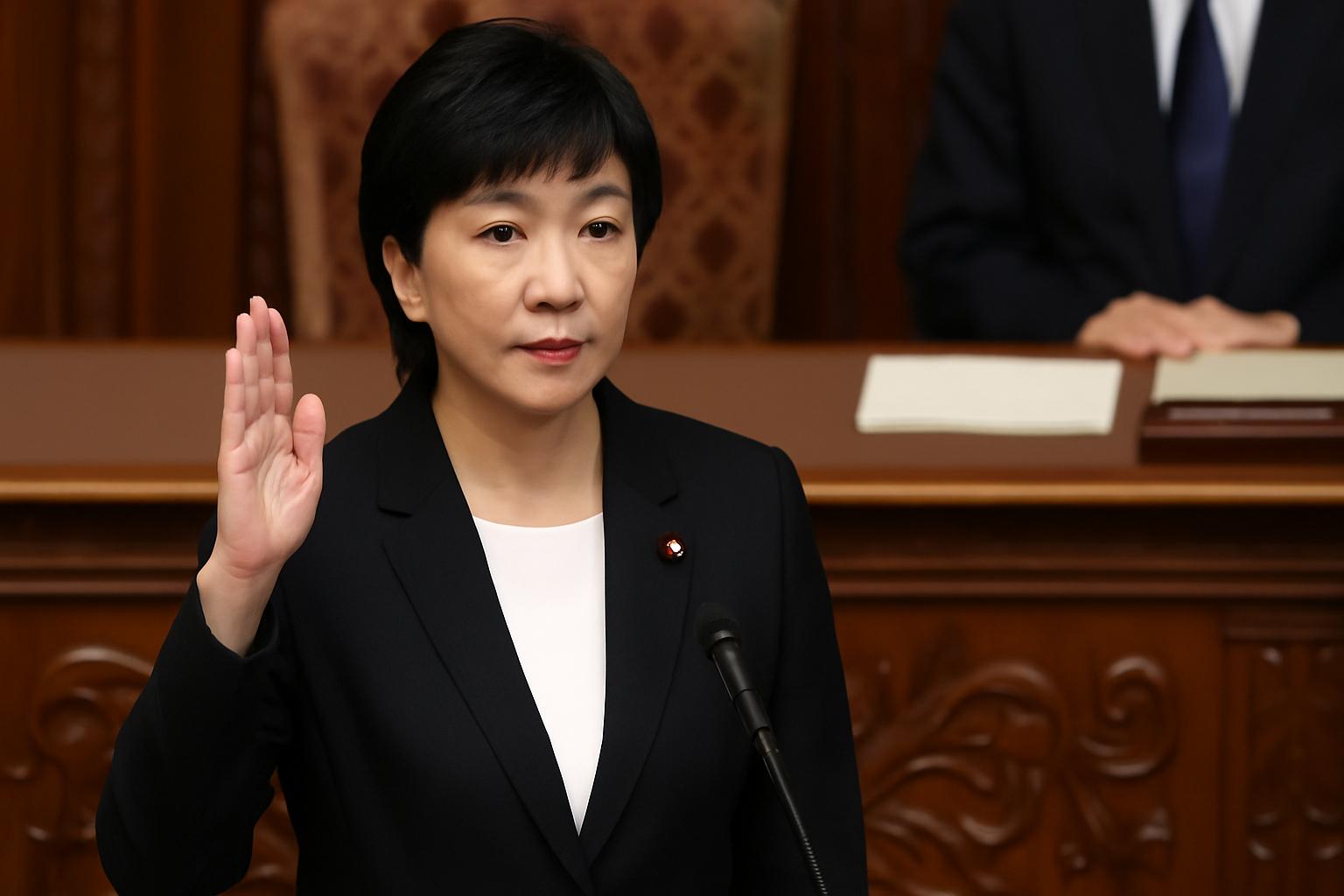
Japan made history on Tuesday as Sanae Takaichi was appointed the country’s first woman prime minister after a decisive vote in the lower house of parliament. Her elevation marks a groundbreaking moment in a nation where political and corporate leadership remains overwhelmingly male. Takaichi, a prominent conservative and known China hawk, secured 237 votes in the 465-member House of Representatives, crossing the majority threshold in the first round itself. She is expected to formally assume office following a ceremonial meeting with Emperor Naruhito later in the day.
Takaichi’s rise to power represents a symbolic breakthrough in Japan’s gendered political landscape, where women occupy less than one-fifth of parliamentary seats and hold few top corporate positions. Her appointment is being viewed globally as a significant step toward greater representation, even though her political stance remains firmly conservative. Many analysts note that while she has shattered a long-standing glass ceiling, her policies may not necessarily align with feminist or liberal aspirations.
Soon after her appointment, Indian Prime Minister Narendra Modi extended his congratulations to Takaichi and expressed his intent to deepen the India–Japan Special Strategic and Global Partnership. “Heartiest congratulations, Sanae Takaichi, on your election as the Prime Minister of Japan. I look forward to working closely with you to further strengthen the India–Japan partnership. Our deepening ties are vital for peace, stability, and prosperity across the Indo-Pacific and beyond,” Modi said in a post on X. The two countries share strong economic and defense cooperation, with Japan contributing to several infrastructure projects in India and collaborating closely through multilateral frameworks such as the Quad.
Takaichi’s political journey has been shaped by her mentor, former Prime Minister Shinzo Abe. A loyal follower of Abe’s economic and national security vision, she is expected to maintain a similar ideological course. In a move that further underscores this continuity, Takaichi plans to appoint Satsuki Katayama as finance minister, who would become the first woman ever to hold that portfolio. Katayama, known for her expertise in finance and local economic revitalization, currently chairs the Liberal Democratic Party’s (LDP) research commission on finance and banking systems and previously served in Abe’s cabinet. Her appointment signals a focus on economic reforms and fiscal resilience amid Japan’s challenging financial climate.
The path to Takaichi’s appointment was not without political drama. Her campaign initially faltered when the centrist Komeito party withdrew from its alliance with the ruling LDP, creating uncertainty about her majority prospects. However, she swiftly negotiated a power-sharing deal with the right-wing Japan Innovation Party (Ishin), which solidified her parliamentary support and paved the way for her victory. The political markets responded positively to the development, with Japan’s Nikkei index rising 3.4 percent to a record high after the coalition deal was announced.
Despite the historic nature of her appointment, expectations for sweeping social change under Takaichi remain limited. Her political record suggests a rightward shift on social and immigration issues. She opposes same-sex marriage and the movement to allow married couples to retain separate surnames. Takaichi is also known for her visits to the controversial Yasukuni Shrine, which honors Japan’s war dead, including convicted war criminals, often drawing criticism from neighboring countries.
Economically, Takaichi faces an uphill task from the outset. Japan continues to struggle with decades-long deflationary pressures and recent spikes in prices that have strained households and fueled public dissatisfaction. Reviving consumer confidence and stabilizing inflation are expected to top her agenda. Analysts predict she will prioritize fiscal stimulus and structural reforms to stimulate growth and reassure both domestic industries and foreign investors. The early optimism in equity markets suggests that investors expect her to pursue pro-business policies reminiscent of Abe’s “Abenomics.”
For Takaichi, there is little time to settle in. With economic challenges, rising living costs, and shifting regional dynamics in the Indo-Pacific, her leadership will be immediately tested. Her ability to navigate these domestic and international complexities while maintaining Japan’s alliances will define her legacy as the country’s first woman leader. Whether she can balance conservative ideals with the demands of modern governance remains to be seen, but her historic ascent has undeniably reshaped Japan’s political narrative and opened a new chapter in its postwar democracy.