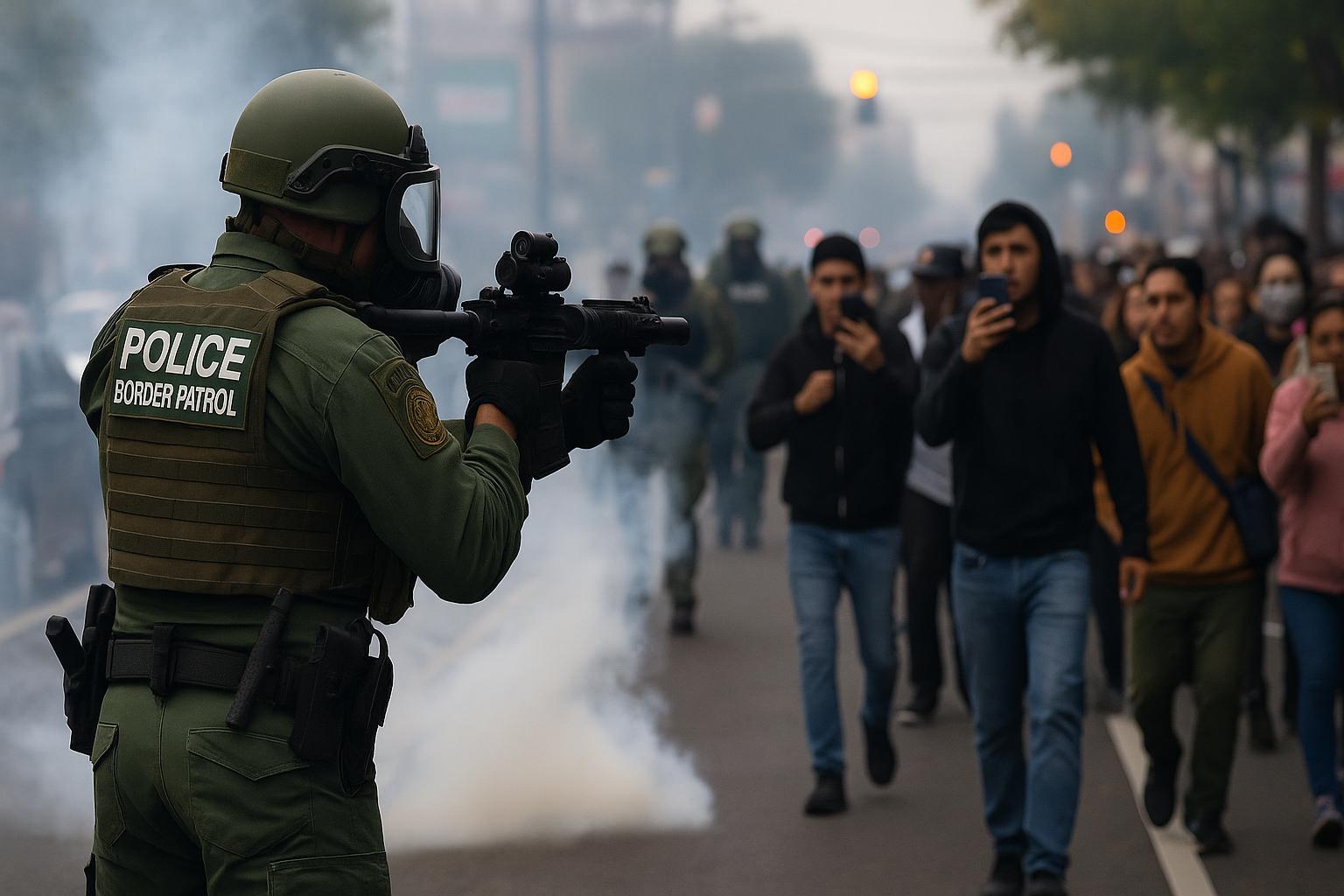
The streets of Chicago’s Little Village turned tense on Thursday morning as heavily armed federal agents clashed with residents during an enforcement operation near the Discount Mall at 26th and Troy. The scene unfolded amid growing public concern over the expanding presence of federal officers in local neighborhoods. Witnesses reported the use of chemical irritants, including tear gas and pepper bullets, while helicopters hovered overhead and residents recorded the confrontation on their phones.
The operation, which saw dozens of agents outfitted in tactical gear, helmets and gas masks, also drew the presence of Border Patrol Chief Gregory Bovino. His visit underscored the federal government’s heightened activity in Chicago following recent incidents in nearby Cicero. Bovino later stated that his agents had conducted themselves with “extreme professionalism” and had adhered to operational standards.
Tensions rose as witnesses claimed that tear gas and pepper balls were used indiscriminately. One resident told local reporters that he was struck by a pepper round despite standing several feet away from the agents. Yellow residue from the impact was visible on his jacket. The account prompted fresh debate about the proportionality of federal responses and compliance with a temporary court order that restricts the use of chemical crowd-control methods unless officers face a direct threat.
According to a statement from the Chicago Police Department, officers were dispatched to assist after 911 calls from the scene indicated a disturbance involving federal personnel. CPD supervisors arrived around 10:15 a.m. and attempted to de-escalate tensions by managing both traffic and crowds. One individual was arrested for allegedly battering a police officer, with charges still pending. After stabilizing the situation, CPD reported that it withdrew its units from the site, emphasizing that its role was limited to ensuring public safety.
Officials from the Department of Homeland Security, Border Patrol, and CPD have not yet issued detailed statements regarding the nature of the operation. Local lawmakers, including State Senator Celina Villanueva and Chicago Alderman Byron Sigcho-Lopez, scheduled a news conference to address the growing unease among residents.
The events followed a chaotic day on Wednesday, when federal agents executed multiple enforcement actions in the same neighborhood and nearby Cicero. The operations were accompanied by a series of car crashes along 26th Street near Kostner and Ogden, leaving damaged vehicles, broken glass, and visible debris across intersections. Confusion grew as witnesses described seeing masked, armed agents detaining several individuals while instructing drivers to keep moving.
Cicero police later clarified one of the incidents, explaining that the reported collision involving a Border Patrol vehicle did not occur as initially described. Instead, officers determined that a blue GMC pickup truck had attempted to strike Immigration and Customs Enforcement agents driving a Chevrolet Silverado. The truck then sped through a red light, colliding with a Toyota Corolla. The driver was taken into federal custody without reported injuries. Cicero authorities said the crowd that had gathered nearby dispersed peacefully, and the scene was cleared within 45 minutes.
As images of the federal agents’ presence spread, community leaders and civil rights advocates raised concerns about the impact of militarized operations in densely populated residential areas. Many questioned the timing and communication of the raids, particularly given Little Village’s reputation as a vibrant hub of immigrant culture and commerce.
The enforcement activity coincides with broader legal and political tensions between local and federal authorities. A federal judge in Chicago recently extended a temporary restraining order that limits National Guard deployment within city limits, citing the need to preserve civilian oversight and prevent escalations.
While officials have not disclosed the precise objective of the raids, the heavy federal presence in Little Village and surrounding neighborhoods has intensified public scrutiny. Residents have voiced frustration over a lack of transparency, while city leaders are calling for accountability and clear communication regarding the purpose and legality of such operations.
For now, the streets of Little Village remain unsettled. The sight of armored vehicles, chemical clouds and frightened bystanders has left many residents questioning the balance between enforcement and community safety. As investigations continue, both federal and local authorities face mounting pressure to clarify what led to the clashes—and to ensure that the city’s neighborhoods do not become flashpoints in a broader struggle over law enforcement boundaries and public trust.