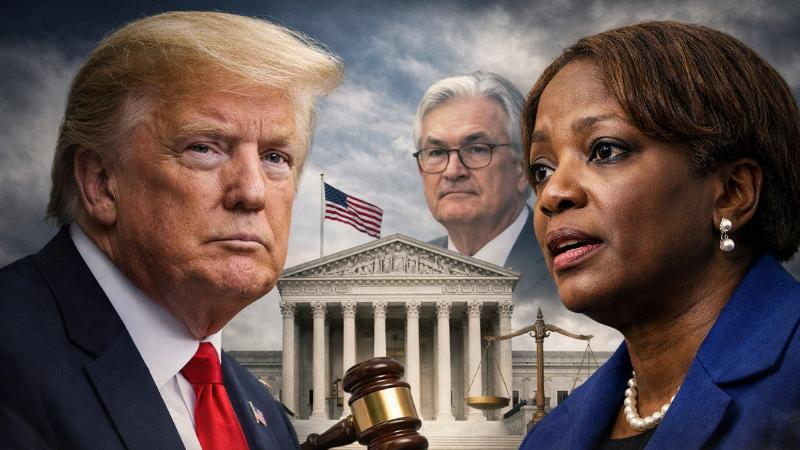
The Supreme Court on Wednesday is considering a case with wide-ranging consequences for both the US economy and the balance of power within the federal government, as it reviews President Donald Trump’s attempt to remove Federal Reserve board member Lisa Cook. The dispute centers on whether a sitting president has the authority to dismiss a member of the central bank’s governing board and what legal standards must be met for such a decision. Beyond Cook’s individual case, the outcome could redefine the long-standing independence of the Federal Reserve, an institution central to the nation’s economic stability.
The issue has taken on heightened significance following the emergence of a Justice Department investigation involving Federal Reserve Chair Jerome Powell. The development has raised fresh concerns about political pressure on the central bank, which is responsible for setting interest rates, overseeing parts of the financial system, and working to maintain price stability and low unemployment. Congress intentionally structured the Federal Reserve to operate independently, insulating it from short-term political considerations so that monetary policy decisions are guided by economic data rather than electoral concerns.
Under the Federal Reserve Act, members of the Board of Governors can only be removed by a president “for cause,” a standard that generally requires evidence of wrongdoing, neglect of duty, or incapacity. Trump has said he intends to remove Cook under this provision, citing allegations of mortgage fraud raised by the head of a federal housing agency appointed during his administration. Cook has strongly denied the allegations, and financial records reviewed as part of the dispute appear to contradict the claims, fueling debate over whether the accusations meet the legal threshold required for removal.
The Supreme Court previously declined to allow Cook’s immediate removal, instead scheduling full oral arguments in the case. That decision suggested the justices viewed the matter as one involving serious constitutional and institutional questions. At the heart of the dispute is a broader legal tension between presidential authority under the Constitution and Congress’s power to create independent agencies protected from direct political control.
Cook’s attorneys argue that she is entitled to procedural fairness before being removed, including formal notice of the allegations and an opportunity to respond. They contend that the president’s stated reasons do not satisfy the for-cause requirement and that allowing unilateral action would undermine the independence of the Federal Reserve. According to their position, weakening these protections could expose the central bank and similar institutions to political retaliation and instability.
The Trump administration counters that the Constitution grants the president broad authority to oversee executive officials and determine whether the for-cause standard has been met. In legal filings, government lawyers argue that Cook does not have a right to a hearing or judicial review of the president’s decision. They maintain that requiring such procedures would improperly restrict executive power and interfere with the president’s responsibility to ensure the effective functioning of the government.
The broader backdrop includes Trump’s long-standing criticism of the Federal Reserve and its leadership, particularly regarding interest rate policy. He has repeatedly argued that the central bank should have taken more aggressive steps to lower rates, even as Fed officials emphasized the need to balance inflation control with employment goals. Although Trump originally appointed Powell as chair in 2017, their relationship has often been marked by public disagreement.
While Trump has not moved to remove Powell, the Justice Department investigation related to Powell’s congressional testimony has drawn attention to the potential vulnerability of Federal Reserve leadership to political scrutiny. Powell’s current term as chair is set to end in May, though he could remain on the Board of Governors until 2028. His expected attendance at the Supreme Court hearing highlights the importance of the case for the future leadership and independence of the institution.
Lisa Cook was appointed to the Federal Reserve Board by President Joe Biden to a term that runs until 2038. The length of her appointment reflects the Fed’s design of staggered, long-term terms intended to provide continuity across different administrations. The Supreme Court’s ruling will therefore have implications far beyond this individual dispute, shaping how future presidents interact with independent agencies and how securely those agencies can carry out their mandates.
As arguments are heard, legal scholars, economists, and policymakers are closely watching the case. The decision could clarify the limits of presidential power, define the meaning of for-cause removal protections, and determine whether the Federal Reserve can continue to operate with the level of independence that has long been viewed as essential to maintaining economic confidence and stability.