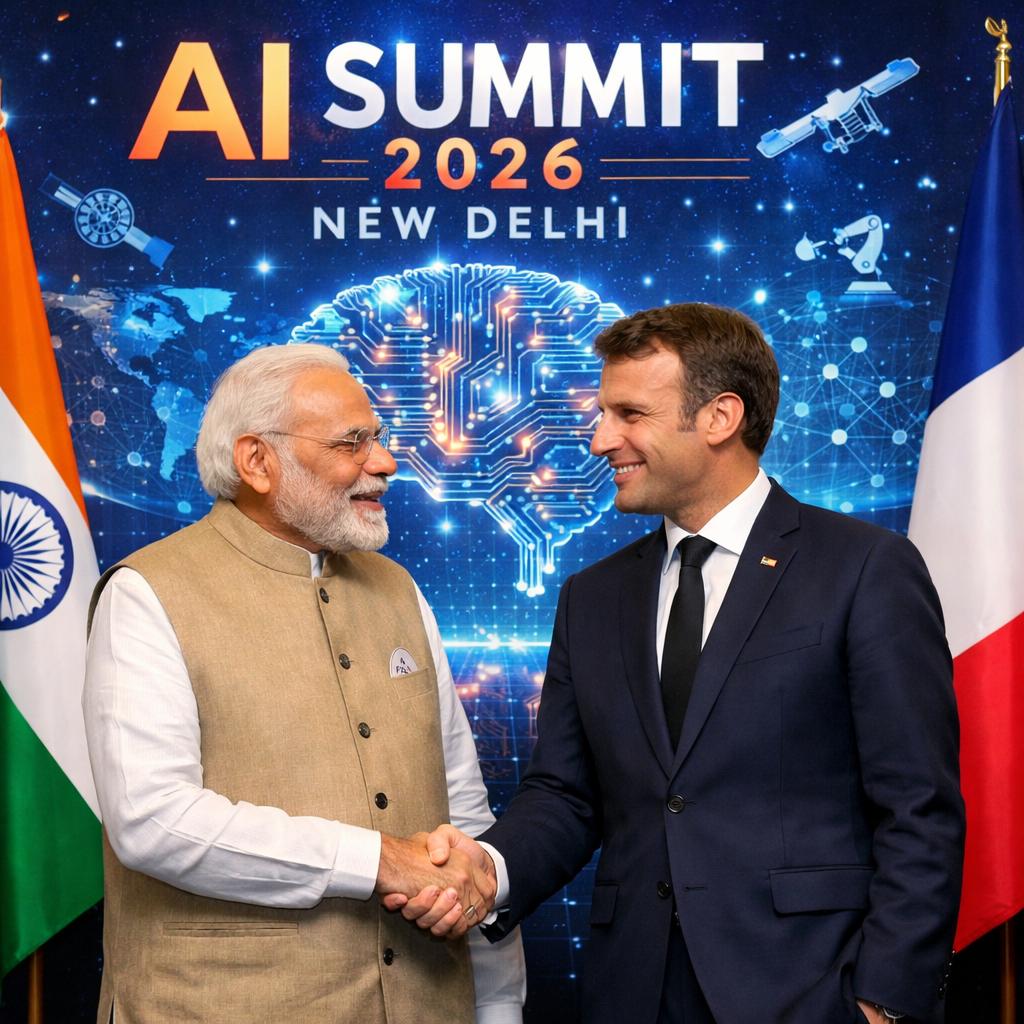
Prime Minister Narendra Modi and French President Emmanuel Macron elevated bilateral ties to a new level by signing more than 20 agreements across defence, artificial intelligence, trade, skilling, health and critical technologies during high-level talks in Mumbai. The agreements were announced during President Macron’s three-day visit to India from February 17 to 19, where he is also attending the AI Summit 2026 in New Delhi.
Addressing a joint press conference, Prime Minister Narendra Modi described the India-France partnership as a force for global stability at a time when the world is facing uncertainty. He said both countries have decided to establish their relationship as a Special Global Strategic Partnership, reflecting deep trust and shared long-term vision. President Emmanuel Macron, on his fourth official visit to India, called the bilateral relationship remarkable and unique, built on trust, openness and ambition. He emphasized that the decision to elevate the partnership demonstrates complete faith in the strength of ties between the two nations.
A major highlight of the visit was the expansion of defence cooperation. Days before the summit, India cleared a proposal to procure 114 Rafale fighter jets from France under a government-to-government framework, marking one of India’s largest military procurement programmes in recent years. From Rafale jets to submarines, both leaders confirmed that defence ties are expanding significantly. Macron stated that India remains one of France’s most trusted strategic partners, particularly in the Indo-Pacific region.
In a significant defence-industrial development, an Airbus and Tata Advanced Systems joint venture inaugurated the Final Assembly Line for H125 helicopters in Karnataka. The helicopter is known as the only one capable of flying at the height of Mount Everest, and the two nations plan to manufacture it in India and export it globally, strengthening the Make in India initiative and boosting defence exports.
Technology and innovation formed another pillar of the agreements. Prime Minister Modi announced the launch of the India-France Year of Innovation 2026, aimed at transforming strategic ties into a people-centric partnership. New initiatives include the Indo-French Centre for AI in Health, the Indo-French Centre for Digital Science and Technology, and the National Centre of Excellence for Skilling in Aeronautics. These institutions are designed to link startups, MSMEs, industries, researchers and students across both nations to accelerate collaboration in clean energy, space, defence and emerging technologies.
Both leaders highlighted their shared commitment to global stability and a rules-based international order. Macron underlined cooperation in artificial intelligence, advanced technologies and the Indo-Pacific, reiterating the importance of a world without hegemony. Joint initiatives such as the International Solar Alliance and the India-Middle East-Europe Economic Corridor were cited as examples of ambitious collaboration over the past eight years.
Cultural ties were also strengthened during the visit. India announced plans to open the Swami Vivekananda Cultural Centre in France and collaborate on heritage projects such as the National Maritime Heritage Complex in Lothal. These steps aim to deepen people-to-people connections alongside strategic and economic engagement.
Macron was received in Mumbai by Maharashtra Governor Acharya Devvrat and Chief Minister Devendra Fadnavis, along with French First Lady Brigitte Macron. His visit includes participation in the AI Impact Summit in New Delhi and extensive bilateral discussions in Mumbai, signaling a new chapter in India-France relations focused on defence expansion, AI collaboration, economic growth and global leadership.