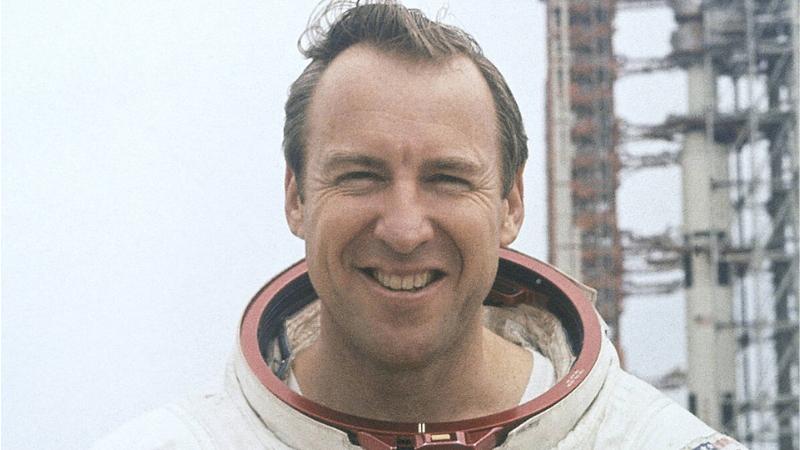
James Lovell, the iconic Apollo 13 commander whose leadership and quick thinking turned a near-disaster into one of NASA’s greatest examples of problem-solving, has died at the age of 97. He passed away on Thursday in Lake Forest, Illinois, as confirmed by NASA in an official statement on Friday. Lovell’s remarkable career in space exploration spanned some of the most pivotal missions in the early years of the United States space program, and his achievements left an enduring impact on both space history and public imagination.
Lovell’s career as an astronaut began during the Gemini program, where he flew on Gemini 7 in 1965 and Gemini 12 in 1966. He later became one of NASA’s most experienced astronauts, traveling into space a total of four times. His most notable missions were Apollo 8 in 1968 and Apollo 13 in 1970, both of which cemented his reputation as a calm and resourceful leader under extreme conditions. Apollo 8 was the first mission in history to leave Earth’s orbit, travel to the moon, and circle it, marking a significant victory for the United States in the space race against the Soviet Union. Lovell, along with crew members Frank Borman and William Anders, made history by sending back breathtaking images of Earth and the moon, giving humanity a new perspective of our place in the universe.
However, it was Apollo 13 that truly defined Lovell’s legacy. Originally intended to make him the fifth human to walk on the moon, the mission was abruptly derailed when an oxygen tank in the service module exploded en route to the lunar surface. The explosion crippled the spacecraft and forced Lovell and his crewmates, Fred Haise and Jack Swigert, to abandon their moon landing plans. With limited power, heat, and water, the astronauts were forced to use the lunar module as a lifeboat, enduring four grueling days in cold, cramped conditions. Lovell’s steady leadership, combined with the expertise of NASA’s ground team, turned a potential catastrophe into what many consider one of the space agency’s finest hours.
Lovell himself later reflected on the mission’s significance, emphasizing that while Apollo 13 failed to accomplish its original objective, it succeeded in demonstrating NASA’s resilience and problem-solving capabilities. He saw the mission as a testament to the ingenuity and dedication of the entire space program, a viewpoint that has been echoed by historians and space enthusiasts for decades.
In addition to his Apollo missions, Lovell’s earlier Gemini flights were crucial in developing techniques for orbital rendezvous and docking, skills that would prove essential for later moon missions. His career was characterized by discipline, courage, and a willingness to embrace the unknown, qualities that inspired generations of astronauts and space fans alike. Before the mid-1970s Skylab missions, Lovell held the record for the most time spent in space, logging an impressive 715 hours, 4 minutes, and 57 seconds.
Lovell’s story reached an even wider audience in the mid-1990s when a feature film about Apollo 13 introduced his heroics to a new generation. The film dramatized the tense days of the mission, immortalizing his now-famous words: “Houston, we have a problem.” While the dramatization brought him renewed fame, those who knew Lovell best recognized that his calm demeanor and quick decision-making were not exaggerated for the screen—they were his defining traits both in space and in life.
His passing marks the end of an era in space exploration history, as Lovell was among the few remaining astronauts from NASA’s pioneering days. Tributes from colleagues, space enthusiasts, and historians have poured in, celebrating his remarkable career and contributions. Lovell’s life serves as a reminder of the bravery and teamwork that defined the early space program, and his name will remain etched alongside the most celebrated pioneers of space exploration.
James Lovell’s journey from the early days of Gemini to the high-stakes drama of Apollo 13 reflects the evolution of space travel itself—from tentative first steps into orbit to daring attempts to reach another world. His leadership and dedication to exploration ensured that even in moments of crisis, humanity’s pursuit of knowledge and adventure could prevail.