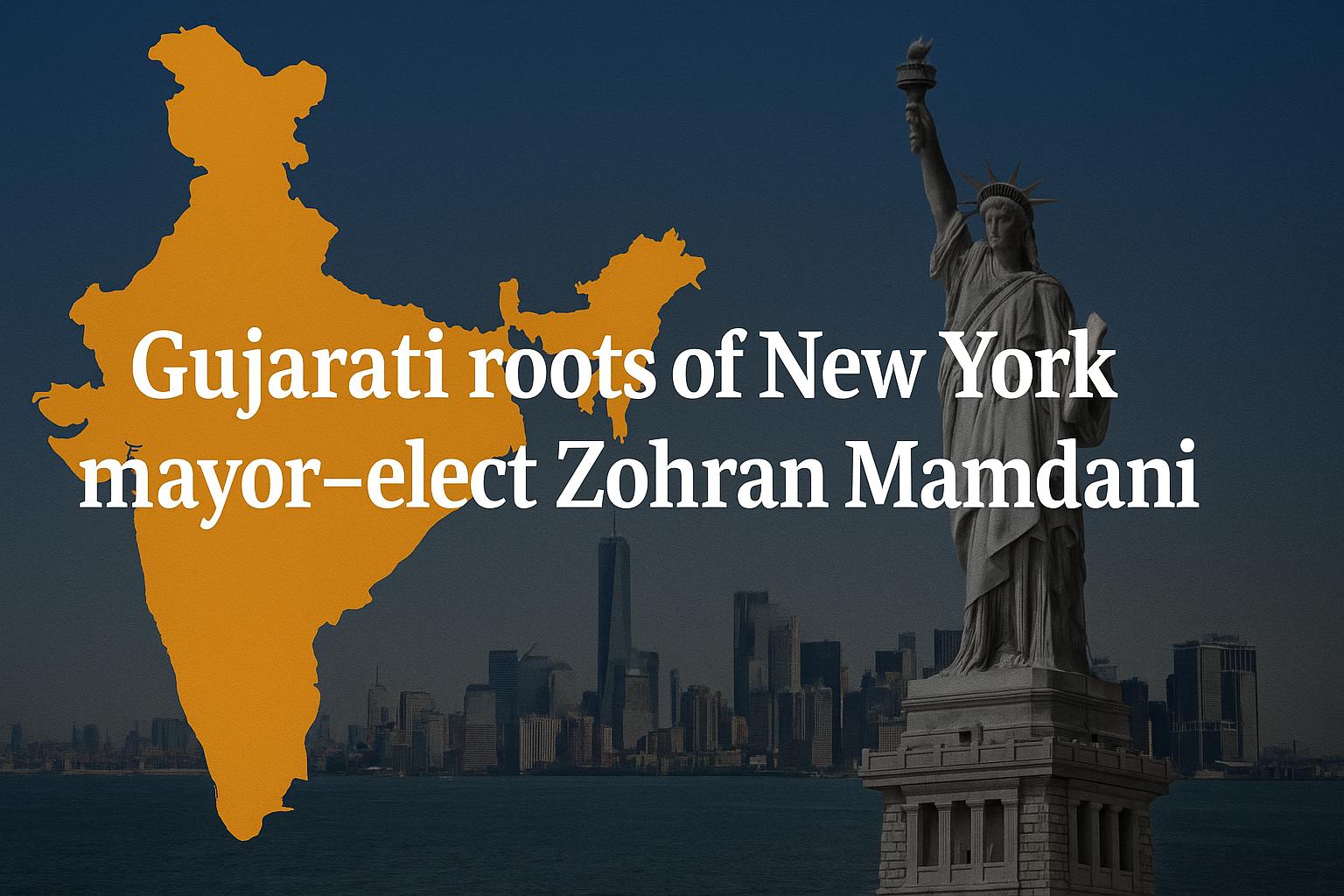
The story of New York City’s newly elected mayor, Zohran Mamdani, stretches far beyond the political landscape of the United States. His name itself carries the echoes of centuries-old migration, commerce, and cultural exchange across the Indian Ocean, linking him symbolically to the mercantile traditions of Gujarat that also gave rise to business dynasties like the Ambanis and Adanis.
Mamdani, who will soon become the first Muslim and Indian-origin mayor of America’s largest city, achieved a historic victory on Wednesday after defeating former governor Andrew Cuomo. At 34, he will also be the youngest mayor of New York in over a century. His campaign, built on promises of affordable housing, rent freezes, and free public transport, reflected his democratic socialist ideals. Yet behind the political persona lies a lineage deeply rooted in the history of Indian trade, migration, and cross-cultural exchange.
Born in Kampala, Uganda, Zohran Mamdani is the son of Indian-American filmmaker Mira Nair and Ugandan-Indian academic Mahmood Mamdani. His father’s ancestry belongs to the Khoja Muslim merchant community of Gujarat, a group historically renowned for its trading networks spanning Africa, Arabia, and the Indian subcontinent. The Khojas, originally from the Sindh and Kutch regions, established vibrant commercial links across East Africa, dealing in textiles, spices, and gemstones since the 18th century.
While Mamdani represents a new generation of progressive American leaders, his surname evokes an older, civilisational narrative. Linguistically, “Mamdani” is a derivative of “Muhammadan,” meaning a follower of the Prophet Muhammad. The suffix “-ani” is akin to “-an” in English, signifying origin or belonging. The name likely evolved as a Gujarati adaptation of “Muhammad,” mirroring similar linguistic shifts across regions — “Mehmet” in Turkey, “Mamad” in Persia, and “Momudu” in West Africa. In essence, “Mamdani” encapsulates a cultural intersection of language, religion, and migration.
According to scholars of South Asian history, surnames like Mamdani, Adani, and Ambani share common geographic and cultural roots in western India. All three originate from communities that thrived in the coastal trade networks of Gujarat and Sindh. Industrialists Mukesh Ambani and Gautam Adani, two of the world’s most prominent billionaires, also trace their ancestry to Gujarat’s mercantile castes. The Ambanis hail from the Modh Bania or Lohana community, while the Adanis come from Tharad in northern Gujarat.
Both Ambani and Adani surnames are toponymic — derived from the names of places from which families originated. Similarly, many Gujarati surnames ending with the “-ani” or “-ee” sound, such as Lalwani, Jethwani, and Mamdani, follow a linguistic pattern that reflects the shared phonetic evolution across Sindh and Gujarat. These naming conventions were often shaped by geography, profession, and community affiliation within the Indian Ocean’s vast trading ecosystem.
Persian author Muhammad Ali Mojaradi, known for his linguistic research, notes that Zohran’s first name also has layered meanings. Derived from the Arabic root “za-ha-ra,” it signifies “flower-like” or “blooming.” The name, therefore, carries connotations of vitality and renewal — a fitting metaphor for a young politician whose campaign message centred on social equity and civic reform.
Beyond etymology, Mamdani’s ancestry is emblematic of India’s deep ties with Africa. During the 19th and 20th centuries, thousands of Gujarati and Sindhi traders migrated to East Africa, building transnational communities that bridged continents. Mahmood Mamdani’s own family settled in Uganda generations ago, where they became part of the thriving Indian diaspora that contributed to the country’s commerce and academia. Despite the upheavals of the Idi Amin era, many families like theirs preserved their cultural identity and maintained strong connections to India.
In Zohran Mamdani’s case, his identity encapsulates this global journey — an Indian-rooted name carried by a Ugandan-born, American-raised leader now shaping one of the world’s most influential cities. His rise underscores how migration histories continue to shape modern politics and cultural identity in unexpected ways.
Interestingly, the shared suffix in names like Mamdani, Ambani, and Adani is not merely phonetic but historical. It reflects the linguistic continuity and socio-economic fabric that tied together communities from Gujarat, Sindh, and the Persian Gulf. Even former Iranian president Akbar Hashemi Rafsanjani’s surname follows a similar linguistic pattern, denoting origins from a specific place — Rafsanjan in Iran. This reveals how centuries of trade, religion, and cultural assimilation wove together a network of identities across the Indian Ocean region.
While Zohran Mamdani’s political beliefs diverge sharply from the capitalist empires of Ambani and Adani, their surnames remind us of a shared heritage — one that transcends geography and ideology. From Gujarat’s trading ports to New York’s City Hall, these names echo a long, intertwined saga of enterprise, migration, and adaptation.
In that sense, Mamdani’s ascent is not just a political milestone but also a testament to India’s global diaspora — a story where the past quietly endures in every syllable of a name that bridges continents and centuries.