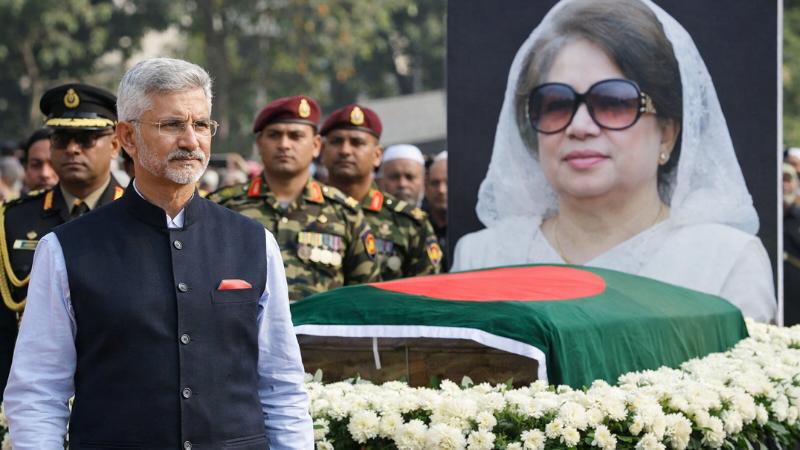
India’s External Affairs Minister Dr S Jaishankar is scheduled to attend the state funeral of former Bangladesh Prime Minister Begum Khaleda Zia in Dhaka on December 31, marking a significant diplomatic gesture at a time of strained relations between the two neighbouring countries. The decision comes amid heightened political uncertainty in Bangladesh and a broader reassessment of regional alignments in South Asia following last year’s dramatic change of government in Dhaka.
Khaleda Zia, who served as Bangladesh’s prime minister during two separate tenures between 1991 and 1996 and again from 2001 to 2006, was a central figure in the country’s modern political history. As chairperson of the Bangladesh Nationalist Party, she led a political force that frequently positioned itself as a counterweight to the Awami League, particularly on questions of foreign policy and regional alignment. Her death coincides with a pivotal moment in Bangladeshi politics, as her son and the BNP’s de facto leader, Tarique Rahman, has returned to the country after spending 17 years in exile.
New Delhi’s decision to be represented at the highest diplomatic level is being viewed as an attempt to re-engage Dhaka following a period of visible cooling in bilateral ties. Relations deteriorated sharply after former prime minister Sheikh Hasina was removed from power in a student-led uprising last year, leading to the formation of an interim administration under Nobel laureate Muhammad Yunus. Since then, Indian officials have expressed concern over Bangladesh’s evolving foreign policy posture and its implications for regional stability.
During her years in office, Khaleda Zia’s approach to international relations often caused unease in New Delhi. Her governments sought closer ties with China, and during her second term Bangladesh increasingly turned to Beijing for military supplies, eventually making China its principal defence partner. These moves were widely interpreted as an effort to diversify Dhaka’s strategic options away from India’s traditional influence.
India’s current apprehensions extend beyond China. Policymakers in New Delhi are closely watching Bangladesh’s interactions with Pakistan, particularly at a time when domestic political forces are being reshaped ahead of national elections. Tarique Rahman, who is widely seen as the leading contender in the upcoming polls, has so far signalled a more nuanced position on foreign relations. In May, he questioned the authority of the interim government to take long-term diplomatic decisions without an electoral mandate, a statement that resonated with concerns about governance legitimacy.
Following his return, Rahman has also sought to distance himself from binary regional alignments. Addressing a rally in Dhaka, he stressed that Bangladesh would prioritise its national interests above external affiliations, declaring that the country would not align itself exclusively with either India or Pakistan. His remarks were widely interpreted as an attempt to project strategic autonomy while reassuring multiple domestic constituencies.
In a notable shift, Rahman has also openly criticised radical political groups, including Jamaat-e-Islami, which was once aligned with the BNP. He has highlighted the party’s support for Pakistan during the 1971 liberation war, signalling an effort to redraw political boundaries ahead of the elections and to counter allegations of extremism.
Against this backdrop, Jaishankar’s presence at Khaleda Zia’s funeral carries symbolic weight. It reflects India’s recognition of the moment of transition underway in Bangladesh and underscores a willingness to maintain channels of engagement across political divides. As Dhaka prepares for a crucial electoral contest, the coming months are expected to play a decisive role in shaping the future trajectory of India-Bangladesh relations and the broader balance of power in the region.