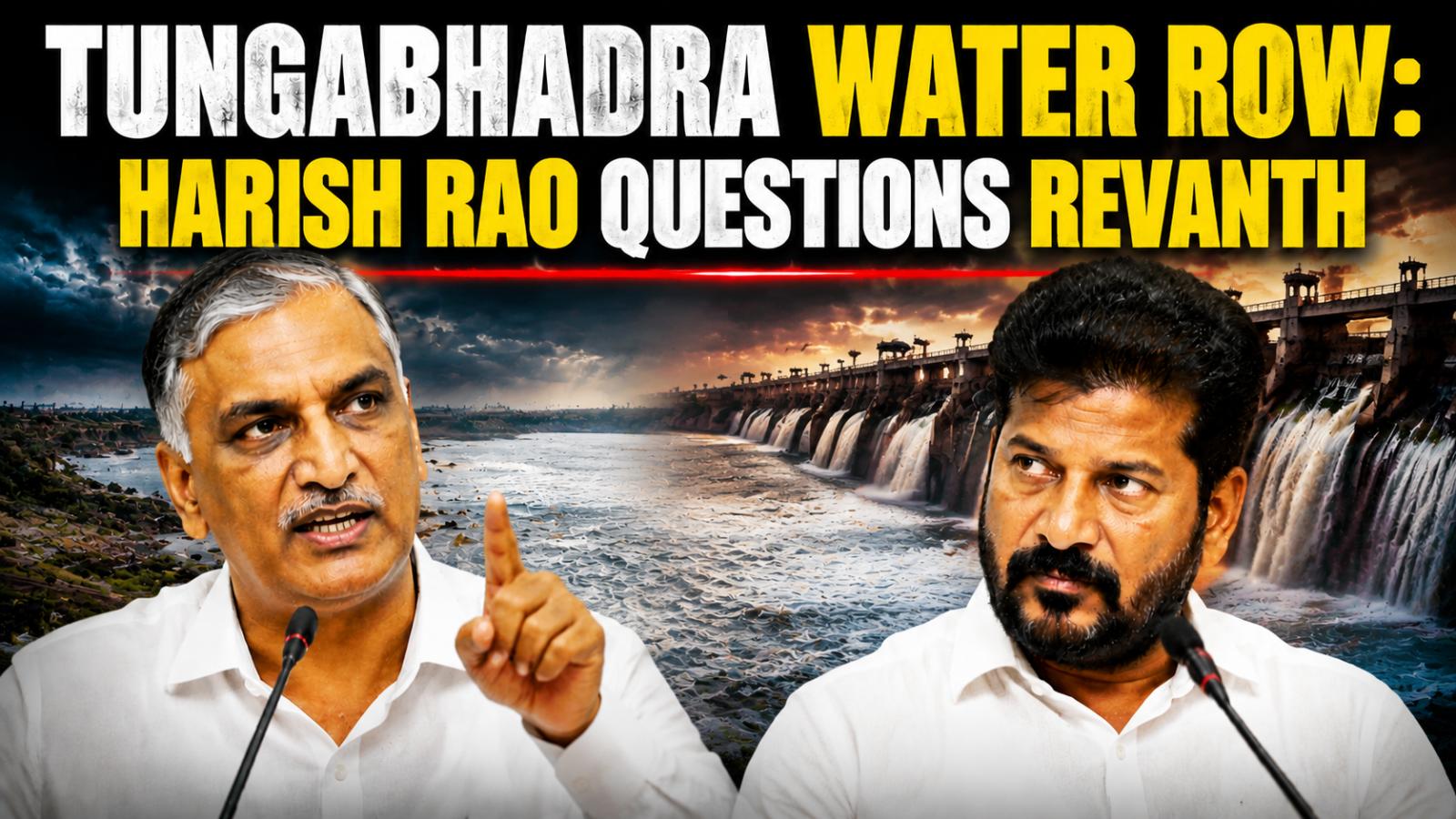
Senior BRS leader T. Harish Rao has launched a sharp political attack on Telangana Chief Minister A. Revanth Reddy, questioning his claim of a “historic agreement” on Tungabhadra river water sharing with Karnataka and Andhra Pradesh. He alleged that Telangana’s irrigation interests were being compromised and demanded clarity on the outcomes of recent high-level meetings involving the two neighbouring states and the Union water resources ministry.
Harish Rao questions “historic agreement” claim
Former irrigation minister and senior T. Harish Rao has demanded a detailed explanation from Telangana Chief Minister A. Revanth Reddy over what he described as an “unverified and misleading” claim of a historic agreement on the use of Tungabhadra river water. Addressing a press conference, Harish Rao said the Chief Minister’s remarks following a recent inter-state meeting lacked transparency and raised serious concerns about Telangana’s water rights.
He referred to the event held in connection with the replacement of gates at the Tungabhadra dam, which was attended by the chief ministers of Karnataka and Andhra Pradesh along with Union water resources officials. According to Harish Rao, the public narrative presented by the government does not reflect the actual discussions held behind closed doors.
He questioned whether Telangana had received any concrete assurances regarding its share of 15.9 tmc ft water allocation for the Rajolibanda Diversion Scheme (RDS), or on critical issues such as the closure of unauthorised outlets and restoration of damaged canal infrastructure. He insisted that the Chief Minister must disclose the full details of what transpired during the restricted meeting.
Allegations of water diversion and project risks
Harish Rao further alleged that parallel irrigation developments in Karnataka and Andhra Pradesh could significantly reduce inflows into Telangana’s key reservoirs. He claimed that Karnataka is advancing a 35 tmc ft Naveli reservoir upstream of the Rajolibanda Diversion Scheme, while Andhra Pradesh is planning a 20 tmc ft Gundrevula project downstream.
He argued that the combined storage of these projects—totaling nearly 55 tmc ft—would directly impact water availability into the Srisailam reservoir system. This, he said, would eventually threaten major Telangana lift irrigation projects, including the Kalwakurthy and Palamuru-Rangareddy schemes, which depend heavily on consistent river inflows. According to Harish Rao, the lack of resistance from Telangana in these matters indicates a weakening negotiation stance. He said that even small reductions in inflow volumes could have long-term agricultural and drinking water consequences for large parts of the state.
Secret meeting allegations deepen political clash
The BRS leader also raised concerns about the nature of the inter-state discussions, alleging that Telangana ministers were not fully included in key deliberations. He claimed that Irrigation Minister N. Uttam Kumar Reddy was made to wait outside while a closed-door meeting was held between the chief ministers of Telangana, Karnataka, and Andhra Pradesh along with senior central officials.
Harish Rao described the situation as “non-transparent” and suggested that such exclusion raises questions about decision-making processes affecting state resources. He further alleged that Telangana’s silence on Karnataka’s ongoing Tungabhadra-related projects may have been part of an informal exchange, linking it to Karnataka’s reported no-objection stance on the Kodangal Lift Irrigation Scheme. He also pointed out that Karnataka had earlier written to Telangana regarding objections to three barrages being constructed on the Tungabhadra river, but claimed that the state government chose not to respond strongly, which he described as a strategic lapse.
Political pressure builds over inter-state water sharing
The controversy has intensified political tensions between the ruling Congress government and the opposition BRS over irrigation governance in Telangana. Harish Rao argued that river water sharing agreements require full transparency and legislative accountability, especially when multiple states and central agencies are involved.
He said that any perceived compromise on Telangana’s share of river water would have long-term consequences for agriculture, rural livelihoods, and irrigation-dependent regions. The BRS leader demanded that the Chief Minister publicly release meeting minutes, official agreements, and technical clarifications to ensure accountability. As the debate continues, the issue is expected to become a major flashpoint in Telangana politics, particularly around irrigation policy, inter-state negotiations, and the management of river basin resources.