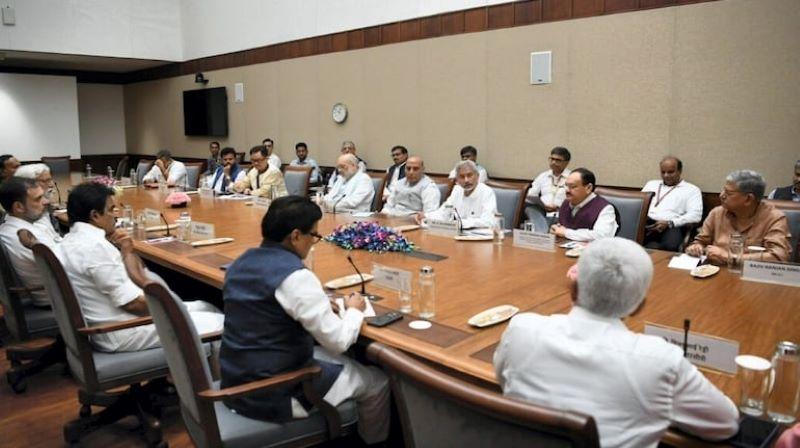
The high-level briefing comes amid heightened national security concerns and marks a significant moment of bipartisan cooperation. The meeting, held in Parliament, was attended by senior opposition leaders including Leader of Opposition in the Lok Sabha Rahul Gandhi and Leader of Opposition in the Rajya Sabha Mallikarjun Kharge. Representing the government were Union Home Minister Amit Shah, Defence Minister Rajnath Singh, External Affairs Minister S. Jaishankar, and Parliamentary Affairs Minister Kiren Rijiju.
Operation Sindoor was described by officials as a “measured, non-escalatory, proportionate, and responsible” military response aimed at dismantling terrorist infrastructure. The Indian Air Force and other defense forces conducted high-precision strikes targeting assets belonging to proscribed terrorist organizations such as Jaish-e-Mohammed, Lashkar-e-Taiba, and Hizbul Mujahideen. According to official sources, the briefing covered detailed objectives of the strike, destruction of terror infrastructure, strategic locations of the camps targeted, and the intelligence gathered in preparation for the operation. It also addressed India's readiness in the event of a potential retaliatory strike from Pakistan.
Minister Kiren Rijiju emphasized that the purpose of the meeting was to ensure transparency and national solidarity. “Our armed forces have carried out a major operation. As a responsible government, it is our duty to brief all political parties. The Prime Minister has given clear instructions to involve the entire leadership in this matter of national security,” Rijiju stated. While attending the meeting, the Congress party reiterated its expectation that Prime Minister Narendra Modi should personally address such serious national security matters. Congress general secretary Jairam Ramesh had previously remarked, “We expect PM Modi to attend at least tomorrow’s all-party meeting. We had requested the PM’s presence earlier, but he did not attend.”
Despite this demand, the meeting took place without the Prime Minister’s presence. Nevertheless, the mood was one of rare political unity. Political parties from across the spectrum including the Congress, Left parties, Trinamool Congress, Samajwadi Party, Bahujan Samaj Party, Rashtriya Janata Dal, Shiv Sena (UBT), DMK, and NCP (SP) extended full support to the government’s anti-terror action. Opposition leaders reportedly appreciated the timely action and emphasized that political differences should take a backseat in matters of national interest and security. “We stand united with our armed forces and support every legitimate step taken to secure the country,” said a senior opposition leader.
Following Operation Sindoor, the government initiated a series of mock drills in several states and union territories to test emergency preparedness and civilian readiness in case of further escalation. Sirens, simulated air raids, bomb threats, and coordinated rescue missions were enacted in urban and semi-urban centers.
The security exercises covered a broad swath of the nation, including Delhi, Punjab, Haryana, Rajasthan, Gujarat, Maharashtra, Karnataka, Kerala, Tamil Nadu, Andhra Pradesh, Telangana, Uttar Pradesh, Bihar, West Bengal, Odisha, Jharkhand, Assam, the northeastern states, and parts of the Himalayan region. These drills were coordinated by the National Disaster Management Authority and state police forces to test response times and inter-agency coordination.
As tensions remain high, India has conveyed to the global community that Operation Sindoor was a preventive and deterrent action targeting terrorism, not an act of aggression. International observers are monitoring developments closely, while the Indian government continues diplomatic engagement to preempt any misinterpretation of its intentions. The all-party briefing on Operation Sindoor is being seen as a significant moment in India’s internal political landscape, underscoring unity across ideological lines in the face of external threats. It also sends a strong message to adversaries that the Indian democratic fabric stands resilient and united when national security is at stake.