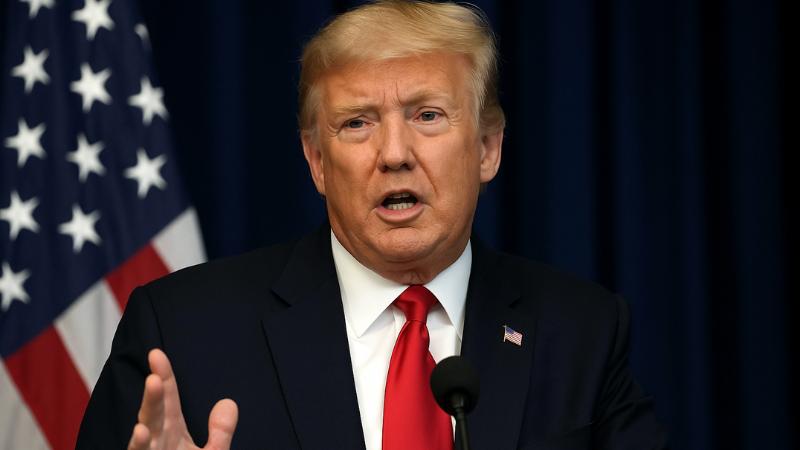
US President Donald Trump asserted on Friday that all documents signed through an autopen during the tenure of former president Joe Biden have been terminated and will no longer carry legal effect. The declaration, made during a public address on Nov 28, marks Trump’s latest attempt to challenge actions taken under his predecessor and introduces considerable uncertainty about the status of numerous executive documents issued in the previous administration. Trump claimed that nearly 92 per cent of the documents attributed to Biden were not personally signed by him, alleging instead that they were executed using an autopen and lacked the former president’s approval.
Trump further stated that individuals who operated the autopen under the Biden administration “did so illegally,” without offering evidence to substantiate the allegation. He went on to argue that Biden was not involved in the signature process and insisted that any contrary statement by Biden would expose him to charges of perjury. The remarks immediately renewed public interest in how presidential signatures are authenticated, especially in an era when remote approval of documents has become more routine.
An autopen, first patented in the United States in 1803, is a mechanical device capable of reproducing an individual’s signature with striking accuracy. Equipped with a template containing a digital or physical model of a person’s handwriting, the machine can replicate ink strokes in a consistent manner and is often used for large batches of correspondence or when a public official is travelling. The practice is not new, and its legality has been the subject of official guidance.
A 2005 directive issued by the Justice Department during the administration of President George W. Bush clarified that a president is not required to physically sign a bill. The guidance explicitly stated that the president may authorize an aide or official to affix the president’s signature to a bill, including by using an autopen. The interpretation has served as the legal basis for the use of automated signatures across several administrations, suggesting that the practice is considered lawful when properly directed.
Historically, multiple US presidents have used automated signature devices. Early prototypes were associated with Thomas Jefferson, according to historical records, while later leaders such as Harry Truman, Gerald Ford, and Lyndon B. Johnson were also linked to their use. More recent administrations made public references to the device, such as when President Barack Obama authorized an aide to sign an extension of the Patriot Act while he was overseas—a moment that marked the first openly acknowledged use of the autopen for formal legislative approval. Obama used the device again in 2013 to sign legislation aimed at preventing a financial disruption during a holiday trip to Hawaii.
Trump himself previously acknowledged that he had used an autopen during his presidency for what he described as “very unimportant papers.” He explained that the White House receives thousands of letters, including messages of support or correspondence addressed to young people and those dealing with illness, making automated signatures necessary. Despite this admission, Trump criticised the Biden administration for using the autopen to sign what he described as significant documents, including formal actions and pardons. He labelled the alleged reliance on the device as “disgraceful,” even though he provided no evidence that autopen use under Biden was inconsistent with established legal guidance.
Trump’s latest comments are expected to fuel ongoing political debate regarding presidential authority, the legitimacy of signatures produced by automated devices, and the boundaries of executive action. Legal experts note that the status of documents signed by autopen has long been recognized as valid when properly authorized, leaving significant doubt about Trump’s ability to unilaterally nullify such documents. As political tensions escalate, questions surrounding the practical and legal implications of Trump’s declaration are likely to remain in focus in the coming weeks.