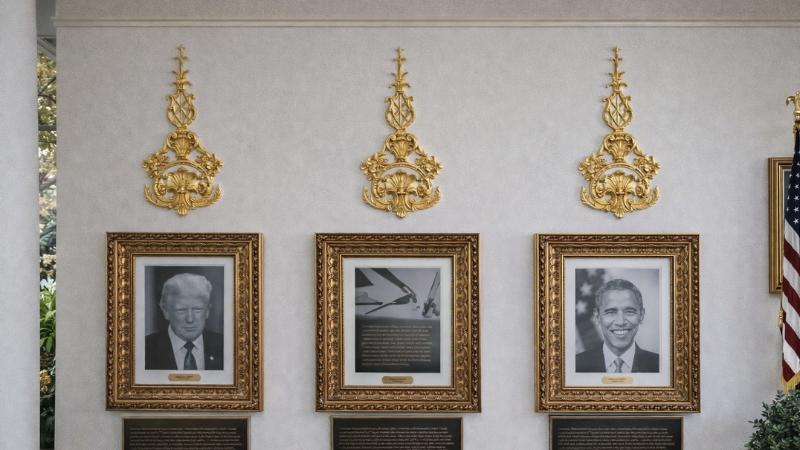
President Donald Trump has introduced a strikingly unconventional transformation to the White House’s historical displays, turning a traditional walkway honoring former presidents into a sharply worded political statement. Along the West Colonnade near the Rose Garden, newly installed plaques beneath presidential portraits present blunt assessments of Trump’s predecessors while offering an expansive portrayal of his own record in office. The changes have drawn immediate attention from visitors and historians alike for their unusually personal and confrontational tone.
The most controversial display focuses on former president Joe Biden. Rather than featuring a customary portrait, the frame shows an image of an autopen, a symbolic reference to Trump’s repeated assertions that Biden lacked direct control over executive decisions during his term. Beneath the image, a plaque labels Biden as the “worst President in American History” and accuses his administration of overseeing national decline. The text reiterates Trump’s long-standing claims regarding the legitimacy of the 2020 election, allegations that have been consistently rejected by election officials and courts.
Former president Barack Obama is also depicted in critical terms. The plaque accompanying Obama’s portrait describes him as a divisive political figure and criticizes policies related to healthcare, economic management, and national security. It refers to the Affordable Care Act using disparaging language and includes claims about surveillance and investigations during the 2016 presidential campaign. The inscription uses Obama’s full name, including his middle name, a detail that echoes controversies from Trump’s earlier political career. These accusations mirror rhetoric Trump has employed publicly for years, despite multiple official inquiries finding no evidence to support such claims.
In sharp contrast, the plaque dedicated to Trump himself adopts a celebratory tone. It credits him with resolving international conflicts, strengthening the economy, and restoring American influence abroad. The statements are presented without independent verification, reflecting the president’s own interpretation of his accomplishments. Departing from long-standing White House tradition, Trump’s portrait is displayed while he remains in office, a move that underscores the personal nature of the overall presentation.
Not all former presidents receive critical treatment. Ronald Reagan’s plaque is notably favorable, praising his leadership during the Cold War and highlighting mutual admiration between Reagan and Trump. Bill Clinton’s entry is comparatively restrained, briefly referencing scandals from his presidency while also noting Hillary Clinton’s defeat in the 2016 election, without extended commentary.
The plaques are part of a broader physical and aesthetic overhaul of the White House since Trump’s return to office in January. Structural changes include the demolition of the East Wing to accommodate a new ballroom, alterations to the Rose Garden, and expanded use of gold accents within the Oval Office. Together, these modifications reflect a presidency that places a strong emphasis on personal legacy and visual symbolism.
By reshaping the White House history walk, Trump has blended architecture, history, and political messaging into a single narrative space. What was once a largely neutral chronicle of past administrations now serves as a vivid reflection of the sitting president’s views, ensuring that visitors encounter not only the faces of former leaders but also Trump’s unmistakable perspective on their place in American history.