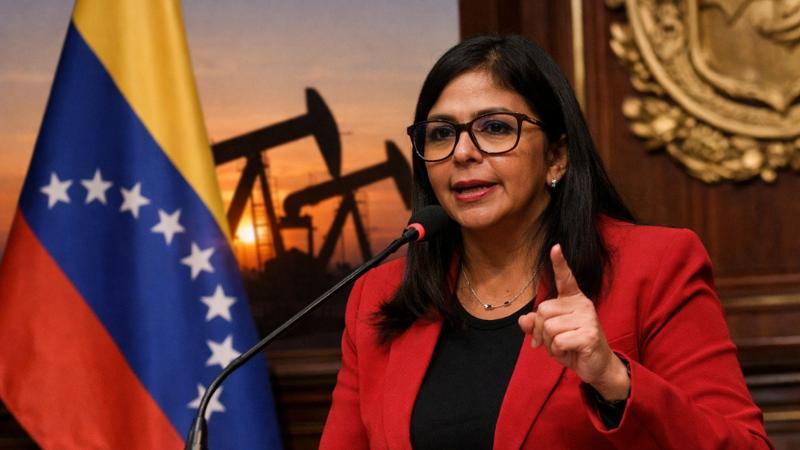
Venezuela’s interim president Delcy Rodríguez has accused the United States of using allegations related to drug trafficking, democracy, and human rights as a pretext to pursue control over the country’s vast oil resources. Speaking before the Venezuelan Parliament, Rodríguez said that external pressure on the country has long been driven by energy interests rather than genuine political or humanitarian concerns, while emphasizing that Caracas remains open to energy cooperation based on clearly defined and mutually beneficial commercial agreements.
In a speech that has drawn significant attention domestically and internationally, Rodríguez described Venezuela as a major energy power whose natural wealth has historically attracted foreign ambition. She argued that the country’s oil reserves have been at the center of repeated disputes with Washington, framing recent accusations against Venezuela as part of a broader strategy to justify economic and political pressure. According to Rodríguez, claims surrounding drugs, democratic governance, and human rights have been repeatedly used to obscure what she described as a longstanding desire by the global North to gain access to Venezuelan energy resources.
Her remarks came shortly after comments by former US president Donald Trump, who said in a recent interview that Washington was receiving extensive cooperation from Venezuela’s leadership and would maintain long-term influence over the country and its oil production. Trump asserted that Caracas was providing what the United States considered necessary and suggested that Washington would oversee Venezuela’s oil sector for years to come. Those statements have fueled debate in Venezuela, particularly as the government seeks to assert its sovereignty over natural resources.
Rodríguez said Venezuela’s position on energy relations has been consistent, stressing that the country is willing to engage with international partners under terms that respect national interests and international law. She highlighted the importance of economic cooperation that is clearly structured through commercial contracts, adding that diversity in energy partnerships is central to the government’s strategy. While acknowledging the strain in relations caused by past US actions, she said that trade in energy itself is neither unusual nor inherently problematic.
Earlier this week, US authorities seized two Venezuelan oil tankers that were operating under sanctions and announced plans to manage future sales of Venezuela’s crude production, including oversight of petroleum exports worldwide. The move has added to tensions between the two countries and raised questions about control of Venezuela’s oil market at a time when global energy supplies remain under pressure.
In her address, Rodríguez also touched on domestic political challenges, announcing plans for upcoming legislation aimed at ensuring economic and social stability. She called on all political forces to work together to overcome internal divisions, warning that extremist or fascist expressions in social, political, and economic life could threaten the country’s future. Emphasizing the need for peace and national coexistence, she said unity was essential to protect the republic during a period of heightened international scrutiny.
Venezuela holds some of the world’s largest proven oil reserves, and its energy sector has long been a focal point of international interest. Rodríguez’s comments underline the government’s effort to reframe the narrative around sanctions and foreign pressure, presenting Venezuela as open to partnerships while firmly rejecting what it views as external attempts to dictate control over its resources.