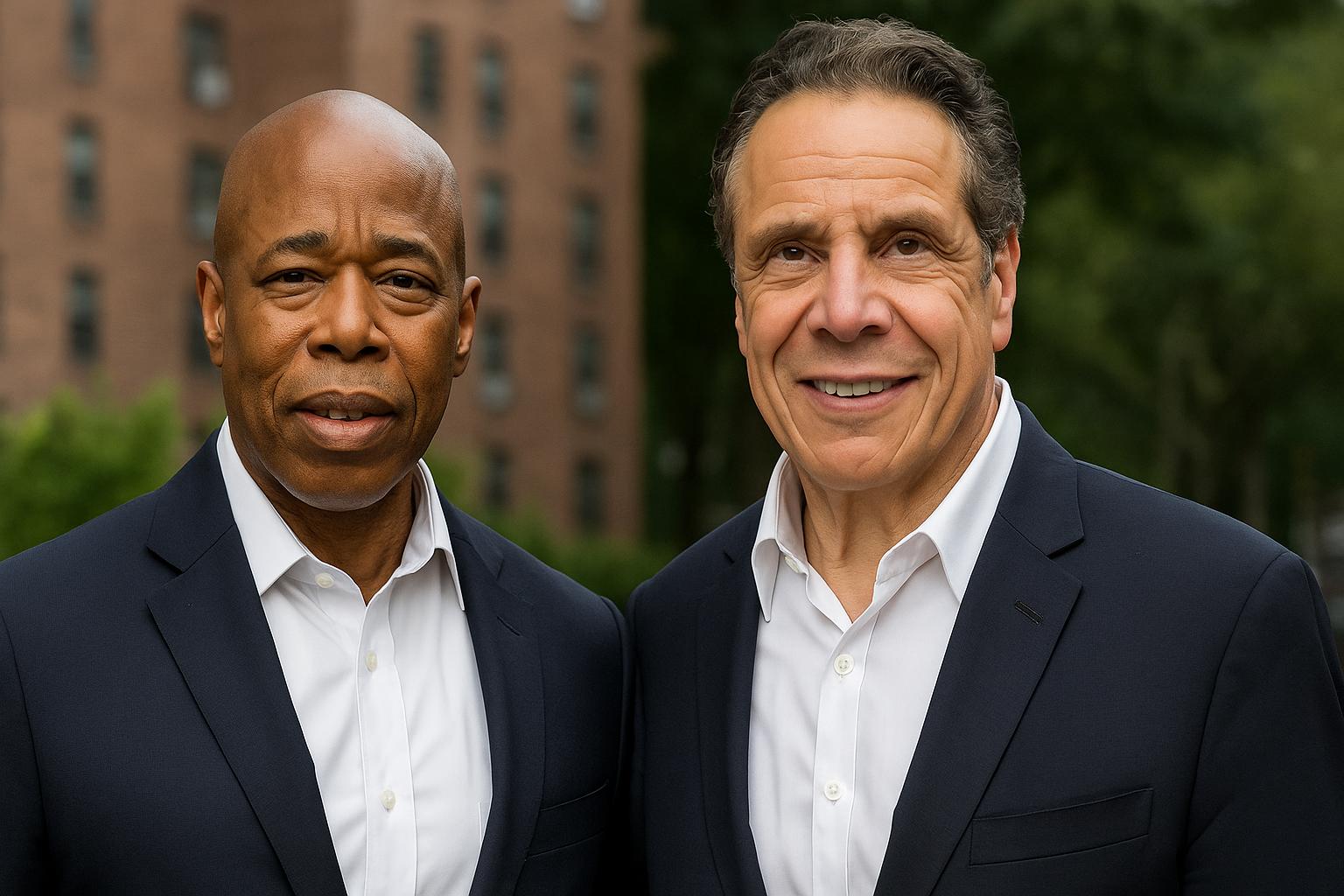
Mayor Eric Adams has officially endorsed former New York Governor Andrew Cuomo in the upcoming New York City mayoral race, a move that reshapes the city’s political landscape and intensifies the already heated contest. Adams made the endorsement Thursday during a public appearance alongside Cuomo at the New York City Housing Authority’s Carver Houses, declaring his support for the former governor’s bid to lead the city.
“I’m fighting for the family of New York, that’s why I’m here today to endorse Andrew Cuomo,” Adams said to a crowd of supporters and reporters. “New York needs a leader who understands the complexities of this city and is ready to take on the challenges that affect working families every day.”
Cuomo, who served three terms as governor before resigning in 2021, expressed gratitude for Adams’ endorsement, saying it reflected a shared commitment to stability and progress in the city. “The mayor put his own ambition aside because he cares more about New York City,” Cuomo said. “He believes Zohran is an existential threat to the future of this city, and I share that belief. This endorsement is about protecting New York’s values and its people.”
The two men appeared together at Madison Square Garden the night before the endorsement, attending a Knicks game shortly after the final mayoral debate. The sight of Adams and Cuomo together prompted speculation that a formal endorsement was imminent, especially since Adams had announced in September that he would suspend his own reelection campaign.
Cuomo’s return to New York politics marks a controversial comeback for the former governor, who left office under a cloud of sexual harassment allegations and political turmoil. Nonetheless, he has steadily reemerged in public life, framing his candidacy as an effort to restore effective governance and unity to a city grappling with affordability, safety, and housing issues.
The endorsement immediately drew sharp criticism from Cuomo’s opponents. Democratic frontrunner Zohran Mamdani, a progressive state assemblyman, dismissed the announcement as a predictable alliance. “Today confirms what we’ve long known: Andrew Cuomo is running for Eric Adams’ second term,” the Mamdani campaign said in a statement. “It’s no surprise to see two men who share an affinity for corruption and Trump capitulation align themselves at the behest of the billionaire class and the President himself. We are going to turn the page on the politics of big money and small ideas these two disgraced executives embody and build a city every New Yorker can afford.”
Mamdani’s statement echoed a broader frustration among progressive Democrats who view both Adams and Cuomo as emblematic of establishment politics that prioritize elite interests over working-class concerns. His campaign has emphasized issues such as rent control, police accountability, and social equity — policies that directly contrast with Cuomo’s centrist positions and Adams’ law-and-order approach.
Republican candidate Curtis Sliwa also weighed in, condemning both Adams and Cuomo in characteristically sharp terms. “Cuomo standing with Eric Adams is the architect joining the crooked landlord of a failing city,” Sliwa’s campaign said. “This is corruption past, corruption present, and corruption waiting to happen again. They can co-author the book ‘The Art of the Steal.’”
Political analysts say the endorsement underscores an evolving realignment within New York City’s Democratic base. Adams’ decision to back Cuomo suggests a consolidation of moderate and centrist support in an election that could define the city’s political direction for years to come. Cuomo’s candidacy, once seen as improbable, now carries renewed legitimacy with Adams’ backing — particularly among voters seeking a balance between reform and pragmatism.
For Adams, the move could also be strategic. By aligning himself with Cuomo, he strengthens his standing among traditional Democratic donors and city unions while maintaining influence in shaping the city’s leadership even after stepping away from the race. However, the endorsement also risks alienating progressives and young voters who have grown increasingly critical of both men’s records on governance, transparency, and accountability.
Despite the controversy, both Adams and Cuomo framed the endorsement as a moment of unity. “New York City needs leadership that can cut through division and deliver results,” Cuomo said. “This campaign is about competence, compassion, and the courage to fix what’s broken.”
The endorsement sets the stage for a volatile and closely watched election season. With the Democratic primary just months away, Cuomo now faces a formidable test: rebuilding trust among New Yorkers while navigating a field that includes energized progressive challengers and a vocal Republican opposition.
As the city’s political lines sharpen, the Adams-Cuomo partnership may prove to be one of the defining alliances of the 2025 New York City mayoral race — one that could either signal a return to establishment politics or spark a new wave of reform-driven opposition.